

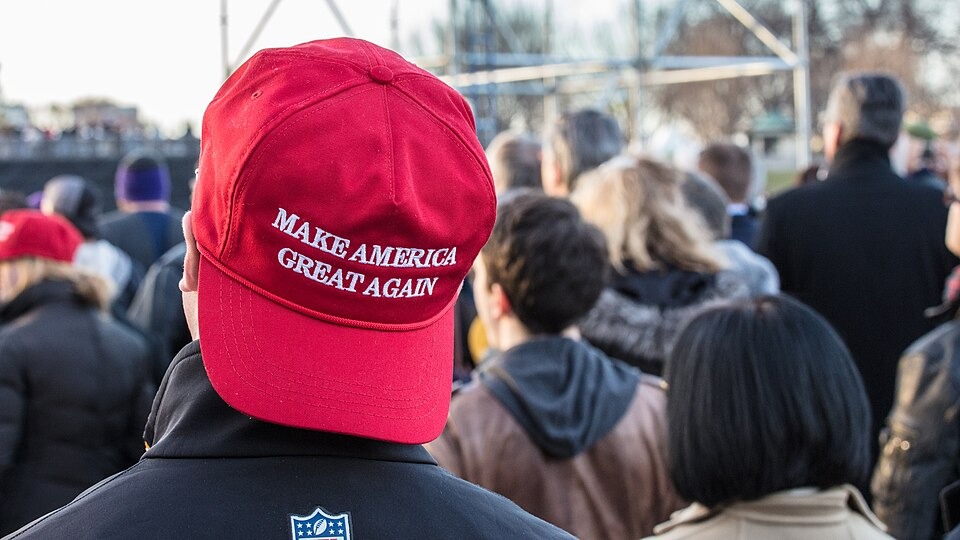
President Donald Trump’s popularity has taken a hit, with recent polls showing his approval rating at a record low of 34 percent, compared to the 52 percent at the beginning of his second term.
Throughout his 2024 campaign, there were a few issues that Trump seemed to repeatedly discuss and that struck a chord with the American public: affordability, brokering international peace and mass immigration. Across campaign ads and rallies, he claimed he would “defeat inflation,” “make America affordable again” and “create the biggest, greatest and strongest middle class in the history of our country.”
While on the campaign trail, Trump declared that by launching “the largest deportation program in American history,” he would “get the criminals out,” allegedly leading to a mass reduction in murder, as well as drug and sex trafficking. Finally, during the 2024 Republican National Convention, he boldly stated he’d “end every international crisis that the current administration has created, including the horrible war with Russia and Ukraine… and the war caused by the attack on Israel, which never would’ve happened if I was president.”
It’s been a year and three months since Trump launched into his second term, so the question is, have his policies worked?
Affordability
Only 29 percent of Americans approve of Trump’s handling of the economy, and when observing his policies, it’s clear why. His main controversial technique was to employ tariffs, a tax imposed by the government on foreign imported goods and services. Traditionally, being set around two percent, they’re used as a form of increasing government revenue. Trump, however, declared he would impose a 10% baseline tariff on all trading partners on April 2, 2025, on a day he called “Liberation Day.”
Although this policy was recently struck down in a 6-3 ruling by the Supreme Court as an overstep of power, the damage has already been done, with American consumers shouldering up to 55 percent of the imposed tax, according to analysis at Goldman Sachs. The effect can be seen through the rise in goods, measured through the Consumer Price Index (CPI).
Specifically, the CPI, which “measures the average percent change over time in prices paid by urban consumers,” had fallen to 2.3 percent in April of last year. Yet, after Trump’s alleged “Liberation Day,” it dramatically rose again to 3.02 percent. Practically, this means that on average, families are paying $2,120 more per year in necessities, with the lowest 20 percent of earners having to pay $950 more per year (5 percent of their annual income).
Immigration
One of the promises Trump has stuck to since entering his second term is launching the largest immigration crackdown project in this nation’s history. By weaponizing both Immigration and Customs Enforcement (ICE) and U.S. Customs and Border Protection, the Trump administration has detained over 69,000 people as of February 2026.
An operation this large-scale costs a nauseating amount of money for the taxpayer, $29 billion each year, to be precise. It also requires large-scale hiring, with ICE hiring 7,500 more officers in 2025, making it the largest government agency to be expanded. To support this influx of people, the department has drastically lowered its hiring standards, decreasing age requirements, training time and including signing packages of up to $50,000.
These reduced standards have deadly implications, with the toll of innocent civilians murdered by ICE having risen to five innocent civilians and another 46 people dying while in custody. Earlier this year, Minneapolis became a battleground between citizens and federal law enforcement, as members of the city fought back hard against the infiltration of their city, especially after the killings of two community members, Renee Good and Alex Pretti. 65 percent of Americans now have negative sentiments towards ICE, a historic high.
International Peace
On Feb. 28, Israel and the U.S. began “Operation Epic Fury,” an assault against Iran, which claimed 200 victims on its first day, 118 of them being from a girls’ elementary school. The attack has now expanded, culminating in the loss of over 2,000 lives spanning 14 different countries in the Middle East.
From the beginning of the war, Trump has espoused nothing but positive rhetoric across social media and press conferences, posting on March 12 that, “We are totally destroying the terrorist regime of Iran, militarily, economically and otherwise.”
Despite this, officials have growing concerns about the diplomatic and economic implications of continuing down this path much longer. The Strait of Hormuz, an Iranian waterway between the Persian Gulf and the Gulf of Oman, has become a focal point of discussions about the war, as 20 percent of the world’s oil passes through there. Since this war began, Iran has been using the Strait as its main negotiating power, shooting down any tankers that don’t request direct permission, causing oil prices to increase 30 percent, and further burdening the affordability crisis in America.
Through the U.S.’s management of this situation, Trump has managed to isolate independent voters, further enrage the left and become a political pariah on the international stage for many.
Impact
This war has proven to be the last of a long string of broken promises for the MAGA movement, further fueling the rage of the left, while isolating them from independent voters — a key part of his electoral base — as Trump fails to deliver on three of his main promises throughout his 2024 campaign.
This has allowed the Democratic Party to obtain a much-needed upper hand, just in time for the upcoming Midterm elections. However, it’s to be determined if they’ll step up to the plate and give constituents the stability they are so desperately asking for.
So far in these preceding months, there’s been a blue wave sweeping the nation in response to Donald Trump, with democratic candidates winning over congressional districts with strong republican strongholds and breaking the supermajority in several states, such as Iowa and Mississippi. They’ve also polled an average of 13 percent better in 2025 special elections compared to 2024, largely as a result of voters’ dissatisfaction with Trump’s economic policy.

Voters are fed up with the Trump era, but frankly, many are sick of undelivered promises from Democrats as well. Within recent decades, the left has been accused of abandoning the working class in favor of policies centered around identity politics and academia, but this is their chance to turn it around. The past few years have seen a resurgence in political activism, as outrage surrounding humanitarian global injustices, rising authoritarian governments and an affordability crisis has rocked the nation.
The state of our nation has become so dire that Americans have once again been forced into political consciousness. Democrats must harness this moment, must stop the political grandstanding, listen to their constituents and truly deliver on the promises made. If not, much darker days are on the horizon for the American public.
Copy edited by Daryl R. Thomas Jr.