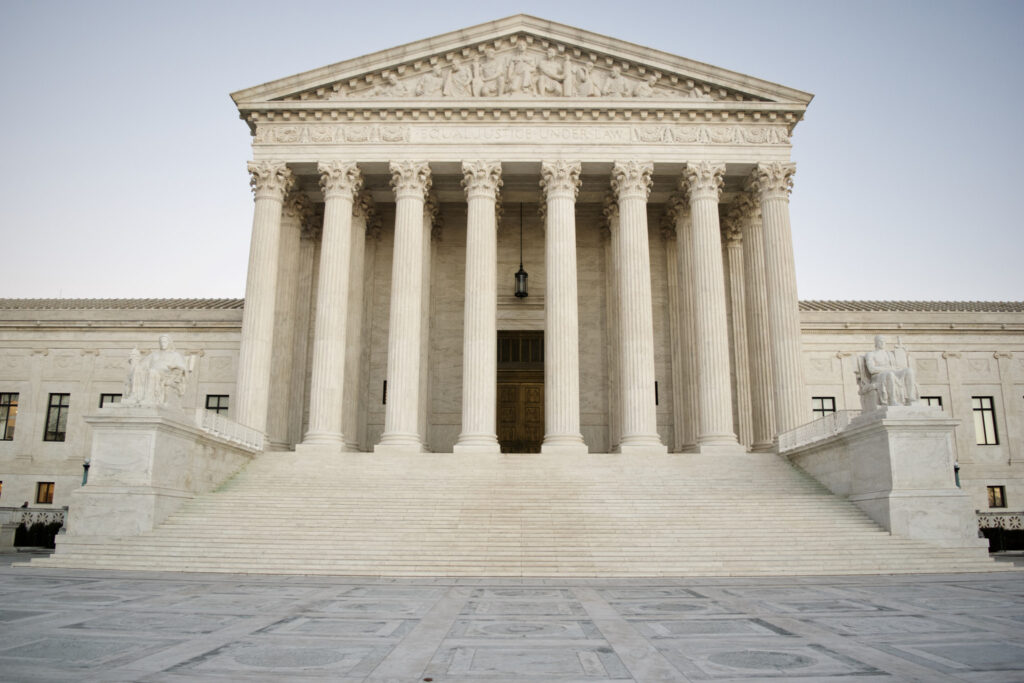
The Supreme Court heard oral arguments on April 1 in the first direct executive challenge to birthright citizenship in over a century. As one of the few nations that grants citizenship by “right of the soil”(jus soli), the United States faces a significant dilemma in Trump v. Barbara. The case threatens to dismantle the long-standing interpretation of the 14th Amendment, potentially stripping automatic citizenship from thousands of infants born on American soil to non-citizen parents.
In a flurry of executive orders on his first day in office, Donald Trump signed Executive Order 14160, “Protecting the Meaning and Value of American Citizenship.” The order critiqued the “misinterpretation” of the 14th Amendment; instead of granting citizenship to everyone born on U.S. soil, the administration argues that the privilege should be reserved for those whose parents proved their “permanent allegiance” to the country by becoming citizens.
The order would apply to children born after the cut-off date of Feb. 19, 2025, whose parents are neither U.S. citizens nor legal permanent residents. The administration would order the cessation of Social Security numbers and passports given to these infants.
Parents with children affected by this order challenged the mandate in a class-action lawsuit. The namesake of the plaintiff, Barbara, is a Honduran asylum applicant with a child born after the cut-off date. She, along with the two other members of the lawsuit, allege that the order unlawfully strips their children of citizenship guaranteed by the 14th Amendment and thus removes access to benefits like social security, medicare and SNAP nutrition assistance, which provides monthly financial assistance to help low-income individuals buy nutritious food.
As an Equal Justice Works fellow at the NAACP Legal Defense Fund Mide Odunsi worked on the legal team that litigated Trump v. Barbara. She noted that this case will have far-reaching consequences beyond undocumented immigrants; even visa holders and those in the process of applying for refugee or temporary protective status would have their citizenship stripped away by this order.
“If this executive order were to go into effect, it would upend centuries of legal principles that have long been understood to be confirmed in our Constitution,” Odunsi said. “It really could pave the way for the administration to undo other bedrock civil rights.”
The case was first heard in the U.S. District Court for the District of New Hampshire in July 2025. The judge, Joseph Laplante, blocked Trump’s executive order, ruling that it contradicted the 14th Amendment and “untouched precedent.” In a rare expedition of the process, the Supreme Court granted “certiorari before judgment,” allowing the case to bypass the lengthy appellate system and jump directly to the Supreme Court docket.
On the Docket: Barbara v. Trump
Two hours and nine minutes of oral arguments conducted earlier this month will define one of the most seminal Supreme Court cases of the 21st century. D. John Sauer, the Solicitor General representing Trump, anchored his argument in the 14th amendment’s citizenship clause, which grants U.S. citizenship to anyone “born … in the United States, and subject to the jurisdiction thereof.”
The 14th Amendment was established to reverse the infamous Dred Scott decision, in which the Supreme Court stated that enslaved people were not United States citizens and were therefore excluded from federal protections. Sauer explained that, under the administration’s interpretation, the 14th Amendment only served as a remedy for that specific period in history.
“The clause thus does not extend citizenship to the children of temporary visa holders or illegal aliens,” argued Sauer. “Unlike the newly freed slaves, those visitors lack direct and immediate allegiance to the United States.”
Under this interpretation, being “subject to the jurisdiction” of the U.S. requires more than just geographical presence; it requires parents to have documented mutual loyalty, provided only through “lawful permanent domicile” in the U.S. Since undocumented immigrants cannot establish this domicile, their children cannot legally receive automatic citizenship.
The lead counsel for the respondents (the plaintiffs arguing against the order), Cecillia D. Wang, recognized the administration’s direct opposition to the legal precedent set in The United States v. Wong Kim Ark. Thirty years after the 14th Amendment’s ratification, the landmark case confirmed that a child born to Chinese immigrants was a U.S. citizen despite his parents being ineligible for citizenship themselves.
“Thirty years after ratification, this Court held that the 14th Amendment embodies the English common law rule,” Wang stated during the hearing. “Virtually everyone born on U.S. soil is subject to its jurisdiction and is a citizen . . . a closed set of exceptions to an otherwise universal rule.”
Odunsi similarly identified that even those who are rightfully “domiciled” in the United States — those with refugee status or those caught in the long web of refugee backlogs with decades of U.S. residence — could face the prospect of having their citizenship revoked. The 14th Amendment, according to Odunsi, had a clear purpose in correcting the previous exclusion of enslaved people.
“What Congress was trying to do in ratifying the 14th Amendment,” Odunsi said, “was to make sure that citizenship would be guaranteed for all people born in the United States and that that citizenship wouldn’t be taken away because of any political whims or any political process.”
What’s at Stake
Every lower court thus far has struck down Trump’s executive order as a violation of the 14th Amendment, but the Supreme Court’s decision in late June or early July, will be hard to predict, according to Odunsi. If a majority of the justices decide to uphold the executive order, a birth certificate would no longer be sufficient to prove citizenship.
The justices echoed concerns that the government has no clear plan for how hospitals or clerks could verify a parent’s legal status at the moment of birth. Justice Ketanji Brown Jackson, in particular, pressed the solicitor general on the limited practicality of the order.
“Are you suggesting that when a baby is born, people have to present documents . . . Is this happening in the delivery room?” Brown Jackson inquired. “How are we determining when or whether a newborn child is a citizen of the United States?”
Odunsi added that this new system would leave thousands without crucial public health benefits like SNAP, Medicaid and Medicare. Because federal and most state elections require U.S. citizenship to cast a ballot, this executive order would also strip away the ability of many U.S. residents to participate in the democracy they live under.
United States immigration enforcement has already deported migrants to countries they have no relationship to, and the order would force thousands more into a stateless limbo where they have neither citizenship in their parents’ birth country nor United States citizenship.
An amicus brief fort he case by the University of California, Davis School of Law warns that a decision with Trump could normalize presidents making unilateral decisions about citizenship to suit their agenda. They highlight the Dominican Republic as a cautionary tale, where courts retroactively redefined citizenship to exclude the children of Haitian migrants, stripping over 200,000 people of their nationality overnight.
“Birthright citizenship is something that has been enshrined in the Constitution for centuries, and it can’t be taken away through any political process,” Odunsi says. “Allowing this could empower and embolden future administrations to use citizenship as a political tool to silence dissent.”
Copy edited by Kennedi Bryant