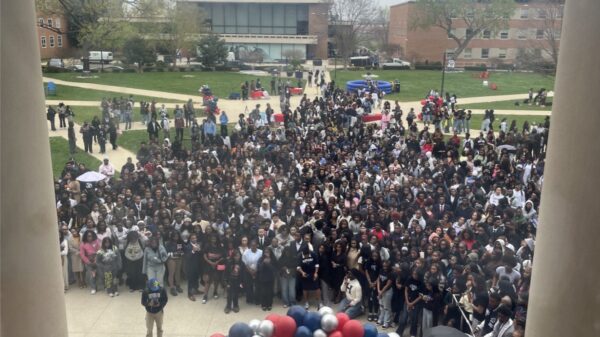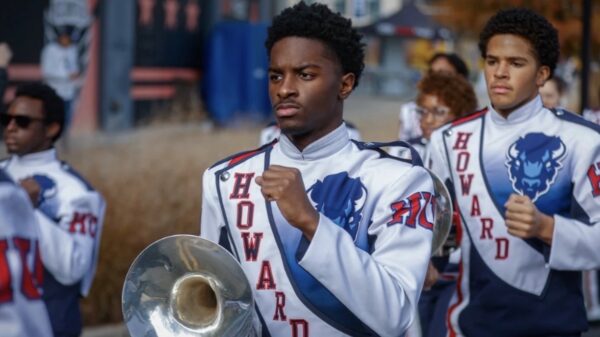
“Students are searching. They want to go deeper and be in a community that’s like-minded and shares similar values and interests in order to deepen one’s understanding and practice of the faith,” said Fr. Robert P. Boxie III the Catholic chaplain at Howard University and a priest of the Archdiocese of Washington.
Boxie’s observation of students’ internal search can be found across the Black community, with people reorienting themselves within the country. Black people are flocking to the South, specifically Texas, Florida and Georgia which have experienced the greatest numerical increase in Black residents from 2010 to 2024, according to the Pew Research Center. This phenomenon, referred to as “the reverse migration” has afforded Black Americans with greater economic and cultural comfort and, in some cases, a new level of freedom, according to PBS.
Renee Harrison, PhD, a professor of African American and United States religious history at Howard University’s School of Divinity, affirms that there is a rising awareness of traditional and ancestral religions among young Black Americans.
“There is absolutely a resurgence of people to traditional religions. Vodun as an example. I do not believe that people are not just being awoken by oppression but by our actual spirit, ‘a calling,’” she said.
The Pew Research Center has kept a record of Black Americans’ representation in religion spanning from 2007-2024. The data has shown a 12 percent decline in people who identify as Christian and a 10 percent increase in those who are religiously unaffiliated.
However, Generation Z slightly skews this trend. The Religious Landscape Study reports that “Americans born in 2000 through 2006…are just as likely as those born in the 1990s…to identify as Christians.”
Harrison believes that, for some, this religious adherence is a means of survival.
“Power and control is fueled by economics, religion, government and law. The narrative has to sustain itself with those ingredients,” she said. “If I’m telling you your economic well-being and your social standing in the world is impending upon your allegiance to a religion, what are you going to do?”
According to Research Lifeway, an evangelical research firm, “…Churchgoers ages 18-34 (81%) and 35-49 (85%) are among the most likely to say God wants them to prosper financially.” Additionally, “African American churchgoers are the most likely to say their church teaches that if they give more money to the church and charities, God will bless them in return (71%).”
This is defined as prosperity gospel, or the teaching that if one gives financially to the church or charity, they will be rewarded by God in return.
Paula White-Cain, the spiritual advisor to the White House Faith Office, is a supporter of this transactional relationship between God and his followers. During Easter of 2016, she made an especially hefty request from her congregation, leveraging the story told in the Bible verse John 11:44, when Jesus raised Lazarus from the dead, to convince them.
“There’s someone that God is speaking to, to click on that donation button by minimizing the screen. And when you do to sow $1,144. It’s not often I ask very specifically but God has instructed me and I want you to hear…” she said.
Now, as a spiritual advisor, she has blurred the lines between church and state. In an Easter lunch hosted by the White House, she compared the sacrificial ethos of Jesus Christ to the character of President Donald Trump.
“And Mr. President, no one has paid the price like you have paid the price. It almost cost you your life. You were betrayed and arrested and falsely accused. It’s a familiar pattern that our lord and savior showed us,” she said.
Boxie warns his congregation of Black college students to be aware of manipulations of the faith.
“It’s frustrating to hear things that are being spoken in the name of Christ that we should not. That’s a co-opting of Christianity for nefarious and evil purposes,” he said.
He encourages his congregation to educate themselves on the religions or practices they choose to commit to.
“I remind them that the church does not condone this. We have to lean into the truth and also give them [students] the tools to evaluate for themselves,” he said.
Myriama Zaine, a senior health science major from Maryland, finds herself conflicted betweenfully embracing Christianity and creating a religious path of her own, uninfluenced by her peers and surroundings.
“It’s easy to fall back into what we already know. We have been taught that traditional or African religions are wrong but we know that it’s not,” she admitted. “It’s always giving versus. If we can find a way to come together and find the similarities between the two that would be good.”
However, the similarities are already there; Louisiana Voodoo, also known as New Orleans Voodoo, was born from the entangling of West African Vodun and Roman Catholicism.

“I think in a very clandestine way it was easy to translate the Orisha in Vodun to the saints in Catholicism. I think our ancestors had a keen way to code it in an existing religion but still practice their indigenous religion,” Harrison said.
An example of this can be found with Papa Legba, often thought of as the gatekeeper of the spirit world in West African and Caribbean Voodoo. He is often associated with a pair of keys and with the Catholic St. Peter, who is depicted holding a pair of keys into heaven.
Voodoo Queen Kalindah Laveaux, a priestess in New Orleans Voodoo, doubles down on the inextricable influence of African religion on the Black American religious experience.
“When we talk about what’s so great about the church, what do you enjoy about it? You enjoy the singing, the laying of hands, the healing, the community,” she said.
She goes further to interrogate why that is.
“What you’re wanting is the black experience and the warmest of your ancestors, and that’s in your bloodline. What you’re simply seeing is the voodoo in someone’s bloodline playing out in a Christian setting,” Laveaux said.
Despite Generation Z appearing to be divided on which religious path to take, she is optimistic that with the help of social media, more young people will be exposed to religions that resonate deeply with them.
“Now people are understanding and having demonstrated to them what this tradition is. Even from videos, you’re seeing something that feels very familiar to you that calls to you. The young people have the benefit of the age of information; they have fresh perspectives,” she said.
She urges Black people to keep in mind the history and use of Christianity by those in power.
“We have to realize that Christianity wasn’t a decision. If someone is enslaving you, they’re not giving you what’s the best for you; they’re giving you what’s best for them. An advantage for you would be to go into your own spiritual system and science,” she said.
Copy edited by Daryl R. Thomas Jr.