The week after spring break, third-year architecture majors immersed themselves in the Victoria neighborhood of San Juan, Puerto Rico, where the sunny landscape became both their classroom and a real-world test of their craft.
This was not an average school trip, but animmersion into the Victoria community, a neighborhood where the history of Afro-Caribbean identity provides a unique canvas for architects.
The objective of the studio project was comprised of two parts: to engage in a long-term multi-family housing redevelopment and to leave a tangible mark on the Victoria community through a collaborative service project. Outside the confines of the regular classroom, students grappled with the realities of a climate and culture that views architecture as an extension of the real world.
“The architecture in Puerto Rico was obviously designed for Puerto Rico…a lot of the buildings we went into didn’t have glass windows. They didn’t even like proper front doors. A lot of it was very open and very breathable because it’s so hot there that they need the ventilation,” said Myles Hickman, a third-year architecture student from Raleigh, North Carolina.
The students moved beyond the familiar concept of enclosed structures to embrace a style of building where the indoors and outdoors flow together as one.
Hickman, who helped spearhead the design initiatives within the local community, reflected on his perspective change during this trip.
“This is gonna be our first project that is outside of [the] Washington D.C., Maryland [area]. So just learning the different styles of architecture that we can bridge our project into,” Hickman said.
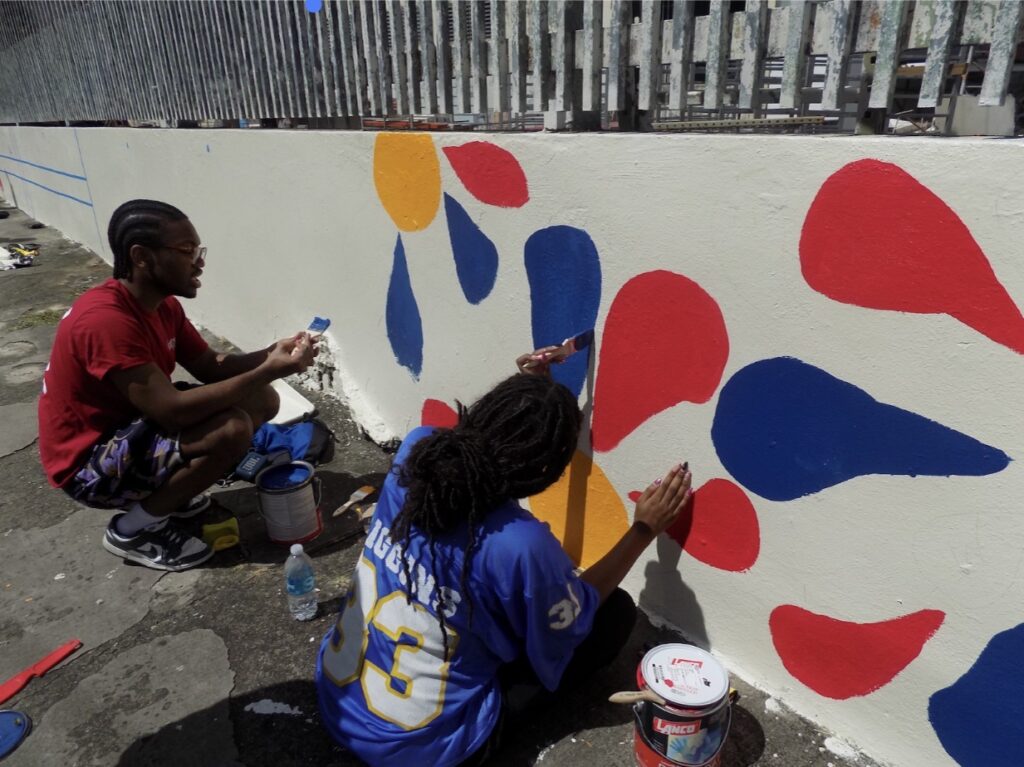
Central to their experience was the creation of a community mural, an endeavor that required the students to act as both artists and sociologists. Hickman’s team’s design was selected by the residents after a process of deep research and community feedback. He said it was an “ambitious and difficult undertaking,” with students working on-site from 8:00 AM until about 6:00 PM to bring the vision to life.
Hickman also described the experience as “incredibly rewarding,” and said part of the project was learning from the community and adjusting their work accordingly. For the project, the students initially proposed a design with flags of six countries from across the Latin American diaspora, but the community pushed back, requesting a more specific focus.
“[The community] loved the actual design, but one of the critiques that they had was that Mexico, Venezuela, Cuba, Colombia flags don’t really represent their community,” Hickman said. “And they wanted us to keep Puerto Rico, and they wanted us to keep [the] Dominican Republic…it was a lot of research.”
Hickman noted that after consulting with his peers and professors, they refined the mural to feature the Puerto Rican and Dominican Republic flags, reflecting the demographics of the neighborhood. This pivot is connected to a core element of the Howard architecture program: the importance of listening to the people who will live in the spaces these students design.
Akylah Woods, a third-year architecture major from Chicago, Illinois, also reflected on a shift in perspective that was prompted by her trip to Puerto Rico. She said it was especially interesting to see how different the architecture is in Puerto Rico due to the climate.
In Puerto Rico, the architects use “open architecture,” collaborating with the heat rather than keeping it out like the climate-controlled buildings in the United States. Woods noticed how the environment can dictate a completely different set of rules for construction.
She observed that because it stays hot all year round, “architects can design portions of a building that are completely open twenty-four hours a day.”
During their tours of the University of Puerto Rico and the works of architect Henry Klumb, Hickman noted that they “saw buildings without glass windows or traditional front doors.”
Myles Hickman described walking through a dormitory where the halls felt like “open atriums,” allowing the breeze to flow through the structure. He said it was inspiring to see raw concrete and wood transformed into comfortable, breathable spaces that felt integrated into the landscape.
Beyond the technicalities of the architecture, the trip was an exploration of the African diaspora. Woods spoke about the human connection she felt while working in San Juan, noting that the history of Puerto Rico mirrors many aspects of the African American experience.
Woods emphasized a desire for “reimagining ideas,” particularly for the marginalized members of the community. She recalled seeing the locals and workers in the neighborhood and felt a drive to create designated areas where they could be seen and supported by the architecture.
Hickman said he returned to Washington, D.C. “with a newfound appreciation for adaptive styles and a desire to replicate the feeling of being inside a building while still hearing the trees and feeling the wind.”
Copy edited by D’Nyah Jefferson – Philmore