

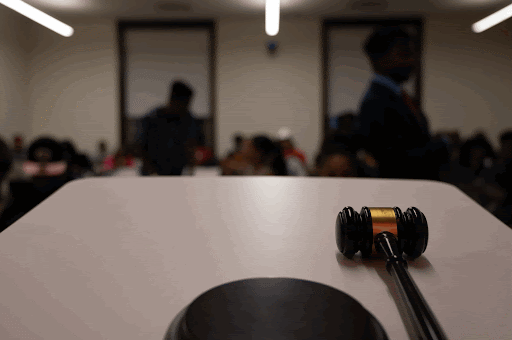
The HUSA Senate passed seven of 13 total proposed constitutional amendments at the spring constitutional convention, with topics ranging from establishing an office of public information to abolishing the current senate structure.
On Wednesday, Feb. 25th, the Howard University Student Administration (HUSA) Senate held the spring constitutional convention to vote on which proposed referenda would go on the spring 2026 ballot. The seven enacted by the Senate will be voted on by the student body later this semester.
According to the current HUSA Constitution, all constitutional amendments must be in the form of referenda, approved twice a year during constitutional conventions in which two-thirds of the Senate must vote to enact. If enacted, the referenda go on to the ballot to be voted on by the students.
Katia Papiller, a sophomore political science major and international relations minor from New York, in part authored four of the 13 referenda as the associate director of the office of the attorney general (OAG).
Two were passed, that being Referendum: Reports to get Stipends, which will require paid student leaders to submit reports of the work achieved monthly before receiving their stipends, and Referendum: Reduce the Amount of Bills HUSA Senators are Required to Write.
The second referenda would decrease the number of HUSA Senators required to author from two bills to one a year, which the OAG hopes will allow senators to be more intentional with their legislation.
“We want to shift their responsibility so that they can pursue what they want to do, but can actually oversee past legislation that’s been passed,” said Papiller.
During their OAG’s proposal, Devon Selmon, who served as a senator last year, brought up a similar referendum that he proposed and was ultimately passed by students during the 2025 spring elections, but was somehow not put in the constitution in a technical error. the piece of legislation would have established disciplinary action for senators who didn’t write legislation during a specific timeframe.
“Not only has it been ignored, but now it’s trying to be eradicated through another piece of legislation,” expressed Selmon before explaining the gravity of a referendum, which is approved by at least two thirds of voting students, being incorrectly updated to the constitution if a fundamental error. Papiller believes such inconsistencies serve as an example of decreasing the number of bills written by senators.
“Things definitely get lost in translation,” said Papiller. “We want a system at play that makes things more cohesive and in a timely fashion.”
As for the referendums that weren’t passed, Papiller says the OAG still intends to turn their proposals into other forms of legislation.
Referendum: The Truth in Student Service was authored by the former Vice Chair of HUSA Senate, Alex Blocker, an organizational communication major from Columbia, South Carolina received some objection. Blocker believes the electoral process of the Senate encourages internal aspirations, like social capital, from student leaders.
The Truth in Student Service was the longest of all proposed referenda and aimed to repeal and replace the functioning of the HUSA Senate with a student coordinating committee, which every Howard student would have automatic membership into, with equal political power. Senators representing a given school would be replaced by voluntary councils, which all associated majors have access to as well.
“The election model prioritizes those with the means and ability to mount an expensive campaign, but it often limits the people who are actually interested in the service,” said Blocker. “I think [by] removing the election barrier, it’s about power with and not power over, right? We’re all part of the same university-wide ecosystem,” he added.
“This bill does not abolish structure – it actually keeps a lot of the same necessary functions – but it does stop pretending that elections are the only way to staff them,” said Blocker.
Senator like Brian Singleton, a senior political science and sociology major, felt the bill’s introduction was somewhat “inappropriate,” as there was no bill representation at the constitutional review meeting on Feb. 19, which gave students and senators a chance to debate and question submitted referenda.
“A sweeping bill like this and tonight being the only opportunity to ask questions doesn’t make sense,” said Senator Brian Singleton.
The referendum was modeled on democratic confederalism, which Blocker says stresses the idea that electoral hierarchy isn’t required for institutional success. Blocker believes his referendum was not given proper attention by those who voted on the referendum
“To me, it was at best, mischaracterized, and at worst, deliberately not understood by the folks that were not passing it,” said Blocker.
Former senator Selmon had similar concerns with the legislation primarily about the alleged lack of interest by student win student government, which Selmon disagrees.
“Those students you want to be active in student government are those people that are running campaigns. The people already in the room with our current system of government,” said Selmon.

As a senior, Blocker plans to keep his proposal of a new student government alive.
“Even though I may want to see a change in student government in terms of its structure, I’m still lending support to those who are earnestly and meaningfully engaging with it,” said Blocker.
Copy edited by D’Nyah Jefferson – Philmore