

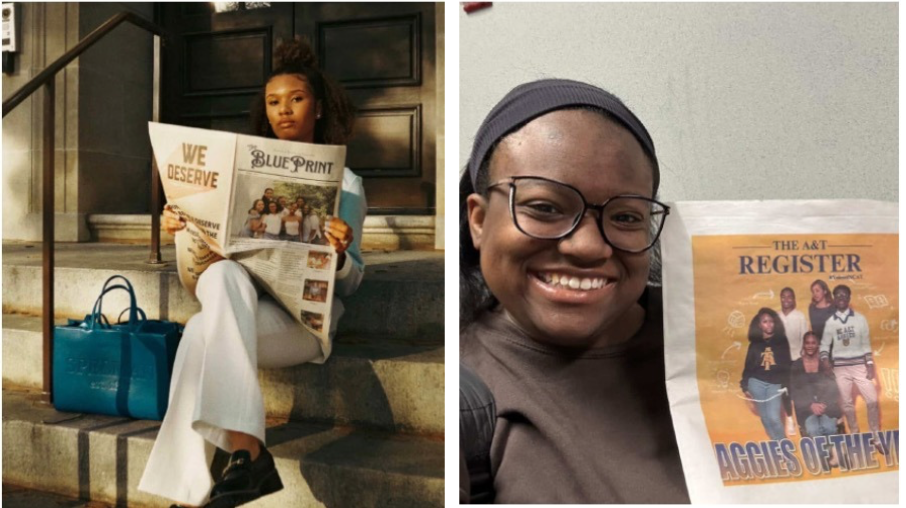
(Photos courtesy of Erin Gardner and Kennedi Lyons)
Black collegiate newspapers have long served as spaces for resistance, community-centered reporting and truth-telling. These papers continue a legacy of amplifying voices often ignored by mainstream media while fostering generations of young journalists.
The first student newspaper at a historically Black college or university (HBCU) was The Fisk Herald at Fisk University, created in June of 1883 by three literary societies.
“Black college newspapers are among the primary documents chronicling Black life in America,” according to an article by Black media historian Pamela E. Foster.
The Fisk Herald covered issues on campus, with students and in the Black community. Although the paper’s last publication was in 1930, it paved the way for many who followed.
The A&T Register is the student newspaper of North Carolina A&T University. First published in 1894, the publication continues to be the voice for the student body. Kennedi Lyons currently serves as the scene editor for the A&T Register.
“I was inspired to write for The Register because I have always loved to write and tell stories,” Lyons said.
She expresses how The Register is a welcoming environment where students can hone their journalistic skills.
Lyons’ central goal is to be a voice for the voiceless and she said loves storytelling with her fellow students. She said becoming a writer has helped her blossom as a person.
“I love seeing Black stories shine and I am passionate about highlighting marginalized voices. I enjoy encouraging budding writers and helping them nurture their talents in this field,” Lyons shared.
Erin Gardner, a junior English major and entrepreneurship and innovation minor at Spelman College, found a love for journalism in high school. Now, she serves as the co-editor-in-chief of Spelman’s newspaper, The Blueprint.
“When I got to Spelman, I knew that I wanted to carry that passion that I have for journalism and amplifying voices over to my matriculation and just share the voices of students,” Gardner said.
She shared how The Blueprint was recently reestablished. Due to low viewership, according to Gardner, the publication went on a seven-year hiatus and was revived in 2022.
Due to this, Gardner joined the Maroon Tiger, which is the student-led publication of Morehouse College.
“I started on the Maroon Tiger and then I told myself I needed to go home and be more involved with The Blueprint,” Gardener said.
Her goal as a writer on The Blueprint is to capture, execute and share stories about the Atlanta University Center (AUC).
Sam P.K. Collins is an adjunct lecturer in the Media, Journalism and Film Department in the Cathy Hughes School of Communications at Howard University. He teaches classes such as multicultural media history and public affairs reporting.
Collins stressed the importance of students writing as much as they can to help them find their voices as writers.
“Students need every opportunity they can to practice writing and the school newspaper is the way to do it,” Collins said.
He said that working for the school newspaper allows students to learn how to write, gather information and challenge power.
“The school is probably one of the easiest places they [students] can do that,” Collins said. “They’re finding themselves, and it’s a smaller community.”
Collins said that HBCUs have to do a better job of educating and raising awareness about the Black press. He said he observes the university creating pipelines to more mainstream publications. He shared advice for student journalists.

“You have to like writing, researching and be a historian,” Collins said. “Your political acumen has to be very strong and find a niche.”
Copy edited by D’Nyah Jefferson – Philmore