

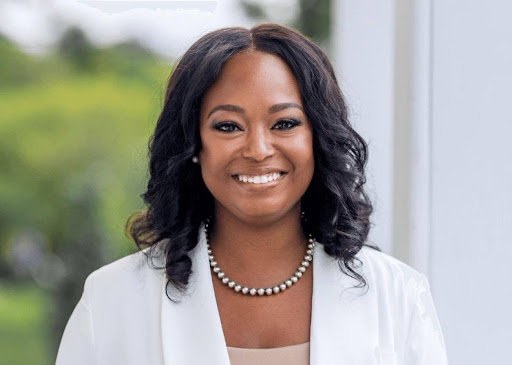
Councilwoman Janeese Lewis George announced on Dec. 15, 2025, her run for Washington, D.C mayor, making her the first Howard University graduate to enter the 2026 mayoral race. Lewis George cited her experience with the criminal justice system and grassroots organizing as key influences on her platform.
Lewis George’s commitment to D.C. comes from her third-generation Washingtonian family, who raised her in Manor Park, a residential neighborhood in the Northwest quadrant. Lewis George characterized her childhood neighborhood as a village.
“My neighbors were like second parents. If I came home from school and our mom was working late, my neighbors would step in,” Lewis George said.
That support lasted her through her childhood as she left for college.
“I’m a first-generation college student, so my block was really excited when I left for college,” Lewis George recalled, detailing how her neighbors put together a care package, bought her comforter and other supplies as she departed for St. John’s University in New York.
“We took care of each other. All of us had a place in DC, and that’s why I fight the way I fight,” Lewis George said.
After graduating in 2010, Lewis George came back to the district to pursue a Juris Doctor at Howard University School of Law (HUSL).
“From the first day I walked in the door, I remember my first professor who walked in, this amazing Regal Black Woman,” Lewis George said.
Lewis George believes that attending HUSL is one of the best decisions she has made in her life.
“It was such a blessing to be in a space where we were being taught to be lawyers, but also trained to go into a world where we would be in the minority,” said Lewis George.
Her first professor, Okianer Christian Dark, Esq., was one of the first Black students to integrate Rutgers University School of Law, and she told Lewis George and other students that when she attended the school, it did not expect her to succeed. She wanted something different for HUSL scholars.
“She wanted us to remember that we have to go into every space prepared, excellent and ready to succeed,” Lewis George said.

Along with her work ethic, Lewis George said HUSL gave her the rhetoric of a social engineer, a concept articulated by Charles Hamilton Houston, the first dean of the school. To Lewis George, this meant using the law to fight for justice.
“We heard this every day of law school. The quote goes ‘As lawyers, you are either a social engineer or a parasite on society,’” Lewis George recounted.
Lewis George hopes to live out her life as a social engineer, which to her means using the law to obtain justice and improve society. She started this journey as a prosecutor, first in Philadelphia, then in D.C. for the juvenile division, where she worked with restorative justice principles in mind.
As a prosecutor, Lewis George helped to develop deferred disposition agreements (DDAs), which drop or reduce an offender’s charges upon the completion of classes, community service and other rehabilitative activities.
“That young person has to be held accountable, but now they also have a pathway to not have a record for the rest of their life,” she said.
Lewis George first got into politics by organizing with the Long Live GoGo foundation, which advocates for racial justice amidst the erasure of Black people and culture in D.C. as the city grows more expensive.
“That grassroots organizing led to us fighting for equity across all eight wards in the city,” Lewis George said, specifically mentioning food inequity in Wards 7 and 8. Grassroots campaigning, especially for a raise in minimum wage for tipped workers, is what led her to run for the city council.
“The grass roots fight that we fought for in D.C. was a fight to say Black D.C. residents and long-term D.C residents deserve a space in the city’s future,” said Lewis George.
She was elected and currently serves as the councilmember of Ward 4. Lewis George is one of two democratic socialists on the city council and hopes to bring her ideology to the mayoral administration.
“I follow the socialist tradition that was shaped by Dr. King,” Lewis George said, who said there is nothing radical about Martin Luther King Jr.’s support for the distribution of wealth. “A better distribution of wealth means lowering the home costs for working people. It means raising wages,” she added.

As mayor, Lewis George hopes to bring universal affordable childcare to D.C., along with other measures to make the city more affordable under her “People First Platform.” Lewis George believes in strengthening the Tenant Opportunity for Purchase Act (TOPA), which gives current tenants the right to purchase their home if the property owner puts the unit up for sale. Through TOPA, Lewis George purchased her family’s house, where she lives with her husband and one-year-old
Lewis George also hopes to establish community hubs in all eight wards to centralize existing and future services for all residents, which she believes will also help to address the root causes of crime.
“Hubs that will be a place for young people to go, where people can get connected to jobs and support,” Lewis George said.
As mayor, she also aims to approach crime as a public health crisis, along with sticking to past initiatives that implemented such.
“Crime is a disease. Gun violence is a disease, and it has to be treated as such,” Lewis George said, adding that she hopes to prioritize D.C.’s gun violence prevention office, which has operated without a director for over a year.
She said she intends to ensure that the attorney general takes cases where justice is necessary to the safety of the community. While Lewis George admitted her policies are advantageous, she doesn’t believe they are impossible.
“We can do enforcement work, accountability work, and robust prevention work all at the same time,” Lewis George said. “As my grandmother said, we can walk and chew at the same time.”
Copy edited by D’Nyah Jefferson – Philmore