

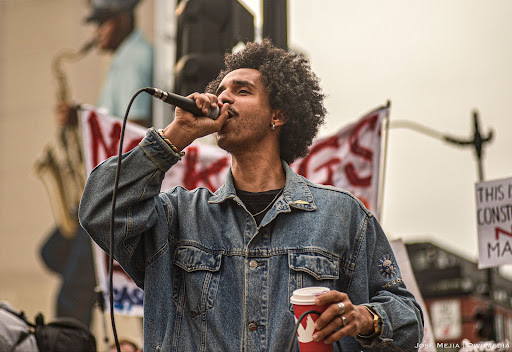
Washington, D.C.-born and raised filmmaker and social activist Merawi Gerima has built a reputation for pairing independent films with grassroots political work aimed at uplifting the Black community around D.C.
The D.C native comes from a family of longtime activists. His father, Haile Gerima, taught film at Howard University for over 40 years, while his mother, Shirikana Aina, directed several films, including “Footprints of Pan-African Activism,” which examines the Black experience.
The pair later co-founded Sankofa Video, Books & Café near Howard University’s campus, naming the space after the Akan principle meaning “to go back and fetch it.” The concept, which emphasizes learning from the past to shape the future, mirrors the through line in Gerima’s own filmmaking, according to him.
Gerima says he developed an early commitment to justice and standing by his principles that later shaped his understanding of organizing as rooted in history.
“Now, as an organizer, I understand there’s nothing that exists today that doesn’t come directly out of historical circumstances,” Gerima said.
That influence is especially evident in Gerima’s 2020 film “Residue,” which follows a young screenwriter returning to his hometown and confronting the gentrification of the neighborhood where he was raised.
Through “Residue” and his broader body of work, Gerima centers stories of Black D.C residents confronting displacement and the rapid transformation of the neighborhoods that shaped them, consistently returning to the question of who gets to remain in Black Washington and whose histories are at risk of being erased.
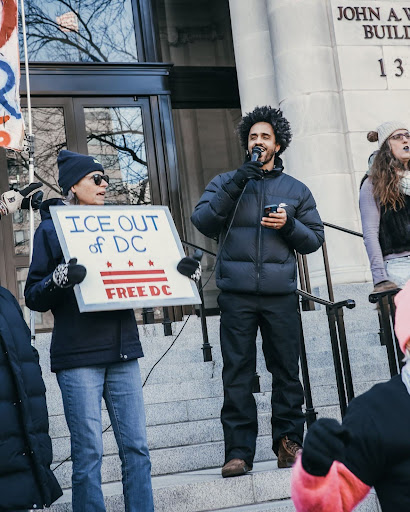
Organizers across D.C tackle similar issues. Sebrena Rhodes with Empower DC says the group fights for Black and brown communities citywide to prevent injustices.
“We work to pass laws and budgets that promote racial equity and environmental justice,” Rhodes said.
Gerima’s filmmaking ties directly into this mission of collective struggle and community organizing.
“Film is a tool in that struggle. I’m not making film for film’s sake,” Gerima said.
That commitment extends beyond filmmaking into community organizing. On Oct. 16, 2025, Gerima and the D.C. Alliance Against Racist and Political Repression (DCAARP), alongside the Families Not Feds Coalition, launched a sustained pressure campaign during a Ward 5 council meeting, where organizers publicly confronted and disrupted Mayor Bowser and her administration on her collaboration with ICE.
In September 2025, following Trump’s emergency takeover of D.C police, Bowser issued an order for local law enforcement to collaborate with federal agencies “to the maximum extent allowable by law within the district,” even after 30-day federal control ended.
Gerima said Bowser had “rolled out the carpet” for President Trump and ICE by hosting community events praising the federal occupation, which made her the target of the activists’ campaign. Gerima believes this helped to influence her choice to not run for re-election.
“We helped to end the reign of Bowser in D.C. It cleared a way for potentially someone who would be willing to stand up against Trump. I felt good as Black and brown, working-class people, uniting to fight back — and it worked,” Gerima said.
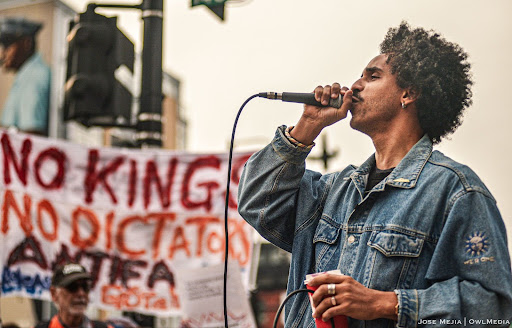
This narrative runs through Gerima’s organizing efforts across the District, particularly his work with groups such as the DCAARPR and the D.C. Against Trump Agenda Coalition.
Within the DCAARPR, organizer Ermiya Fanaeian describes Gerima as an important contributor while acknowledging the collective nature of their work.
“Merawi is an individual that many of us learn from, who we also follow, and he is definitely somebody who keeps the political focus of the organization in mind,” said Fanaeian, adding that the group’s organizing efforts are sustained by a broader network of partners.
His involvement has also placed him directly on the front lines of local demonstrations. In November 2025, Gerima was among several members of the DCAARPR arrested while mobilizing in Southeast Washington in support of Black youth during a protest against a citywide youth curfew that organizers said disproportionately targeted and harassed Black minors. The organizers were later released from custody after supporters described the arrests as wrongful.
Fanaeian says activism in Washington, D.C. carries a particular weight given the city’s geopolitical position.
“In D.C it’s really about recognizing that we’re in the belly of the beast of the United States empire. We’re the heart, the capital of this nation, and so we have a duty to connect with people who are most impacted by that nation,” Fanaeian said.
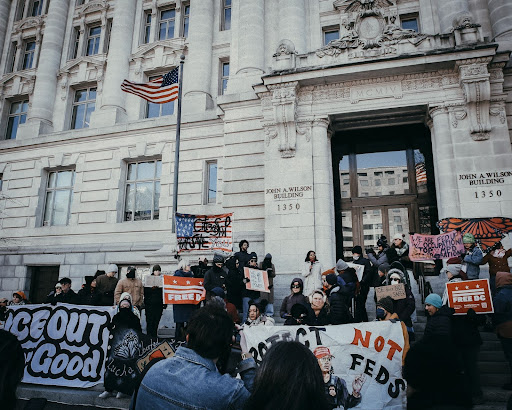
At Howard University, students say the university’s historical role in community engagement and political responsibility continues to influence them.
Sedona Farquaharson, a sophomore political science major, philosophy minor from Severn, Maryland, says students still carry much of the university’s community-oriented drive.
“Howard University, as an institution, was built to be around community and help the community, and I feel like our university has lost that, but you can find that drive still alive in the students,” Farquharson said.

Farquharson added that while many students remain committed to community work, the role of social media has complicated how authenticity in activism is perceived.
“People who aren’t doing it to post on social media, I feel like that’s the most authentic of it all,” Farquharson said. “I feel like the use of social media is like a double-edged sword.”
Students involved in recent demonstrations say meaningful activism requires consistent community engagement.
Josiah Washington, a senior political science major from Louisville, Kentucky, says the struggles of communities abroad are tied to struggles at home.
“Their oppression is connected to our oppression,” Washington says.
Perspectives like Washington’s reflect the continued overlap between student activism and the kind of community-rooted work Gerima has long emphasized.
For Gerima, political engagement is not optional but necessary. Encouraging those hesitant to get involved, he warned that disengagement carries its own risks.
“It’s more dangerous for you to stay at home,” Gerima said. “The only way to stop these things from happening is to fight back. You never get what you don’t fight for.”
Copy edited by Daryl R. Thomas Jr.