

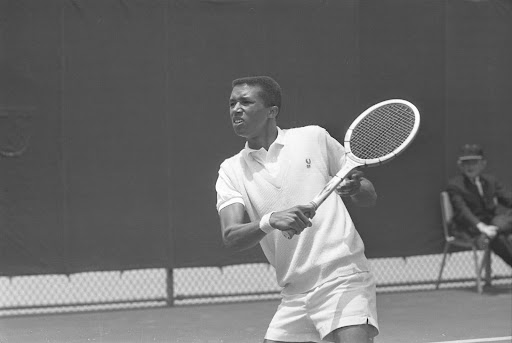
According to the United States Tennis Association’s 2026 U.S. Tennis Report, Black tennis participation grew by 14 percent across the country in 2025.
This participation in the sport was shaped early on by the work of Brenda Gilmore, a former Howard University tennis player who founded Prince George’s Tennis & Education Foundation (PGTEF).
The foundation is a registered United States Tennis Association (USTA, formerly the USLTA) community tennis association that develops and delivers programs for underserved youth in Prince George’s County, Maryland, supporting them academically, athletically and socially through tennis.
As a program director at UTSA, Gilmore was tasked with introducing tennis to the Washington metropolitan area by encouraging school systems to integrate the sport into their regular curriculum. She noticed whenever she would go to the tennis courts to practice, there were only adults there and not any youth. This led her to create PGTEF.
The rise of Tennis in Black communities is often attributed to players like Arthur Ashe or the Williams’ sisters; however, this foundation was laid long before them. It partially began with Lucy Diggs Slowe, a Howard University graduate and first Dean of Women.
In 1881, the U.S. Lawn Tennis Association (USLTA) was formed as the national governing body for tennis in the United States. Starting in the 1890s, historically Black colleges and universities (HBCUs), including Tuskegee University and Howard University, offered tennis to students and Black community members who were denied admission to private clubs where membership was restricted to white people.
Many joined tennis clubs specifically for Black people, but as the USLTA continuously barred Black people from competing in U.S. tournaments, it pushed a dozen Black tennis clubs to gather in Washington, D.C. on Thanksgiving Day 1916.
There, the American Tennis Association was born to provide Black tennis players an alternative tournament circuit and a stage of their own.
On that stage, history was made. During their first national championships, Slowe won the women’s singles, making her the first African American to win a national title in any sport and marked the first of her 17 national tennis titles.
While attending Howard, Slowe was president of the Howard University Women’s Tennis Club that would later become a varsity team in 1986 under Larry Strickland, who served as the head coach for 32 years.
Strickland was named Mid-Eastern Athletic Conference (MEAC) Coach of the Year 11 times, led four teams to achieve the Intercollegiate Tennis Association (ITA) Team All-Academic Team award, won 12 MEAC championships and won three HBCU National Championships in 1994, 1995 and 2015.
Strickland also coached Gilmore, who went on to become a ranked Tennis player during her time at Howard.
The former Bison acknowledged the growth of tennis in the Black community, but expressed her frustrations with more experienced non-Black students from other countries taking opportunities from Black students.
“They’ve got rankings and all that, now little babies have to play at the level that some of them have. Howard tennis is the last HBCU that is all Black in the MEAC,” said Gilmore.
“I believe it is important that HU continues to be the standard of excellence for HBCUs when it comes to ensuring opportunities for Black men and women in both academics and athletics,” Gilmore continued.
One person who came up through the foundation Gilmore built is Howard University tennis Associate Head Coach Zach Tobias.
Tobias started in PGTEF at eight-years-old as a participant and, after graduating from Temple University, returned as the director of programs.
Now coaching at Howard, he reflected on what sets the team apart from others in the conference.
“We are the absolute only team in our conference that is composed only of people from the African diaspora,” Tobias said.“We want our team not only to be able to compete for championships, but also to be a reflection of our school.”
In addition to the United States natives, the team has players from the Bahamas and the United Kingdom. Last year, the Bahamas Lawn Tennis Association announced its Team Bahamas, where Bahamian junior Michael Major Jr. was selected to compete with the squad in the Davis Cup, set for Aug. 4-9 in Trinidad & Tobago.
“We are extremely cognizant of that when recruiting. Not that there’s anything wrong with anybody else, but this is Howard University, this is Black excellence,” Tobias continued.

As Black tennis participation continues to grow, Howard’s program serves as a reminder of the lesser known history of a sport that is rapidly growing. The sport’s rise is the continuation of a legacy built by those who created opportunities when none existed.
Copy edited by Daryl R. Thomas Jr.