

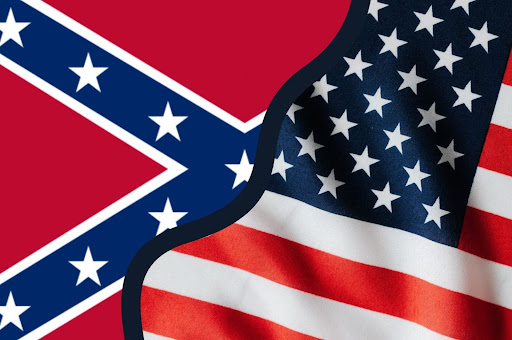
comparisons of modern politics to the Civil War. (Graphic by The Hilltop Staff)
Today, people on the internet are discussing parallels between the current political moment and one that unfolded over 160 years ago: the Civil War.
As debates over federal authority intensify and trust in major institutions declines, historians and scholars such as Heather Cox Richardson and Kevin Waite raise a cautionary question: Are the United States’ divisions part of a natural political rhythm, or are they a reflection of what led to the turmoil of the 1860s?
Howard University professor Jeffrey Kerr-Ritchie, who has a doctorate degree in history, said the Civil War was caused by the country’s differing views on slavery.
“The United States failed to deal with the issue of slavery politically in its foundation. The war itself was an inevitable product of that failure,” Kerr-Ritchie said.
Even though the country is currently seeing similar divides among political parties, Kerr-Ritchie cautioned against drawing direct historical parallels.
“I do not think that an analogy between the period that we’re now in and the American Civil War is appropriate. The country is politically divided. The country is not militarily divided,” he said while cautioning against sweeping historical comparisons.
Kerr-Ritchie said that due to differences in context, neither Civil War nor the Revolutionary analogies adequately capture the present moment.
Felix Martinez, a police officer of 13 years and the current chief of police at St. Mary’s College of Maryland, believes that a lot of the division between civilians and law enforcement stems from a lack of knowledge on what federal and state laws actually allow police officers to do. Further, he said that a job does not define a person or their beliefs.
“The biggest misconception simply is that people believe that we don’t agree sometimes with what they’re protesting,” Martinez said. “My uniform pays my bills, and my character is who I am.”
The Confederate attack on Fort Sumter in 1861 marked the formal beginning of the war after attempts by Southern states to secede from the Union, which the federal government saw as illegitimate. These efforts included the formation of the Confederate States of America in February of 1861, and a wave of secession conventions in states including South Carolina, Mississippi and Florida.
Though Southern political leaders framed the election of Abraham Lincoln as the driving threat, secession documents and speeches make it clear that upholding slavery was the Confederacy’s main goal. The Confederate vice president, Alexander Stephens, said in his “Cornerstone Speech” that slavery and white supremacy were central to Confederate political order.
In South Carolina’s “Declaration of the Immediate Causes of Secession” it explicitly states that the preservation of slavery was central to the Confederacy. Lincoln’s subsequent call for volunteers to suppress the rebellion confirmed Southern fears of federal involvement, widening the Confederacy and the war effort.
Even with major structural differences, there are several indicators that precede internal conflict, many of which are visible in contemporary America.
In both periods, political identity is central to the conflict. In the 1860s, Americans saw the opposing side as incompatible with their personal and economic interests. Today, partisan identity has similarly fused around race, geography and culture.
Some historians and cultural commentators say that understanding past divisions can help contextualize today’s tensions.
Last year, following the Kendrick Lamar Super Bowl halftime show, content creator Taylor Cassidy made a video about him referencing “40 acres and a mule” in his lyrics. She said it’s important for members of society to know about both historical and current events because there are still many lessons to learn.
“The subsequent creation of [giving Black people 40 acres and a mule] and then the abrupt taking away of that from newly freed Black people continues to affect the racial wealth gap today and how Black businesses operate,” said Cassidy, who is also the author of “Black History Is Your History.”
Today, the median white household wealth is more than six times that of the median Black household, according to the National Community Reinvestment Coalition.
“Many people did not know about 40 acres and a mule or have always heard of it, but didn’t know its impact,” Cassidy said. “…Seeing something in the media that’s really popular and getting into the historical significance of it can open a lot of people’s eyes.”
What many scholars describe as the ‘legitimacy deficit,’ — a situation where an organization, government or leader lacks public trust, or moral authority to govern effectively — is visible both historically and in the present day.
Just as Southern leaders during the Civil War rejected the legitimacy of Lincoln’s election and felt the federal government no longer represented them. Today, trust in the courts, Congress and the media has eroded across the political spectrum. According to the Pew Research Center, public trust in the federal government has fallen from about 77 percent in 1964 to 17 percent in 2025, one of the lowest measures in over seven decades.

While today’s political struggles differ from those that led to the Civil War, some scholars say current tensions echo America’s long history of white supremacy. Kay Lewis, who has a doctorate degree in African American history and is an associate professor of history at Howard, similarly emphasized the historical role of fear being used as a persuasive tactic in politics.
“Fear has historically been part of the toolkit of white supremacy…‘Othering’ is part of the white supremacy toolkit, and attached to ‘othering’ is creating fear,” Lewis said.
Lewis also expressed skepticism about the likelihood of a modern Civil War, pointing to the structural realities of the United States today.
“There’s no way that any one particular state could stand on its own as a sovereign nation at this time,” Lewis said, addressing the country’s interconnected economic and political infrastructure.
As Kerr-Ritchie explained, the Civil War was fundamentally a struggle over legitimacy and slavery. Today’s conflict, he suggested, centers on contention over democratic norms and rising authoritarian rhetoric. However, these contentions have unfolded against racial tensions that have always shaped the nation, bringing them forth in a reignited spotlight.
Today, non-white American citizens have reported carrying their passports, remaining vigilant, staying inside and ordering groceries to avoid stepping outside due to fear of government organizations such as Immigration and Customs Enforcement (ICE) and Department of Homeland Security, according to NPR.
According to CT Insider, Latino businesses have experienced a sharp decline in customer traffic. In some areas with a high population of Latino people, such as Meriden, Connecticut, where ICE raids have nearly doubled in comparison to 2024 according to ICE’s website, business owners report sales are down by approximately 50 percent since April 2025.
Racial tension is not new to the country. In the Civil War era, the Southern economy depended on enslaved labor to help drive the march towards conflict. Although the federal government’s role has shifted since the Civil War, according to Lewis, an “us versus them” rhetoric still permeates modern political discourse.
“[This rhetoric] is ingrained within our psyche. It is ingrained in the way we think. It’s ingrained in our institutions,” Lewis said.
Martinez, who is a lecturer at Howard and teaches sociology courses related to the criminal justice system, acknowledges how recent events in history, including the murder of George Floyd, have tainted the view of law enforcement in the U.S. That is why in his police department he prioritizes community building, he said, because policy changes can only do so much.
“I’m always talking to people [in the community], and I expect my guys to follow the leader,” he said. “Give your community events that they would really want to go to [so they can] see you in a different light. It’s really on the person, it’s not on the policy.”
Regardless of the lack of direct evidence that officially ties historical moments to current events, members of society will continue to draw parallels and use history to make more informed decisions today.
Cassidy said a politically charged moment in history reflective of this current time is the Montgomery bus boycott. Although Rosa Parks is the face of the boycott, the first person to refuse to give up their seat was Claudette Colvin, a high school student.
“With resistance, fighting for liberation and making these big strides for change, a lot of people think that you have to be perfect,” Cassidy said. “…But with Claudette Colvin, she was just a high school girl who was coming home from school.”
At this time, more than ever, Cassidy said, it is important for people to come together as a collective to participate in resistance, just like people did generations ago. She cited Browder v. Gale, the Supreme Court ruling that ended segregation on buses, as an example.
“That was only because each and every person chose not to say things like ‘we’re cooked’ or ‘the world is ending,’” Cassidy said. “They thought, ‘No, if we as a community focus on this one thing, we can get something done as long as we’re persistent.’”
Copy edited by Kennedi Bryant