

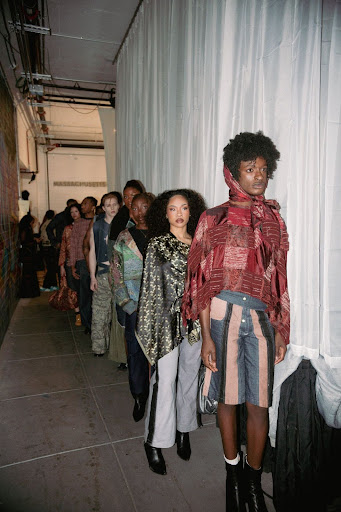
D.C. culture met creative talent at the Dupont Underground community art venue as The Art of Assembly showcased “The Raw and The Beautiful,” a display of avant-garde fashion. The event, which took place in February was powered by Howard University students, local artists and a belief that the kind of innovation often credited to New York Fashion Week or the streets of London already lives in the streets of D.C.
“Art of Assembly is a group of young Black individuals who are trying to shed light on Black creatives,” said Show Director and Model Coordinator Jason Ncquain.
The artists collective was designed to give emerging creatives space to showcase their talents. Its flagship runway leaned on Howard University students and local collaborators who treated the production as both a statement and a reclamation.
Melissa Arango from Colombia was invited to the event by her friend, and said the experience was new for her.
“This is my very first fashion show. These kinds of spaces feel so far from ‘commoners,’ if [that’s how] you want to say [it]. This one feels very accessible, like it’s made for the people, not the elites,” Arango said.
On Feb.15, Attendees filtered in from across the city, adorned in clashing patterns of polka dots and plaid, or in hyperbolic forms of everyday wear. Others donned fur ski masks and slick trench coats.
“On the streets, people are wearing the same thing,” said Arango. “Here, you see something that you don’t see every day.”
Bold colors and sparkling jackets painted the seats as guests sipped tiny beverages. Friends leaned in, taking selfies in VIP seating and quickly catching photo ops on the path where models would soon parade.
With growing anticipation, murmurs continued throughout the crowd until the first model stepped onto the runway. Attendees studied each garment carefully.
“It was cool seeing how some people experimented with fabric, or with silhouettes and how broad I think the definition of avant-garde fashion is too,” said Riya Balachandran, who brought Arango to the event.
The fashion collections featured distinct designs from brands Eyewuh, Goons n Goblins, Hoodlvm and PRATUM.
Eyewuh presented draped and precisely pinned silhouettes sculpted to the body, creating shapes that were structured and unexpected. Models clad in Goons n Goblins and layered flowing denim and silver buckles. Hoodlvm expanded the play of leather and furs into oversized, body-consuming forms, challenging proportion. PRATUM concluded with sculpted hoods, fedoras and snakeskin.
Balachandran explained that the garments felt like they combined what she thinks of as avant-garde with streetwear.
“When we think of the avant-garde, it feels very runway and high fashion,” said Balachandran.
Reflecting on the show, Balachandran realized avant-garde doesn’t have to show up in radical ways, but can be found in adding a slight edge to everyday routine.
“It’s easy to incorporate it with your own clothing by just wearing things differently,” Balachandran said.
Sporting a snake-skin matching set down the runway was a model from Howard University ELITE Models, Michael Tiller, a junior health science major from Columbus, Ohio.
“On Howard’s campus, I am a heel walker,” Tiller said. “This was really different for me. Being in hard bottoms and going between masculinity and femininity was challenging.”
Avant-garde, in this case, required the sacrifice of comfort. For Tiller, stepping outside his usual presentation meant leaning fully into confidence rather than familiarity.
“The risk that I personally took was owning the runway, making it seem like I was the king of the entire show,” Tiller said.
Despite the initial nerves, Tiller found calm in the presence of the community that prepared him for this moment.

“There’s always gonna be a Howard person in every room, no matter what room I go in,” said Tiller. “That made me feel a lot better.”
Ncquain wanted to shift focus away from larger fashion circuits and toward D.C., which he said shaped him. The choice required sacrifice, both professionally and personally.
“I live in New York, so I had a lot of stuff already planned, and I had to move those to the side,” Ncquain said.
For Ncquian, Art of Assembly was about interrupting the assumption that innovation must travel north to matter.
“D.C. has lost what it was about back in the day. We were about the Black community, and it was about supporting the Black community. It lost its traction. We need to bring that back,” he said.
With that conviction in mind, the vision required someone willing to invest more than belief. For the creative director of the show, Charius Fox, that meant being willing to put money on the line.
“We had no funding. This was all out of pocket,” said Fox.
In practical terms, that meant designers contributed materials, collaborators volunteered time and students adjusted their schedules to accommodate production needs.
Howard’s presence extended beyond the runway. Howard interns became central to that structure. They handled outreach, coordinated logistics, managed backstage flow and amplified the show through organic marketing. Preparation stretched back to early fall, long before the February date felt immediate.
“Prep came in in September,” said lead intern Dascia Cofield, a senior marketing major from New Orleans. “It was during Christmas, it was during New Year’s. I love the holidays, so I spent a lot of time trying to do stuff for them while also navigating personal life.”
Cofield described the responsibility not as symbolic participation but as leadership.
“It was myself as an intern lead, and I had nine beautiful ladies who were dedicated from the jump,” she said. “It was a lot as a young woman to carry on other young women, to be there for them and help them throughout the journey.”
Ncquain credited that effort directly.
“Without the interns, I probably wouldn’t have gotten half of this done,” he said. “They are the backbone and what made this happen.”
He explained that their contributions extended beyond assigned roles.
“They used their resources at Howard,” Ncquain said. “I didn’t even ask them for that. They anticipated my moves. They were creative as hell.”
For junior fashion design major Anjolie Richardson from Los Angeles, California, the experience reframed what professional access could look like for students in D.C.
“Not everyone has the opportunity to go to New York,” Richardson said. “There’s so much culture in D.C., in Chocolate City. To be able to actually artistically express the deep parts and the culture of D.C., there is talent here.”
Before a night of mingling, Fox returned to the runway, not to introduce another look but to acknowledge the hands that made the production possible. Thanked designers, interns and attendees who had filled the room.
“Because that’s what ties us back in,” Fox said. “That’s what makes us human, that I’m not the only one who has visions like this. It’s a community out there that does, and I want to let them know that it couldn’t come to life without the community.”
He emphasized that the risk was personal as much as financial.
“I took a risk on not doing it without funding,” he said. “I took a risk on doing it for the raw and the beautiful. I took a risk on doing it about designers in the DMV.”
For Fox, that uncertainty was not something to minimize when it was embedded in the vision.
“It’s what people look for, it’s what people want,” he said. “They want to feel something they haven’t felt before. That’s why it’s called ‘The Raw and the Beautiful.’ It’s about how beautiful things can be ugly, how ugly things can be quite beautiful.”
Copy edited by D’Nyah Jefferson – Philmore