

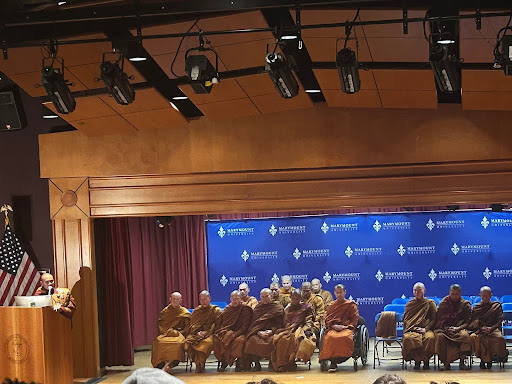
After more than three months on the road, the Walk for Peace reached its conclusion in Washington, D.C., marking the end of a 2,300-mile pilgrimage that drew thousands of supporters in person and millions more online.
19 Buddhist monks arrived in the nation’s capital on Feb. 10 after walking from the Huong Dao Vipassana Bhavana Center in Fort Worth, Texas, completing a 108-day journey rooted in mindfulness, compassion and healing.
The pilgrimage, known as the Walk for Peace, aimed to promote unity across religious and cultural lines while urging lawmakers to recognize Vesak, the celebration of Buddha’s birth, as a national holiday.
Despite its spiritual origins, organizers emphasized that the walk was intentionally inclusive.
Paññākāra, the monk leading the journey, said the reason for the surge of national attention was straightforward.
“It is purely about peace,” he said. “It has nothing to do with religion, and people need that right now.”
As the monks entered Washington, planned interfaith and public stops were scheduled across Northwest D.C., including visits to American University, the Washington National Cathedral and George Washington University.
As the monks passed through Northwest Washington, clusters of students gathered along the sidewalks, some stepping out between classes to watch quietly as the group approached.
Among those who gathered to see the monks was Michael Okoye, a senior health science major at Howard University, who said he followed the journey online before deciding he needed to see it for himself.
“Watching them go from Texas all the way to D.C., I just can’t visualize anybody walking that distance,” Okoye said. “It doesn’t even seem real. But they’re doing it all for peace and humanity.”
For him, being present was about more than curiosity.
“I feel like everybody has a humanitarian side to them,” he said. “Showing up is a way to display it. You can repost something online, but physically being here, that means something different.”
Koye described the walk as a rare moment for the campus community.
“This is history,” he said. “We’re probably not going to see monks walking across the country for peace again for a while. I think everybody should at least have the opportunity to witness that.”
As the monks continued past, many students stood silently, some recording on their phones, others simply watching.
The Metropolitan Police Department warned residents of rolling road closures as officers escorted the group through the city.
The final stretch of the journey included stops in Annapolis and near the White House, culminating on Wednesday, Feb. 11, at the Lincoln Memorial. The monks then returned to Texas by bus, walking the final six miles back to their temple.
The pilgrimage continued despite a serious setback earlier in the journey, when a truck accident injured two monks and resulted in the amputation of one of their legs. Even so, the remaining 19 monks, accompanied by their dog Aloka, pressed on with bandaged feet, drawing even larger crowds along the route.
Local law enforcement agencies helped secure the walk as supporters lined the streets, joined briefly in solidarity and followed updates online, where the journey attracted millions of viewers. Paññākāra said the scale of the response exceeded anything he expected when the walk began.
He expressed how he never expected this many people when they started. Paññākāra said the emotional impact of the walk became deeply personal at several stops.
“The first time I saw so many people come out because of my mission, I cried,” he said. “It touched me because I had done something to help people, and that is what I’ve always wanted to do.”

Throughout the journey, supporters shared stories of loss, trauma and healing, often approaching the monks in tears.
Later along the route, Ra’nyah Douglas and Ada Strait stood among a cluster of students watching quietly as the monks passed, their saffron robes moving steadily through the crowd.
Douglas, a junior criminology major from New Haven, Connecticut, said she followed the pilgrimage online for weeks before seeing it unfold in front of her.
“It felt so unreal,” she said. “I’ve been seeing clips and updates online, but actually seeing them in person, it’s different. The energy felt calm. Everyone around was peaceful, and the monks were peaceful as well.”
She said one of the most striking moments was the way the monks engaged with those who came out to support them.
“I liked how they bowed to the crowd and acknowledged the people who showed up,” Douglas said. “They weren’t just walking past us like we weren’t there. They made it feel intentional. It felt personal.”
Strait, a senior sociology major with a technology minor from Springfield, Massachusetts, said witnessing the walk firsthand gave her a deeper appreciation for its purpose.
“Like she said, seeing them in person, what they stand for and what they’re walking for, it’s amazing to actually witness that in real life,” Strait said. “You hear about peace all the time, but to see people physically walking across the country for it makes it more real.”
Both students said the timing of the walk added to its significance.
“With everything going on in the country right now, they were definitely needed in Washington, D.C., to bring peace,” Douglas said. “It’s a reminder of what the world really needs.”
Strait agreed, saying the completion of the journey carried weight beyond the symbolic finish.
“There are people who sit down in front of me and cry and say, ‘If it weren’t for you doing this, I probably would have ended my life,” Paññākāra said.
He emphasized the impact this had on him saying “that really touched me.”
As the walk comes to a close, organizers say its meaning now extends beyond the physical journey itself.
“We are not walking alone anymore,” Paññākāra said. “We have millions of people walking with us in spirit.”
Copy edited by Kennedi Bryant