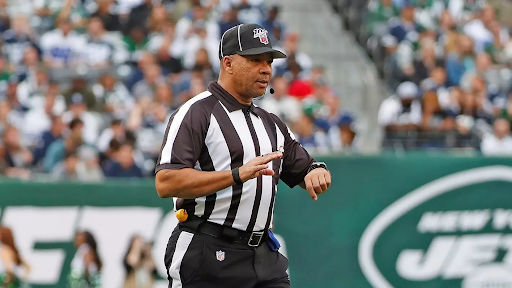
In Super Bowl 2026, three out of the seven officials were historically Black college and university (HBCU) graduates. Umpire Roy Ellison is a Savannah State University graduate, line judge Julian Mapp is a Grambling State University graduate and Howard University’s very own Greg Steed served as back judge.
Steed came to Howard in the spring of 1987 as a computer information systems major in the School of Business. Over the next three years, he attempted to put his years of high school football experience to use and walk on to the Howard football team, but each attempt brought an unexpected setback.
In both his first and second years, he was in car accidents just a week before practice, leaving him unable to play. In the third year, Steed, a member of the Marine Corps Reserve, was called to serve in Operation Desert Storm.
“Needless to say, the message was, I guess I wasn’t supposed to play football anymore,” Steed joked.
On his return from Desert Storm, Steed’s cousin, Boris Cheek, tried to shift Steed’s mindset from the war by inviting him to the adult flag and touch games he would officiate. This introduced Steed to officiating and would launch his career.
Joining the Eastern Board of Officials, the oldest predominantly African American sports officiating organization in the United States, Steed was assigned to work various high school games in Washington, D.C.
Steed would soon return to Howard, attending training sessions on Saturday mornings for aspiring officials held by Tom Beard, who started the first Mid-Eastern Athletic Conference (MEAC) football clinic at Howard University’s George W. Cook Hall dormitory.
Through Beard and his clinics, Steed was able to get his first collegiate officiating opportunity in the MEAC. From there, he went on to work in the Atlantic 10 Conference, the Arena Football League and the Big 10 before being hired by the NFL in 2003.
After working in the NFL for over 20 years, Steed is known as one of the NFL’s most trusted officials in the secondary, according to Sports Illustrated. He has also racked up many accolades.
He was selected for Super Bowl 2008 as an alternate official, served as on-field back judge in Super Bowl 2010 and Super Bowl 2020, where he was among the first five African American officiating crews for the Super Bowl, along with Cheek. Similarly, this past Super Bowl, Steed also served as the on-field back judge with another five African American officiating crew.
Additionally, Steed made history as part of the first all African-American officiating crew to work ESPN’s historic Monday Night Football programming.
“It really paid homage to all of the previous black officials before me who didn’t get that opportunity to work at a high level because of racism and discrimination,” Steed said. “To show the world we can do this at a high level and, in my opinion, we did an excellent job showing [that] when given an opportunity, we will perform.”
Steed’s impact extended beyond the games he officiated. He introduced fellow Bison Greg Yette and Keith Parham to officiating and mentored them through their careers to the NFL.
Parham attributes the smoothness of his journey as a Black official to Steed’s mentorship.
“I don’t think there were any challenges because of the people I had behind me pushing me, encouraging me, training me, advising me,” Parham said. “It was almost like the red carpet or the seat opened up for Greg Yette and myself. What we put into it is what we got out of it.”
Copy edited by Daryl R. Thomas Jr.