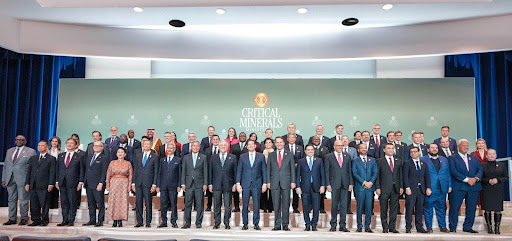
The United States hosted the largest diplomatic meeting on critical minerals in history at the beginning of this month in a bid to reduce American dependence on China for the raw materials underpinning modern technology and national defense. As Secretary of State, Marco Rubio convened representatives from 54 countries and the European Commission at the inaugural 2026 Critical Minerals Ministerial in Washington, D.C.
The day-long summit brought together Vice President JD Vance, Treasury Secretary Scott Bessent, Interior Secretary Doug Burgum, Energy Secretary Chris Wright and U.S. Trade Representative Jamieson Greer alongside 43 foreign ministers. Its central aim was to diversify a global market in which China overwhelmingly controls the supply of critical minerals essential for semiconductors, advanced weapons systems, artificial intelligence and batteries.
Though neither Rubio nor Vance named China directly, the target was clear. China controls nearly 90 percent of global rare earth processing capacity and is the leading refiner for 19 of 20 strategic minerals, according to the International Energy Agency’s 2025 Global Critical Minerals Outlook. Recent Chinese export restrictions on gallium, germanium and several rare earth elements have only heightened urgency among Western governments to diversify supply chains.
“We fell in love with the design of these things,” Rubio said during a press availability at the ministerial. “But forgot that to design something, you have to be able to build it, and to build it, you have to have the fundamental materials to make it. Today, it’s heavily concentrated in the hands of one country.”
In Vance’s opening remarks, he said the international market for critical minerals is failing.
“It’s failing to create domestic markets or dignified jobs for our labor force, and it’s failing to keep our nation safe,” Vance said. “Supply chains remain brittle and exceptionally concentrated.”
At the center of the ministerial’s outcomes was the launch of the Forum on Resource Geostrategic Engagement, or FORGE, a new plurilateral coalition designed to succeed the Biden-era Minerals Security Partnership. Rubio announced FORGE as a platform for coordinating pricing challenges, spurring development and expanding access to financing. South Korea will serve as the inaugural chair of the forum through June.
Vance outlined the coalition’s proposed mechanism: a preferential trade zone for critical minerals, insulated from external disruptions through enforceable price floors.
“We will establish reference prices for critical minerals at each stage of production,” he said, describing pricing that would reflect “real-world fair market value” and be maintained through “adjustable tariffs to uphold pricing integrity.”
Reed Blakemore, director of research and programs at the Atlantic Council’s Global Energy Center, and Alexis Harmon, an assistant director at the center, wrote that FORGE represents a significant departure in the administration’s approach. They characterized it as the administration’s most concrete attempt to build a functioning architecture around its critical minerals ambitions, signaling a core belief that the most difficult challenges in mineral markets are better tackled with partners rather than alone.
The push to secure critical mineral supply chains has drawn bipartisan support on Capitol Hill. On the same day as the ministerial, Senators Jeanne Shaheen (D-NH), ranking member of the Senate Foreign Relations Committee, and John Curtis (R-UT) released a joint statement welcoming the summit and urging colleagues to pass their bipartisan legislation to codify U.S. participation in the Minerals Security Partnership.
“The United States cannot solve the critical minerals challenge alone, and we will be unable to counter PRC dominance over critical mineral supply chains without trusted allies and partners,” the senators said.
The ministerial produced a wave of new agreements. The United States signed 11 new bilateral critical minerals frameworks and memorandums of understanding with Argentina, the Cook Islands, Ecuador, Guinea, Morocco, Paraguay, Peru, the Philippines, the United Arab Emirates and Uzbekistan. Those agreements add to 10 similar frameworks signed in the previous five months, with negotiations reportedly completed with 17 additional countries.
On Feb. 2, just two days before the ministerial, President Trump announced Project Vault, a $12 billion initiative to establish a domestic strategic reserve for critical minerals. The Export-Import Bank approved a $10 billion direct loan for the project, more than double the largest financing in the bank’s history, with an additional $2 billion in private capital. In total, the State Department’s post-ministerial fact sheet cited more than $30 billion in government-mobilized investments, loans and letters of interest over the past six months.
On Feb. 3, Deputy Secretary of State Christopher Landau oversaw the signing of a memorandum of understanding between Glencore and the U.S.-backed Orion Critical Mineral Consortium for a potential acquisition of mining assets in the Democratic Republic of the Congo. The deal aims to secure flows of copper and cobalt from the DRC to the United States, according to the State Department.
Rubio emphasized that the initiative is a global effort rather than a purely American one. “Everyone here has a role to play,” he said at the ministerial, urging each country to find a specialized contribution to the coalition. The United States, the European Union and Japan jointly committed to developing coordinated trade policies, including border-adjusted price floors, and the administration unveiled a 60-day action plan with Mexico on critical minerals.
Not all observers are convinced that the administration’s approach goes far enough. Philippe Le Billon, a professor of geography, public policy and global affairs at the University of British Columbia, called the ministerial “a welcome shift” from Washington’s recent skepticism toward multilateralism and “reflects a growing consensus that diversifying away from China will take a united front.”
The ministerial capped a coordinated sequence of actions: Project Vault on Feb. 2, a government-industry dialogue at the Center for Strategic and International Studies on Feb. 3, and the ministerial itself on Feb. 4, all following China’s escalation of rare earth export controls in late 2024 and a January presidential proclamation declaring critical mineral imports a national security threat.
Le Billon and fellow researcher Raphaël Deberdt warned that centering cooperation around U.S. stockpiles and direct government investments risks shifting global dependence from Beijing to Washington. They argued that selectively backing certain firms could produce a landscape where winners are chosen for strategic alignment rather than commercial viability.
Whether the administration’s ambitious framework translates into functioning mines and resilient supply chains remains to be seen. Blakemore and Harmon put it plainly: the administration delivered speed and ambition at the ministerial, but “execution and durability are the harder tests ahead.”
Copy edited by Kennedi Bryant