

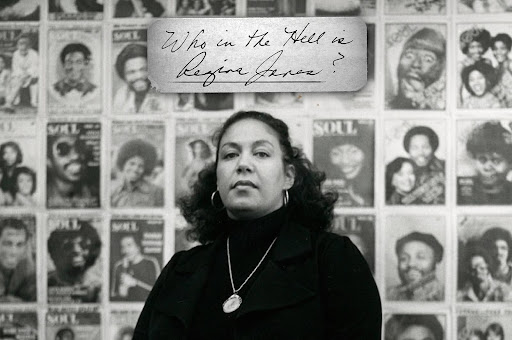
Regina Jones spent most of her career comfortably behind the scenes, first as a journalist and later as a public relations executive. Now, she is stepping into the spotlight, with her life as the subject of a documentary airing on national television.
Weigel Broadcasting will debut the award-winning documentary “Who in the Hell is Regina Jones?” simultaneously across Weigel Broadcasting’s Dabl, Start TV and Story Television networks on Feb. 16 at 8 p.m. ET.
Jones’ motivation is simple: to encourage other women to never give up on themselves and to avoid seeing themselves as victims of their circumstances. However, Jones did not always plan on creating a documentary; it began almost by accident.
She initially agreed to be interviewed about the Watts riot — a series of civil disturbances that erupted in the Watts neighborhood of Los Angeles in August 1965 after the violent arrest of Marquette and Ronald Frye by white police officers. The uprising lasted six days, resulting in dozens of deaths, thousands of arrests and widespread property damage.
At the time, Jones worked as a Los Angeles police dispatcher and was among the first to take calls as the unrest unfolded. After interviewing her about her experience, producers shifted direction and asked if they could center the documentary on Jones herself.
“I said, ‘Oh, okay, thank you,’” Jones said. “And I think I was in some kind of weird space of just suiting up and showing up — not looking at the bigger picture, not thinking about it.”
During production, Jones’ oldest son died, adding some emotional difficulty to the process of filming, a time period she described as “bizzare.” Despite her grief, she never canceled a day of filming or interviews.
Jones never imagined a documentary would be made about her life. She always hoped to preserve the legacy of her creation Soul magazine in 1966, the first publication dedicated to Black musicians, predating magazines like The Rolling Stone.
“I’d always wanted to get the Soul story out there,” Jones said. “But that wasn’t my story. That was Soul.”
Still, she believes the finished film honors both her life and the work she helped build, crediting Weigel Productions Corp., directors Soraya Sélène and Billy Miossi, editor Nancy Novack, co-editor Alisa Selman, producer Alissa Shapiro and executive producer Sam Pollard, an Academy Award nominee, for their care in telling her story.
“I have to congratulate these people for making me look so good,” Jones said. “They did a very kind, wonderful job. I’m very pleased. I have not one criticism. I’m just grateful.”
“Who in the Hell is Regina Jones?” has won several awards, including Outstanding Documentary Feature Award at the Greater Cleveland Urban Film Festival, runner-up Audience Award at the New Orleans Film Festival as well as nominations at the Spotlight Documentary Awards and NAACP Image Awards.
Motherhood is a central part of Jones’ story. She became pregnant at 15 and said parenting taught her that children are individuals who cannot be reshaped at will.
That lesson echoed later in her career when Soul magazine came to an end. Jones often referred to the publication as her “sixth child.”
“When Soul ended, it was like saying, ‘Pull the plug on my child,’” she said. “It was very, very hard.”
The magazine’s closure coincided with other losses, including the death of her mother and the dissolution of her marriage to Ken Jones, who conceived the idea for Soul. She supported his vision and spent her career helping elevate Black artists during a time when mainstream media largely ignored them.
Through Soul, Jones worked with and befriended artists such as Aretha Franklin, James Brown, Stevie Wonder and the Jackson 5, figures who would later become icons and industry moguls. Her work there led her to win an NAACP Image Award for Outstanding Woman In Business in 1980.
At the time, she did not fully grasp the magazine’s historical significance. Looking now at successors such as Essence, she feels pride knowing Soul helped pave the way.
“I remember taking a meeting with [Essence] before they started it,” Jones said, recalling early conversations about the logistics of articles and publishing.
After Soul folded, Jones joined SOLAR Records as the vice president of publicity, a move that she said allowed her to take greater control of her career. After three years at SOLAR, founder Dick Griffey suggested Jones launch her own PR business there, rather than continue as a paid executive for the company.
“Well, two hours later, I had my car packed up and I was gone,” she said. “That didn’t appeal to me.”

Jones launched her PR firm, Regina Jones & Associates, handling publicity for the NAACP Image Awards, Crystal Stairs Inc. and campaigns for the Rev. Jesse Jackson.
Despite her influence on Black media and culture, Jones said she is still learning who she is, even at 83.
“I still don’t know who in the hell is Regina Jones,” she said. “I’m still not sure what I want to do, except do a good job at whatever I do.”
That uncertainty, she said, is what keeps her moving forward.
“I get pleasure in doing the best I can at whatever I can,” Jones said. “I want to keep doing that.”
Jones hopes her documentary will inspire young people, particularly students navigating an increasingly chaotic world, to trust themselves.
“Listen to your inner voice,” she said. “When people are not kind to you, it’s not you — it’s them. Don’t take it personally. No means not right now. And never, ever give up on yourself. Really trust yourself.”
Copy edited by D’Nyah Jefferson – Philmore