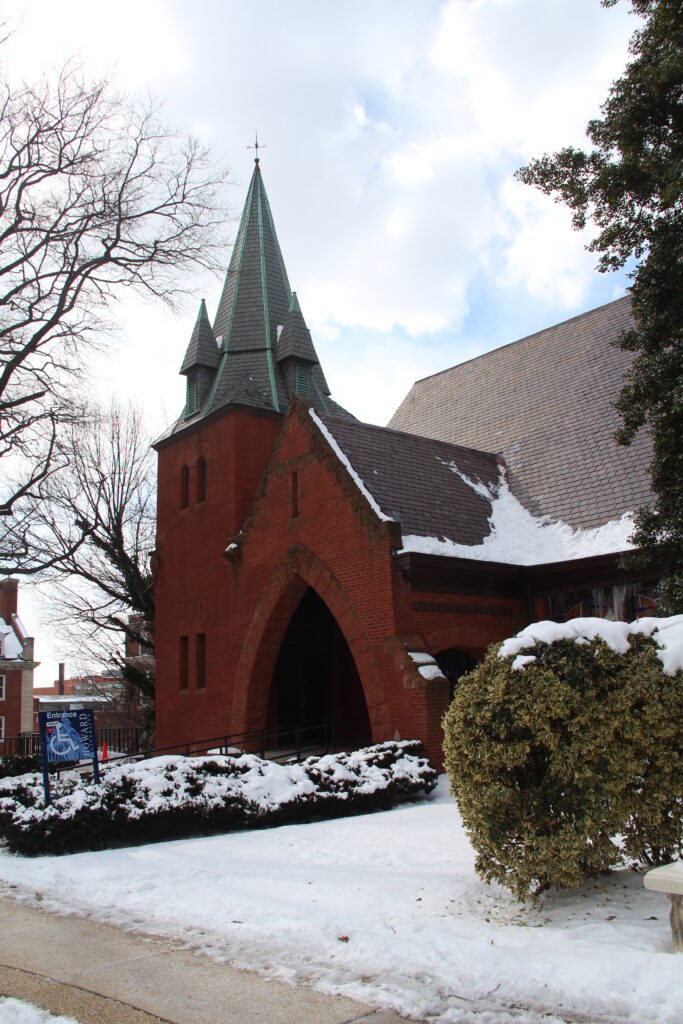
The Andrew Rankin Memorial Chapel is a sacred space on the campus of Howard University, where faith is not insulated from politics or history. Within its walls, pastors, churchgoers and students from all walks of life are immersed in Black intellectualism that confronts white Christian propaganda, particularly the distorted theologies that have long justified the exclusion of LBGTQ+ individuals within the church.
“The legacy of the Rankin pulpit challenges us to think critically about faith as a tool for justice. The Chapel remains committed to equipping students with an informed, justice-oriented faith — one capable of resisting half-truths, prejudice and propaganda,” said Elijah Strong, a second-year Master of Divinity student and the Evans E. Crawford graduate assistant.
White “Christian” propaganda and the half-truths caught in the sad orbit of this never-ending calamity would have us believe that homophobia and other forms of exclusion belong in the church. The Andrew Rankin Memorial Chapel, however, actively resists this logic and directly confronts the refrain: “there’s no hate like Christian love” and other anti-LGBTQ+ sentiments through the lived testimony of Khalil Callender.
Callender, a senior classical voice major from Boston, Massachusetts, discovered his passion for singing at three years old and honed his craft within the church. Now a member of the Howard University Choir and Chorale, the Andrew Rankin Memorial Chapel Choir and the Opera Ensemble Workshop, Callender reflects that his greatest gift at Howard was finding a space where he did not have to shrink himself — or his sexuality — to make others comfortable.
Callender’s talent and signing abilities extend far beyond the Chapel. He has been invited to sing at the Metropolitan Opera House in New York (one of the most prestigious opera houses in the world) and for institutions and organizations such as the National Institutes of Health and the Denyce Graves Foundation, which advances equity and visibility for Black artists in classical music.
“There have been not-so-progressive church leaders in the Black community,” Callender confessed. “I feel as though the Chapel is a great example of what Black ministries in America should be.”
Indeed, if more congregations embraced the inclusion and introspection modeled by Howard’s Chapel through the use of progressive guest speakers, the mass exodus of Americans deconstructing their faith, particularly in response to the mistreatment of LGBTQ+ people, might not be so prevalent. Instead, many churches bend religious texts in an effort to remain relevant, often at the expense of the very communities they claim to serve.
A study conducted by the Williams Institute at UCLA School of Law in partnership with Utah State University found that nearly two-thirds of LGBTQ+ individuals who were raised Christian no longer identify with the faith, reporting heightened levels of internalized homophobia and transphobia stemming from their experiences within the church.
The acceptance Callender got at Howard through the Chapel — from his peers, mentors, pastors and Dean Richardson — made him feel as though he could go into any church space and be able to just be himself. He told me that he began wearing makeup shortly after arriving at Howard, especially within the Chapel, and for the first time did not feel as though he was “going against God.”
“For someone in the clergy [especially of a certain age and deeply rooted in religion] to be this accepting shouldn’t feel new, but oftentimes it does,” Callender reflected.
The affirmation and acceptance he found at Howard taught him never to settle for anything less from anyone.
For me, decolonizing faith means naming what we’ve been taught to excuse. Let’s call a spade a spade: homophobia exists, and it has no place in the church. Many forget that homophobia and xenophobia, along with certain Western interpretations of the Bible, were constructed and promoted by racist white slave masters, much like race itself was socially constructed to justify racism and control enslaved populations. This is precisely what Strong means when he calls on us to “decolonize our faith.”
At Rankin Memorial Chapel, that work takes shape as students learn to recognize how selective interpretations of faith have been passed down and normalized. The Chapel creates space to question what we inherited, understand where it came from, and imagine faith beyond the limits of harm.
Christians are called to love as Christ first loved them, not with fear or distance, but with intimacy, truth and sacrifice. Jesus was not repelled by sinners, he entered relationship with them, spoke truth with grace and loved so graciously that he laid down his life to make us whole. When people love this way, homophobia is exposed for what it truly is: pride.
In Luke 10:29-37, The Parable of the Good Samaritan and recalled the words of Isaiah: “No weapon formed against you shall prosper, And every tongue which rises against you in judgment you shall condemn.”
When renowned author, lecturer, preacher and media personality, Dr. Michael Eric Dyson kicked off Howard’s 2025 Homecoming week at the Chapel, it also marked the first time I witnessed Callender’s extraordinary vocal talent. He performed the overture, “City Called Heaven,” a sorrow song rendered in the tradition of surge-singing, accompanied by members of the Choir.
Callender would sing a line of a hymn, and the congregation responded, repeating and embellishing it, layering sonorous melodies and rhythms interwoven with triad harmonies. Callendar lulled, disarmed and enchanted the audience and as the final note faded and a deluge of emotion surged through the Chapel — immediately there was a report: fervent, unyielding applause.
While I have witnessed many Chapel speakers and choir ensembles, including those of Rev. Al Sharpton and Senator Raphael Warnock, this performance was exceptionally profound. The song, “City Called Heaven,” gained an additional degree of subtext as a “sorrow song,” a term W.E.B. Du Bois used to describe Negro spirituals that express the deep suffering and injustice endured by enslaved African Americans. The song channels grief, resilience and the hope for liberation. For Callender, singing this piece in the Chapel allowed him to connect not only to this historical legacy of endurance and hope but also to a present-day community that affirms his identity.
The Howard University Andrew Rankin Memorial Chapel was once a dream, and it has grown into an unstoppable force of inspiration for Howard students. The Chapel has become so self-sustaining that it continually draws churchgoers and Howard students back to its services, allowing everyone to fully immerse themselves in a space shaped by sound and perspective.
The Andrew Rankin Memorial Chapel, like Callender’s singing, captures the complexities, the layering and the nuance of interpersonal experiences and reduces it to its essential narrative bone in song and spirit. Chapel services are an art form, and true art is not only experienced; it is extracted, remembered, made relatable, revered and inspiring.
If the Chapel could allow Callender — a devoted Christian, scion of a striving class, patron saint of the twice as good — to reclaim his faith by rejecting White Christian propaganda in favor of truth, inclusion and love, then what’s stopping the rest of us from doing the same?
Copy edited by Kennedi Bryant