

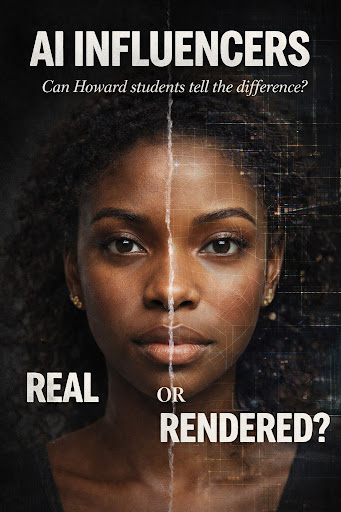
Digitally-generated characters designed to look and act like real people, known as “AI influencers,” are becoming increasingly common across social media platforms. Some of the more popular accounts now feature avatars modeled after Black women, raising questions among the Howard University community about digital representation.
These digital avatars draw large amounts of attention. On TikTok, accounts like @nianoir.xo have amassed 2.6 million followers by performing trending dances with videos that have reached 320.3 million people. On Instagram, an Artificial Intelligence (AI) model, @ayannasoblack, poses in bikinis and appears digitally placed in packed soccer stadiums, posting for an audience of more than 600,000 followers. While these figures appear relatable, they are programmed by developers who profit from these digital Black personas.
“We call that digital Blackface,” said Dr.Christine McWhorter, a journalism professor at Howard University and informative TikTok content creator, in a recent TikTok where she breaks down how AI influencers are built, who designs them, what they reveal about digital audiences and who ultimately benefits from their visibility.
She describes the trend as less about technological advancement and more about the continued circulation of Black identity online.
“A lot of the time, people creating these Black AI characters aren’t even Black themselves,” McWhorter said. “They’re just capitalizing off of Black identity.”
McWhorter explains that the success of these digital personas is not accidental. She pointed to a study, testing the effect of consumer-model racial congruency on consumer behavior, showing how racial familiarity shapes trust and consumer behavior.
“Studies do show that people are more likely to trust or buy from somebody [who] looks like them, especially when it comes to racial or cultural cues,” she said.
For Black content creators watching this unfold in real time, the issue becomes personal. On TikTok, Black women creators discuss their struggle for visibility, consistent engagement and long-term support in an already crowded algorithm.
While many Black women work to build audiences through personality and community, avatars modeled after them are gaining attention and profit without labor or emotional investment. To Haili Powell, a sophomore jazz studies major from Dallas, Texas, that contrast makes the trend feel less like innovation and more like replacement.
“It’s very interesting to see the type of archetypes to choose,” Powell said. “It’s either the ‘Mad Black Woman’ archetype, where they have videos of a person eating fried chicken and telling a story, or they have examples of the ‘Model’ archetype, where it’s a very beautiful, possibly Sudanese girl who favors Anok Yai and she has the darkest, most beautiful skin.”
When examining AI influencer content, Powell doesn’t see range, but instead, Black womanhood filtered into extremes. Powell explains that those portrayals flatten Black women into spectacle rather than identity.
“It doesn’t show any versatility that Black women have and as a content creator, it diminishes the purpose of having certain influences because these aren’t real people. They can’t influence anything,” she said.
Powell’s frustrations are reflected in a 2025 research study, Why Can’t Black Women Just Be? Black Femme Content Creators Navigating Algorithmic Monoliths, which explores the experiences of Black women creators on TikTok and how their identity affects those experiences.
The study concludes that “social media algorithms amplify images of Black suffering, thus perpetuating a narrow, one-dimensional, monolithic view of Blackness.” Participants echoed this reality, describing how their content is often marginalized when it does not align with those imposed narratives.
For Powell, the issue is magnified by the existing culture, one already overwhelmed with performance and inauthenticity.
“I think that the influencer market is already oversaturated with humans who are fake and unauthentic and then to have it saturated with robots and generated images that are now trying to influence you to do or like certain things,” she said. “It’s just another threat to creatives, if you create this thing, we can just take what you do and create a machine that can do it ten times a day instead of twice,” she said.
For Jacob Ecevarria, a sophomore interdisciplinary studies major from Belmont, North Carolina, the rise of AI influencers reflects patterns he has long observed in video games and digital media, where representation is often framed as progress while functioning as an engagement strategy.
Before AI avatars entered social media, Echevarria said similar dynamics shaped gaming culture, in which character customization is marketed as inclusion but rarely redistributes power.
“I think tech developers’ POC representation definitely affects users’ engagement with those platforms,” Echevarria said.
He explained that engagement often determines which characters are added and how they are used. While the inclusion of POC avatars may spark online debate, he said those conversations rarely translate into lasting change. Specifically, live-service games like Fortnite are characterized by engagement fueled by gamer loyalty and addiction.
“A lot of these digital creators can make or do whatever they want with a lot of these characters because at the end of the day, people who complain on the internet will still buy and play a lot of these games,” he said. “It is a discussion for engagement and not a true critical discussion for change.”

For that reason, he said, he approaches corporate representation with skepticism, reflecting his current observations of these AI influencers.
“Unfortunately, I don’t trust the inclusion of diversity from video game studios or developers,” said Echevarria. “Usually because it’s from people who aren’t fully participating in the culture.”
The rise of AI-generated Black avatars is often framed as technological progress, but students argue that the innovation carries an underlying irony. While Black likeness is being replicated and monetized, Black communities continue to absorb the environmental, cultural and economic costs tied to the systems that support that technology.
“Al is polluting Black communities, especially in the south where I’m from. Places like Memphis, their air is being polluted. We just learned that Al used more water than the water industry in order to produce this year. It’s [AI] just something that I am avidly against,” Powell said.
As Black faces circulate more widely through artificial platforms, the people behind those identities become easier to overlook. That shift changes how audiences relate to culture itself. Leaving digital representation and replacing lived experience with images that feel accessible but remain detached from reality.
“People see and believe in the identity and imagery of characters generated from computers that don’t exist and for some reason believe that there is accurate representation for both,” Echevarria said. “Now, actual Black individuals can be completely cut from the process.”
Copy edited by D’Nyah Jefferson – Philmore