

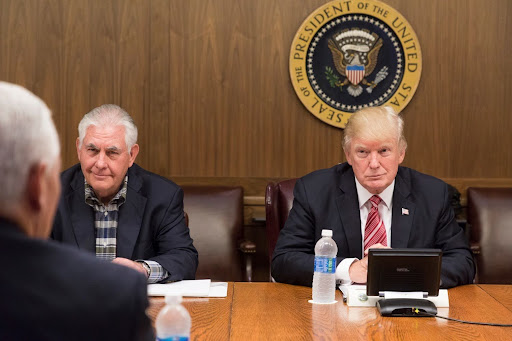
The White House released an address announcing President Donald Trump’s decision to sign a proclamation extending entry restrictions and limitations to five additional countries in Africa last December.
The decision has triggered widespread public concern, as the ban now prevents African students from securing U.S. visas. Current international students have expressed worry, while prospective students fear the new restrictions will prevent them from accessing education in the U.S.
Entry restrictions under Proclamation 10949 originally targeted citizens from 12 countries, including Afghanistan, Burma, Chad, the Republic of the Congo, Equatorial Guinea, Eritrea, Haiti, Iran, Libya, Somalia, Sudan and Yemen. Trump’s recent expansion of the ban adds five nations, primarily in Africa, including Burkina Faso, Mali, Niger, South Sudan and Syria. As a result, individuals from these countries face a complete suspension of both immigrant and nonimmigrant visas, preventing them from seeking opportunities for work, study or tourism.
Partial restrictions have also been imposed on countries such as Angola, Antigua and Barbuda, Benin, Côte d’Ivoire, Dominica, Gabon, The Gambia, Malawi, Mauritania, Nigeria, Senegal, Tanzania, Tonga, Zambia and Zimbabwe. Citizens from these nations are now ineligible for immigrant visas and specific nonimmigrant categories, including student, visitor and exchange visas.
The White House address states that the restrictions and limitations enacted under the proclamation serve as a necessary measure to protect U.S. border security and safeguard public safety interests. According to the Trump administration, these measures are essential to preventing the entry of foreign nationals who may pose a threat to the United States. The address also mentions that the decision was made based on several factors, including persistently high visa overstay rates, refusal of certain nations to share crucial passport exemplars or law enforcement data and concerns regarding government instability in the specified countries.
While the expanded ban cites national security concerns and perceived governance deficiencies as justification for targeting such countries, particularly in Africa, affected African nations such as Mali and Burkina Faso have responded by imposing reciprocal bans on U.S. citizens.
Mali’s Ministry of Foreign Affairs stated that “the changes were being introduced as a matter of reciprocity and with immediate effect.” Similarly, Burkina Faso’s Foreign Affairs Minister, Karamoko Jean-Marie Traoré, affirmed that Burkina Faso “remains committed to mutual respect, the sovereign equality of states, and the principle of reciprocity in its international relations.”
Despite the implications of the ban, Burkina Faso and Mali responded to what they viewed as unequal treatment of their citizens in efforts of demonstrating their nations’ commitment to fairness and solidarity.
Full and partial travel bans have significantly impacted both current African international students in the U.S. and prospective ones. Bimpe Femi-Oyewo, founder of a Nigerian education consulting firm, spoke about the impacts of the ban on African students. Oyewo said that education serves as a vital tool for access and opportunity by unlocking the potential of young individuals.
Oyewo described the bans on African countries as “exhausting and heartbreaking,” noting that students are experiencing confusion, fear and hurt. She also highlighted the tightening of international admissions due to broader political pressures, the reduction in DEI scholarships and increased scrutiny of universities, further complicating pathways for African students seeking to study in the U.S.
“This moment has forced us to rethink timelines, rework application strategies and extend our support far beyond what we anticipated at the end of the year. It’s stressful. It’s emotionally draining. And it’s deeply unfair to students who have already proven they belong,” Oyewo said.
Femi Emmael, an international computer science student at Howard University, further emphasized the implications of the recent travel ban. Emmanuel expressed that the policy has impacted his post-graduation plans by creating barriers such as fewer scholarship opportunities, higher employer denial risks and heightened difficulty traveling into and out of the U.S.
“As travel to the U.S. becomes increasingly uncertain, we are unable to visit our families, and the new ban has made it nearly impossible for them to come see us,” Emmael said.
Copy edited by Kennedi Bryant