
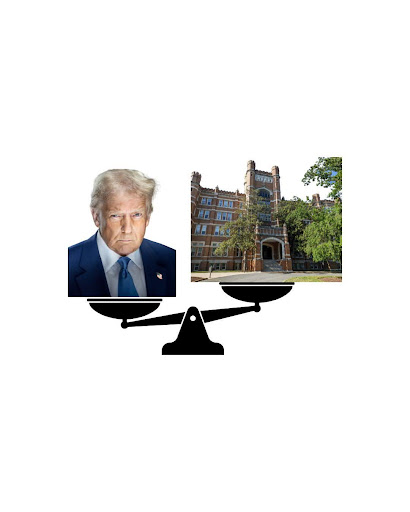
Students from the Howard University School of Law Civil Rights Clinic, under the leadership of Professor Kristen Clarke, filed an amicus brief in District of Columbia v. Trump, a case examining the deployment of the National Guard in Washington, D.C.
The brief was written on behalf of faith leaders across the District and examines how the National Guard’s deployment has affected residents’ ability to gather and practice their faith freely. Ten student attorneys in the Civil Rights Clinic collaborated on the brief, which was researched, drafted and filed in just over a week after being assigned on Sept. 8.
Josephina Nimarko, a third-year law student and student attorney at the Civil Rights Clinic, said she is happy to do the work of the clinic.
“Civil rights work has always been important to me, so it’s definitely one of those once-in-a-lifetime opportunities,” Nimarko said.
Explaining the group’s assignment, Nimarko described what it means to write an amicus brief. It is a ‘friend of the court.’
“We wrote it in support of D.C. The brief provides a perspective that we don’t always talk about,” she said. “We have to talk about the practical, day-to-day effects that legal decisions have on people in the community.”
She said the team wanted to show how legal decisions directly affect residents’ lives.
“We talked about how the law was not applied correctly, and then we provided perspectives from faith leaders across the city,” she said. “We got diverse perspectives, including from a synagogue, just to show how the deployment affected day-to-day people and their ability to have a place of worship.”
According to Nimarko, the original scope of the brief was broad but later narrowed as the students began hearing from community members.
“We were going to highlight how people’s lives were affected, but most of the people who responded were speakers and pastors. We decided that would be unique and more narrow,” she said.
Nimarko said connecting with D.C. residents was one of the most meaningful aspects of the project.
“It was about two or three days after we started the assignment that people began reaching out to share their experiences,” she said. “Most of us in the clinic aren’t from D.C., so this allowed us to see the day-to-day lives of churches that have been here since the civil rights era.”
The short timeframe, Nimarko explained, added pressure to the project.
“The turnaround time was really fast,” she said. “There are a lot of small rules about things like font size, margins and footnotes that can affect whether the court accepts the filing. We had to pay close attention to the details.”
Even with the tight schedule, Nimarko said the experience motivated her to keep pursuing civil rights work.
“In this day and age, it’s hard to see people our age leading initiatives,” she said. “It’s inspiring to see how many students are doing the work. It encourages you to want to do the work too.”
She added that learning under Professor Clarke’s guidance had been invaluable.
“It’s one thing to work in a clinic, but it’s another to learn under one of the great civil rights attorneys,” she said. “I’ve learned so much this semester because of her leadership.”
Nimarko said she learned that justice requires community.
She also reflected on what she hopes D.C. residents and readers take away from the experience.
“Don’t lose sight of what the community means and what it does and the role it’s played in D.C.’s history,” Nimarko said. “Just one quick deep dive on one of the oldest Black churches and the role it’s played can change how you view the community.”

Frantzy Luzincourt, a second-year law student and student attorney at the Civil Rights Clinic, from Brooklyn, New York, described the team’s purpose in filing the brief.
“Our role in the District of Columbia v. Trump was filing a brief…in support of the attorney general’s motion to challenge and stop the president’s deployment of the Federal Guard,” Luzincourt said.
He said the biggest challenge came from balancing community testimony with legal arguments.
“We argued that the National Guard’s presence had a chilling effect on people’s ability to worship freely and that it placed an undue burden on resources on faith institutions,” he said.
For Luzincourt, meeting with faith leaders made the law come alive beyond the classroom.
“Oftentimes the law is seen as abstract,” he said. “Having this experience made what I learned in theory real. When I pulled up to a church and the congregants said they appreciated our work, that’s what reinforced why I came to Howard.”
He recalled that what stood out most was how quickly the team mobilized to meet the filing deadline.
“We got the information on this brief less than a week before it was due,” he said. “The way our team coordinated, shared tasks, and stepped up showed that we knew this was bigger than us. We had a mission, and we took advantage of the opportunity.”
Luzincourt said Professor Clarke’s leadership was essential throughout the process.
“Professor Clarke is one of the greatest civil rights attorneys we have in the country,” he said. “Her work with the DOJ Civil Rights Division and her leadership were paramount. She pushed us not just to be great students, but to be great attorneys.”
Clarke previously served as assistant attorney general for the U.S. Justice Department’s Civil Rights Division and has built a career in civil rights enforcement, voting rights protection and legal advocacy, according to the Howard University School of Law.
He added that Clarke continued to support students even after the brief was filed.
“Even after the filing, we had a debrief about how we could improve our writing and be better civil rights attorneys,” Luzincourt said. “This opportunity she gave us was the most realistic experience of what it means to be a civil rights attorney at this institution, and I’m forever grateful for it.”
Kyla A. Warman, a second-year law student and student attorney at the Civil Rights Clinic, said Clarke’s leadership helped shape how the team focused their efforts.
“Professor Clarke’s perspective was really insightful in deciding who we should focus on,” Warman said. “She helped us decide to center on the Black faith community after analyzing other briefs and finding gaps in representation.”
Warman stated that one of the greatest challenges was translating interviews into persuasive legal arguments.
“I think what makes it challenging is that we didn’t have numbers,” Warman said. “We were only able to focus on the interviews we conducted, so finding the through line of those interviews and translating that into something with legal force was key.”
Reflecting on how the experience shaped her perspective on advocacy, Warman said it strengthened her sense of purpose.
“This really encouraged and empowered me to want to be a lawyer who serves people,” she said. “It begins by building relationships and trust. We didn’t start with a conclusion already. We allowed the community to build our conclusion and the amicus brief rather than the other way around.”
Warman said they have a responsibility to keep fighting for D.C. residents and beyond.
“Our voices and our lives matter,” she said. “Representation brings hope. Justice isn’t just about winning, it’s about showing up, speaking the truth, and refusing to be silent.”
Obinna Okegbe, a third-year law student and student attorney at the Civil Rights Clinic from California, explained that the team’s role was to represent the perspective of D.C. faith leaders.
He said the team relied on testimony from religious leaders throughout the District.
“We went around and asked faith leaders what they were seeing,” he said. “They told us that people were scared to go to church and even to move around D.C.”
After the brief was submitted, Okegbe said seeing it mentioned in court confirmed that their work made an impact when the brief was mentioned during the hearing.
Reflecting on the current political climate, Okegbe said the experience reinforced his belief in the power of both community and law.
“It’s a crazy time right now…,” he said. “But there are still legal ways to challenge what’s happening. Don’t lose faith. In addition to community organizing, there are legal avenues to fight.”
He added that staying hopeful is essential despite the uncertainty.
“We can’t go into nihilism and think everything is over. We have to keep fighting,” Okegbe said.
Copy edited by D’Nyah Jefferson – Philmore