

Of all the sweeping changes President Donald Trump has enacted in his second term, perhaps the most overlooked — and most consequential — is the rapid dismantling of six decades of civil rights progress and Supreme Court precedent that has left Americans questioning their trust in our judicial systems.
Trump’s second-term agenda has accelerated the conservative base’s long-standing legal goals and exposed how our legal institutions have become polarized with the Supreme Court itself becoming a political actor. The rapid erosion of court precedent, ethics and public trust signals to the American people that the court’s legitimacy is now constrained by partisanship and not in alignment with the public views on social issues.
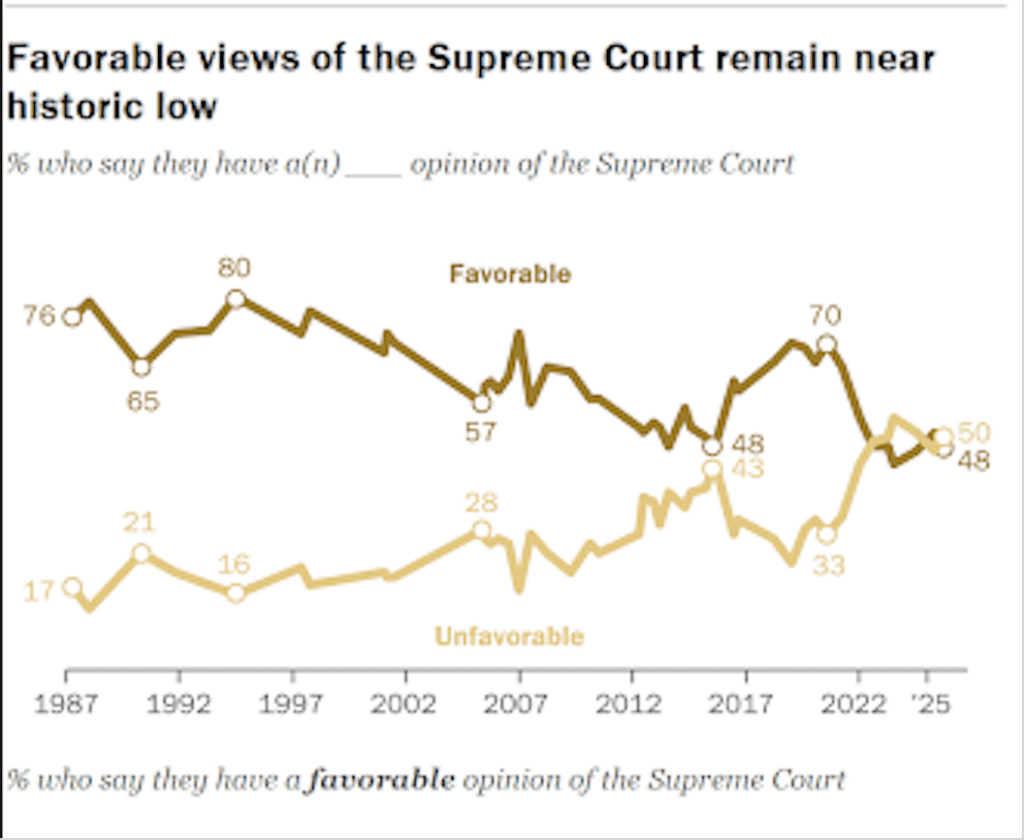
Favorable ratings of the Supreme Court have declined dramatically since the late 1990s. According to a Gallup poll, 58 percent of Americans “disapprove” of the job the court is doing, which aligns with 60 percent of people surveyed who disapproved of the court overruling the right to an abortion.
The court’s wounds are entirely self-inflicted, as the justices refuse to abide by the ethical standards that govern every other federal judge — and routinely decline to recuse themselves in cases where their impartiality is in doubt by the public.
Additionally, details have come to light of relationships some justices have had with wealthy ideological benefactors, including those with interests in past cases. The court’s credibility and the public’s acceptance of its decisions depend on a sacred trust that should not be open to outside influence. Justices Clarence Thomas and Samuel Alito, who have both been accused of impropriety by the media, should step down immediately to restore some semblance of dignity on the court.
Not only has the American people lost faith in the Supreme Court, but in the judiciary system as well. More than three dozen federal judges have told The New York Times that the Supreme Court’s flurry of emergency decisions is hurting the judiciary’s image and has left them confused about how to proceed in matters regarding the Trump administration. In interviews, federal judges — nominated by Republican and Democratic presidents — called the Supreme Court’s emergency orders “incredibly demoralizing and troubling” and “a slap in the face to the district courts.” One judge said the courts were in the midst of a “judicial crisis.”
To remedy the controversial actions of the Supreme Court justices and to align more with the American people in today’s age, the federal government needs to implement term limits for justices and the American people, through their duly elected representatives, should call for the impeachment of sitting justices.
While conservative Justice Amy Coney Barrett says the country is not in a “constitutional crisis” and that the Constitution is “alive and well,” Justice Ketanji Brown Jackson says “the state of our democracy” keeps her up at night. Indeed, we should all be concerned about Trump’s growing power as he enabled employment discrimination by federal contractors, slashed and shuttered civil rights offices across nearly every federal agency, and gutted the Department of Education along with the Department of Justice’s Civil Rights Divisions.
Outnumbered by the conservative supermajority on the court, Justice Jackson and the other two liberal justices have had to watch from the sidelines as critical constitutional laws that have been settled for half a century are torn up by the very court on which they sit.
The truth is, Chief Justice John Roberts and the conservative majority have been eager to have the opportunity to review long-standing court precedents and reshape them to fit their ideological agenda. So far, the list of casualties includes the right to an abortion, affirmative action, environmental protections, voting rights, the mass-purging of federal employees, deporting migrants to war-torn countries and withholding billions in funds intended for international development and global health programs already approved by Congress.
Justice Jackson has warned the public of how the rule of law has been subverted, and called recent Supreme Court decisions “profoundly dangerous” and “existential threat[s]” to the foundation of our democracy. The Guardian writes that in her dissenting court opinions, Justice Jackson draws parallels between the drift in jurisprudence on the Supreme Court to “the legal structure of Nazi Germany.”
In over 20 recent decisions, the Supreme Court used a shortcut called the emergency docket, often called the ‘shadow docket,’ to shortcut the litigation process and expand the powers of the presidency. The Supreme Court is playing along, giving Trump everything he wants as the justices bend over backward to accommodate his wishes.
Furthermore, the Supreme Court enabled the Immigration and Customs Enforcement’s (ICE) masked agents to grab people who they think might be undocumented, on the basis of skin color or because they were speaking another language.
The Supreme Court is also considering whether the police can enter a home without a warrant, whether Trump can fire government officials for no reason and a Colorado law barring mental health professionals from practicing conversion therapy.
While justices on the Supreme Court have repeatedly insisted that their decisions are insulated from politics, their actions tell a different story — and they are not convincing the American people any longer. The cumulative effect of Trump’s second-term agenda, the court’s ethical lapses and the conservative majority’s aggressive rewriting of long-standing precedent is a constitutional crisis in plain sight — with the court abandoning its role as an impartial guardian of civil rights. As the court continues to greenlight executive overreach, weaken individual liberties and erode public trust, it is clear that the legitimacy of our highest judicial body is hanging by a thread.
Copy edited by Daryl R. Thomas Jr.