

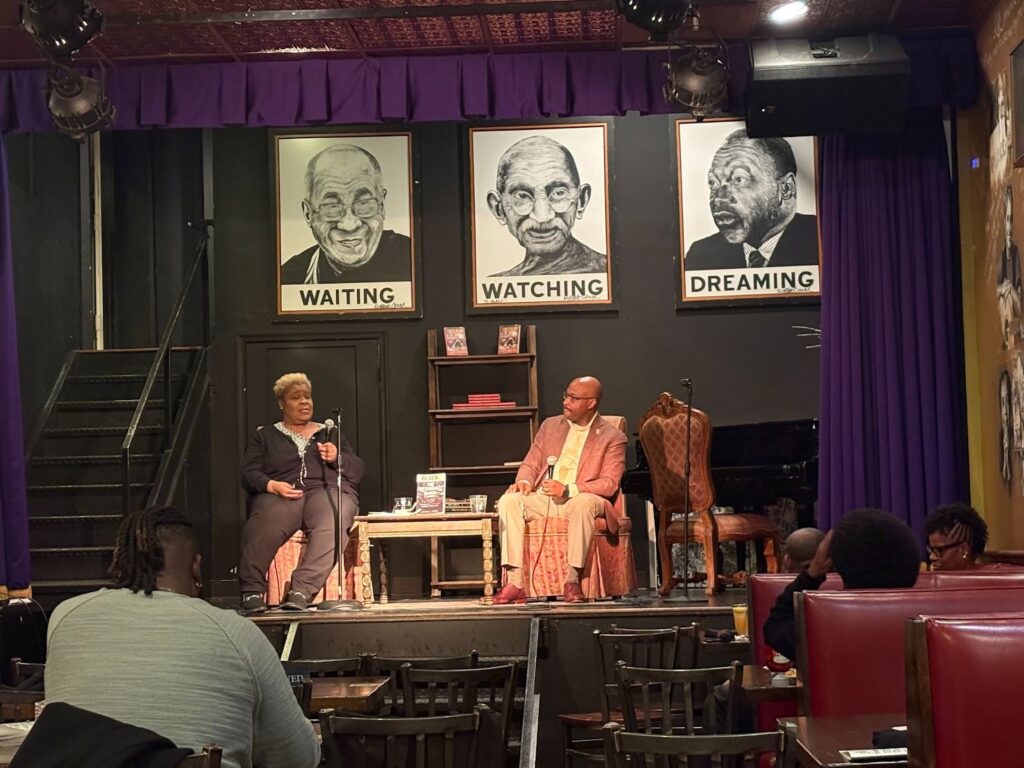
Students, community members and scholars gathered at Busboys and Poets for a public conversation and book signing with political scientist Joseph L. Jones, whose new book, “Black, not Historically Black,” examines the internal challenges facing Historically Black Colleges and Universities (HBCUs).
The event featured a panel discussion moderated by Melanie Carter, associate provost and director of Howard University’s Center for HBCU Research, Leadership and Policy.
The conversation centered on Jones’s critique of leadership and systemic practices within HBCUs, arguing that meaningful progress requires transparency and accountability from people in positions of power along with a willingness to confront longstanding internal issues.
Jones, who currently serves as the executive director of W.E.B. Du Bois Southern Center for the Studies in Public Policy and is an associate professor of political science at Clark Atlanta University, said his goal is to start honest dialogue about how HBCUs can better serve their students and communities.
“We stopped having public conversations around some of the things that are going on in our institutions. What this book is about is for us to have an honest conversation around how we can improve our institutions so they could be more healthy and more functional,” Jones said.
The book emphasized HBCUs as a center for preparing, educating and fostering Black leaders who pour into the surrounding Black community and their respective fields.
In the discussion, Jones outlines his central argument of the book: while HBCUs have historically nurtured and developed generations of Black leaders, many continue to struggle with core infrastructure and administrative challenges. He highlights the shortcomings of HBCUs that prioritize accreditation over student well-being.
“The book ‘Black, not Historically Black’ is about trying to take HBCUs to the table of accountability and for us to deal with what I’m calling our internal contradictions. So our issues with leadership, our issues with finances, our issues with organizational culture; trying to shed light on it so that we can do better,” Jones said.
In the book, Jones suggested that presidents and board members who allocate money are the ones to blame for failing structures at HBCU like housing and financial aid.
Jones argued that HBCU leaders must be willing to acknowledge their role in perpetuating ineffective systems. He challenged students and alumni to voice concerns without the fear of external judgment, by first giving the administration an opportunity to meet and reform policy then taking issues to the media if necessary.
Further suggesting that change for the better will not come unless the community talks about the issues out loud and support each other.
Jones draws on the impact of the Civil Rights Act of 1964, discussing a time when Black people had no choice but to support Black institutions. He believes integration redirected Black intellectual and financial resources away from HBCUs.
Jones emphasized the importance of legitimizing HBCUs to keep them relevant.
“By legitimizing an institution, you’re telling the rest of the world that without said institution, you wouldn’t be where you are today. For this reason, the institution and its students must be protected, funded and served,” said Jones.
Alexis Hawkins is a graduate student of the Howard University Political Science master’s program who attended Jones’s panel. She graduated with a Bachelor of Arts from Clark Atlanta University in 2023 and is a former student of Jones. She plans to earn all her degrees from HBCUs and said Jones’s critique reflects what many students experience firsthand.
“No matter how many times you’ve been to an HBCU, how many degrees you got from an HBCU, you can take one look around and you’ll see issues such as a housing crisis and financial aid. These funds that we’re getting, where are they going?” Hawkins said.
She added that students often face the consequences of leadership failures.
“Within a lot of HBCUs, there is a toxic leadership environment and cycle that happens. Because on the top, if the president allows the provosts and the vice president, then allows a dean to do things that are not ethical, then it’s going to just become a cycle, and they’re going to think it’s okay. Then you have student leaders thinking, ‘this can’t hurt,” Hawkins said.
Copy edited by Damenica Ellis