

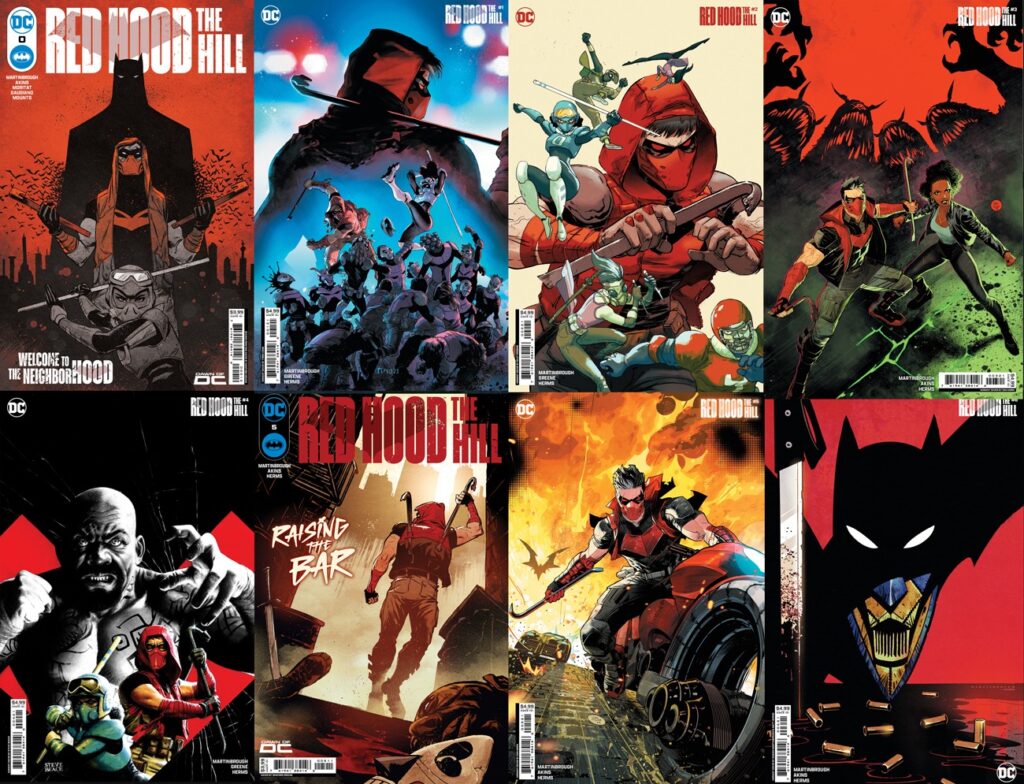
DC Comics released a new trade collection of the comic series “Red Hood: The Hill,” written by Shawn Martinbrough and illustrated by Sanford Greene and Tony Akins. Martinbrough turns toward The Hill to consider how communities safeguard what is theirs on their own terms.
The Hill, a predominantly Black neighborhood in Gotham, first appeared in a one-shot Batman story Martinbrough co-created in 1999. At the time, it was depicted as a neglected part of Gotham, physically and politically isolated from the rest of the city.
Two decades later, “Red Hood: The Hill” revisits the neighborhood after gentrification, development pressure and cultural displacement reshaped its boundaries. Martinbrough’s return to this community foregrounds the residents who built it and the systems they created to keep it intact, alongside the lack of Batman’s presence in their neighborhood.
“The people who lived on The Hill were like, ‘Who is Batman?’ We hear whispers about him, but he’s just some white dude in a cape,” said comic writer and artist Martinbrough.
The collection gathers the full arc featuring characters like Red Hood, Batman and a cast rooted in The Hill itself, where protection is carried out by the people who live there — not out of heroism, but necessity.
That work takes shape through residents like Dana, a business owner who defends her block when police and city systems fail; her twin sister Denise, a journalist pushing for accountability through policy; and Demetrius Korlee Jr., a developer behind the “Godmode” fashion empire, whose vision of “uplift” threatens the same culture that built The Hill.
For Martinbrough, narrative reflects the ways Black communities sustain themselves when institutions fail, overlook or abandon them.
“Not all stories have to have the big bad guy that’s coming to destroy the planet. Some stories can be more grounded and really reflective of your community, your group of friends, your issues,” Martinbrough said.
Martinbrough, the first Black creator to draw the regular Batman “Detective Comics” comic series in 2000, has consistently pushed for stories rooted in the everyday realities of Black life, community care and inherited responsibility throughout his career.
Martinbrough said he wanted to portray Jason Todd — a variant of Robin who was tortured by the Joker and later returned as the vigilante Red Hood — in a different light. Martinbrough shifts Todd away from the familiar cycle of vengeance and conflict, instead positioning him in a community that must protect itself.
“I really liked the idea of showing a different side of Jason Todd. I wanted to take him out of there and have him set in the new environment where he actually is seeing people having a normal life. Hanging out, going to dinner, making friends and camaraderie,” Martinbrough said.
Todd is not the savior of The Hill. The Hill teaches him something: protection comes with accountability to the people who have to live with the aftermath.
During the Joker War, when Gotham was burning and outside institutions were overwhelmed or absent, residents of The Hill organized to protect their own streets.
“The residents banded together to protect their neighborhood. Some of them became vigilantes, patrolling at night and making sure nothing bad happened,” Martinbrough said.
Their ability to fight did not come from nowhere. Miss Asha, a former member of the League of Shadows, offered training to anyone who asked without discerning motive or intention.
“She didn’t take the time to discern who she was giving this power to. So she was arming people both good and bad with these tools,” Martinbrough said.
The Hill is held together not only by those who act now, but also by the memory and guidance of those who came before. Martinbrough threads this through the story in the relationships between elders and the younger figures who inherit both responsibility and conflict. The passing down of protection is not a smooth process; it is a negotiation.
“I thought it was very important to represent different age groups in the story because I feel like there’s always a conflict between young and old, especially in [the Black] community,” Martinbrough said.
Miss Asha models one form of lineage: knowledge shared freely, without judgment. Demetrius seeks counsel from his father in a quiet home of upstate Gotham, grounding ambition in something steadier. Jason now finds himself in the role of Batman, urging caution instead of acting on impulse.
“There’s this constant referencing of young and old having to work together, or relying on each other. I thought that was important to show,” Martinbrough said.
By the time Batman enters the story, the neighborhood has already learned how to defend itself. Jason Todd is not the returning savior; he is one more person learning the weight of belonging. The Hill does not ask to be rescued, but rather to be recognized.

“I think the Hill really emphasizes the individual power that we all have as citizens. You can just rely on this savior to come in and solve your problems. You have to be invested in yourself,” Martinbrough said.
The Hill becomes a place where protection and accountability are shared responsibilities, not heroic performances.
“If you live in a community, you want to protect that community. You should get involved in local politics. Know who your local assembly people are. If your garbage isn’t getting picked up, you call them. You get plugged in,” Martinbrough said.
For Martinbrough, storytelling is not abstract. It is rooted in how people show up for one another and how they remain connected across change.
“If you don’t engage, someone else is going to engage, and then you’re at the mercy of them,” Martinbrough said.
Copy Edited by D’Nyah Jefferson – Philmore