

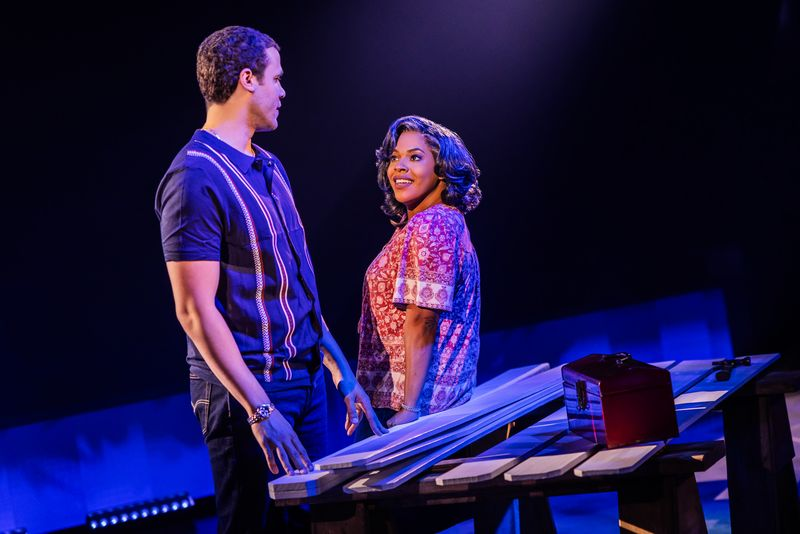
The “Damn Yankees” revival at regional theatre Arena Stage updates the original story to include a Black and Latino cast, causing backlash from conservative publications such as Chronicle Magazine and City Magazine, which criticized the show for being “wokeified.”
Four out of the seven shows of Arena Stage’s 75th anniversary season portray Black actors on stage and at least some Black creative direction behind the curtain.
Two of these shows are reimaginings of mid-twentieth-century all-white Broadway classics with Black main cast members, including the highly praised opening show of the season “Damn Yankees,” which will run its final performance on Nov. 9.
The musical, now set in 2000 instead of 1955, changes little of the Golden Age style it is adapting, showcasing grand jazz numbers and show tunes alongside a heartfelt narrative. The sentimental story follows leading man Joe Hardy, played by Jordan Donica, as he theatrically struggles with his dual temptations of playing baseball for the Baltimore Orioles and returning home to his wife Meg Boyd, who is portrayed by Bryonha Marie.
Many theatre-goers left with smiles on their faces after experiencing a stage transformed by a cast performing captivating choreography and songs, according to Howard alumna Jordyn Taylor. She is part of the ensemble and the understudy for Sister in “Damn Yankees.”
However, alongside her praise for the show, Taylor also said “Damn Yankees” exemplifies how revivals that cast Black actors in traditionally white roles can fall short in making commentary about racial issues.
Taylor referred to the added backstory and character motivation of Joe Hardy’s father experiencing racial discrimination that prevented him from playing baseball in the major leagues.
“Coming from an HBCU, we are very radical in our thinking,” she said. “[Damn Yankees] was a very digestible take on race.”
Donica, when asked about the portrayal of racial issues in the show, focused on the origins of the musical as a classic Faustian tale, as Joe Boyd literally sells his soul to the devil in order to return to his younger body and become Joe Hardy.
“Understanding it as a piece of fantasy more than a piece of reality is always the best first step to take with a piece like Damn Yankees,” he said.
For Donica, deeper themes regarding the race of the characters become up to the interpretation of the audience when the show’s focus is on dancing and having a good time.
Sophie Lee, a double major in biology and bioethics from Marietta, Georgia, saw the musical and said she was unsatisfied with the emphasis on subtext.
“They didn’t talk about how Black people now are treated in the major leagues,” she said.
Lee referred to a 2024 study that showed between 2000 and 2019, Black and Latino players were still promoted from the minor leagues at a disproportionate rate compared to their white counterparts, even when they performed better.
Lee also felt a dissonance when Joe Hardy would lament about the harm done to his father in one scene and then, in another, salute the flag, sing the national anthem and praise the league and country that discriminated against him.
While Joe Hardy never grapples with expressing patriotism, Donica shared his own internal struggle to perform part of the national anthem.
“I don’t sing that song. I’ve sung it one time in my career,” he said.
In conversation with the director, Donica came to understand how Joe Hardy, being a Black man, changes that moment from one of pure patriotism to a political statement in which he can reclaim his rights as an American that were not given to his father.
Donica mentioned how other plot elements, like a drug scandal, a man walking out on his wife and scenes where Joe Hardy shows anger and emotional vulnerability, also mean something different to an audience that knows the stereotypes associated with Black male athletes.
However, conversations about stereotypes are not explicitly addressed in the script’s text.
“The Year the Yankees Lost the Pennant” by Douglass Wallop, the novel in which the musical was based, was published on Sept. 9, 1954.

Originally, the Washington Senators, a former Major League Baseball team based in Washington, D.C. until 1961, were written as Joe Hardy’s team.
Carlos Paula, the Washington Senators’ first Black player, had debuted just three days prior.
When a piece is written for a Black character, that character’s racial identity and cultural experiences become an interwoven and intractable part of the art. “Damn Yankees” exemplifies the difficulties of trying to weave the thread of a Black life into an already completed white tapestry.
Lee gave the 2023 motion picture version of “The Little Mermaid” as an example of this phenomenon. She said that they changed the race of Ariel, but left the narrative and music unchanged. Lee cited “The Wiz” and “Rodgers and Hammerstein’s Cinderella” as examples of adaptations that incorporate predominantly Black music genres, such as R&B, blues or gospel, into their scores alongside new portrayals of their characters.
“If you’re going to remake a story with an all Black cast, make it Black,” she said.
Arena Stage’s production is not the first time “Damn Yankees” has featured a racially diverse cast. In the 2007 production of the show from Jason Alexander, there was an R&B version of the signature song “Heart” performed by a supporting cast member. This remix is notably absent from the 2025 production.
Niara Phillips, a musical theater major from Brooklyn, said she believes the exclusion of this song and nuanced takes from the show has to do with the fact that “Damn Yankees” is aiming to be produced on Broadway sometime next year.
“Bigger producers do not tend to go for what’s nuanced. They pick up what they think is going to make money,” she said.
Phillips said musical theatre productions that get picked up are traditionally light and fluffy as opposed to those that aim to push boundaries.
Taylor said that putting Black women and HBCU alum in the room is a secondary solution to this issue. Finding ways to fund productions that push boundaries is the first step.
Taylor spoke about a previous experience working at a show with a predominantly Black cast that cut deeper themes related to race.
“We are typically gonna go out there and see white faces. I believe that was the reason why things changed,” she said.
Taylor added that while there is always a need for productions to explore themes involving racism and discrimination in a deeper way, sometimes a light take on racial issues is necessary.
“I think from the minute that we start the play, we’re introducing it with comedy and feel-good, light-heartedness. We don’t get too deep about a lot of things, and I think that that is what people need right now,” Taylor said.
Copy edited by Damenica Ellis