

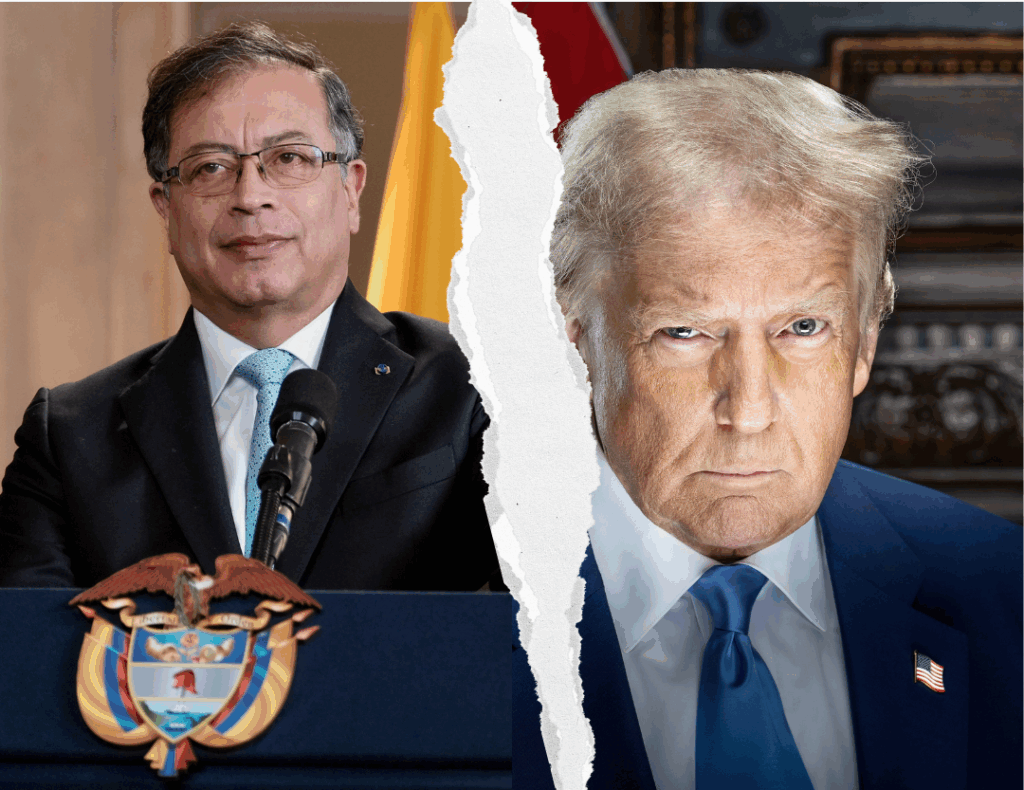
Relations between the United States and Colombia have become increasingly strained under President Donald Trump’s administration. Rooted in longstanding issues such as narcotics production and migration, the conflict has escalated during Trump’s second term.
The tensions now involve accusations of drug trafficking complicity, aid suspensions, sanctions and threats of military intervention. Issues began early in the year with friction over migration policies. On Jan. 26, Trump criticized Colombia on Truth Social for not reaccepting its citizens that were deemed criminals by the United States, threatening economic measures in response.
In the post, Trump said if Colombia did not comply with its “legal obligations” regarding the return of deportees, U.S. officials would impose tariffs starting at 25 percent and increasing to 50 percent the following week, along with travel bans and visa restrictions on Colombian government officials.
Colombia agreed on Jan. 27 to accept deported migrants, leading the White House to suspend the planned tariffs, though a baseline 10 percent tariff was imposed on Colombian imports in April despite the longstanding U.S.-Colombia free-trade agreement.
On Sep. 15, the Trump administration issued a presidential determination designating Colombia as a major drug transit and production country under Section 706(1) of relevant U.S. laws. This move laid the groundwork for subsequent actions, citing increased cocaine production under Colombian President Gustavo Petro’s leadership.
On Oct. 19, Trump took to Truth Social again, labeling Petro an “illegal drug leader” who was “strongly encouraging the massive production of drugs” in Colombia. In this post, which included the misspelling of Colombia as “Columbia,” Trump announced the immediate halt of all U.S. payments and subsidies to the country.
He accused Petro of being “low rated and very unpopular,” saying the decision was a response to unchecked drug flows poisoning American communities. This escalation followed Trump’s threats to suspend approximately $377 million in aid, targeting Colombia’s alleged failure to curb narcotics.
In response to Trump’s Oct. 19 post, Colombian President Petro wrote on X that Colombia had never been disrespectful toward the United States and had, in fact, long admired its culture. Addressing Trump directly, Petro stated that it was the U.S. president who was being “rude and ignorant” toward Colombia.
He urged Trump to read “One Hundred Years of Solitude,” noting that the U.S. embassy’s chief of mission in the absence of the ambassador, otherwise known as chargé d’affaires, in Colombia had recommended it as a lesson in understanding solitude.
Rejecting accusations of drug trafficking, Petro wrote that he was not driven by greed portraying himself as “a lover of life and therefore a millennial warrior for life.”
The Trump administration followed with concrete measures. On Oct. 24, 2025, the U.S. Treasury Department sanctioned Petro and several of his associates under the Global Illicit Drug Trade Act, citing allegations of increased migration and drug trafficking. The action, unprecedented for a sitting Colombian head of state, included the revocation of Petro’s U.S. visa, the first such case involving a Colombian president in three decades.
As of Oct. 31, 2025, the United States has not imposed new tariffs on Colombian exports, with Senator Marco Rubio stating on Oct 25., 2025 that the dispute is directed at Petro rather than the Colombian public.
Jason Marczak,vice president and senior director at the Atlantic Council’s Adrienne Arsht Latin America Center, said “Amid this accelerating decline in bilateral ties, both sides should remind themselves of the historical importance of this relationship in security, commercial and broader geopolitical terms,” in an article published Oct. 23.
According to Marczak, the deterioration of the two countries’ relationship began before Trump’s return to office, tracing back to Petro’s 2022 United Nations speech condemning U.S. anti-drug policy, a core pillar of bilateral cooperation.
“Both parties are at a new low that would have been unimaginable at any point since bilateral ties were strengthened in 2000 with the launch of Plan Colombia,” Marczak wrote, emphasizing that the recent exchanges.
Kevin Whitaker, a former U.S. Ambassador to Colombia and current senior fellow at the Atlantic Council, called the alliance “certainly in a very bad condition. Probably the worst moment in bilateral relations in our 200-year history,” urging more action from Colombia on drugs while critiquing the leaders’ inflammatory rhetoric as “not the way to resolve problems.”
Copy edited by Daryl R. Thomas Jr.