

Jemal Countess/Getty Images
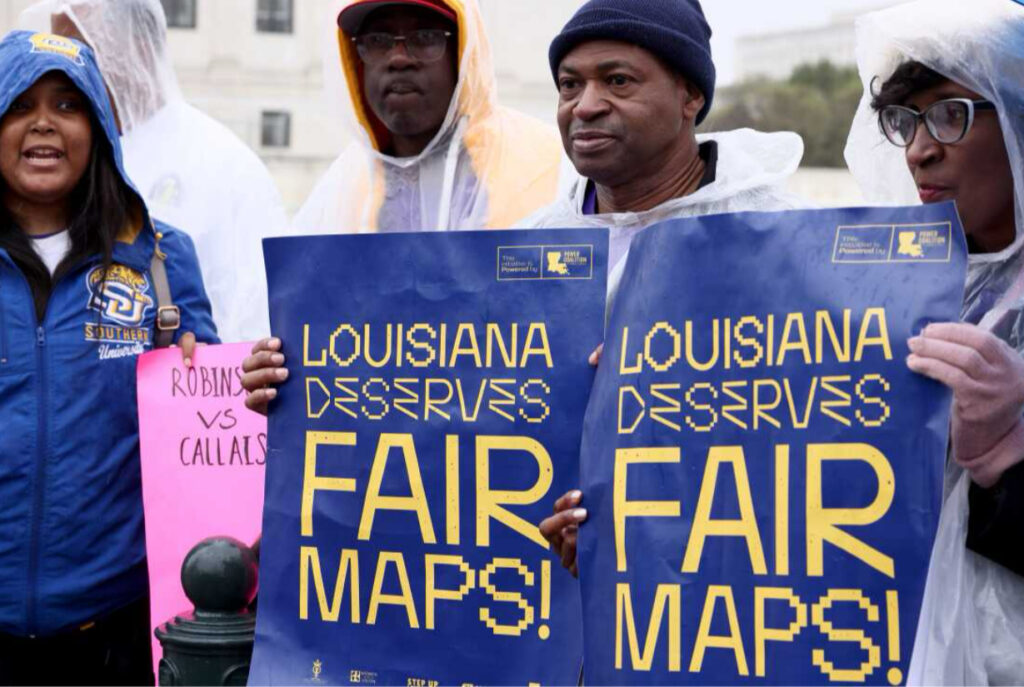
The Supreme Court heard arguments in Louisiana v. Callais, a case that could determine the future of the provision prohibiting racially discriminatory voting practices on Oct. 15. As national political polarization deepens, the voting rights of Black and brown communities and the makeup of their congressional districts face growing uncertainty.
The case puts Section 2 of the 1965 Voting Rights Act under scrutiny. For Richard Johnson, a political science professor at Oklahoma University who holds a doctorate in the field, the case carries weight.
“You can’t put the United States and democracy in the same sentence until the Voting Rights Act happens. That is how fundamental this piece of legislation is,” Johnson said.
Originally passed under President Lyndon B. Johnson, the Voting Rights Act bars voting practices that discriminate on the basis of race. Under Section 2, redistricting must align with demographic data to ensure that underrepresented communities have an equal voice when electing government officials. Section 2 is permanent and applies nationwide wherever its conditions are triggered.
In Louisiana v. Callais, plaintiffs argued that requiring majority-Black districts constitutes unconstitutional, racialized redistricting. If the Supreme Court’s Republican majority agrees, GOP-controlled states may redraw at least 19 southern congressional districts.
Legal analysts warn that this could reduce Black and Latino representation in Congress by nearly a third, a step toward silencing Black and Brown communities in politics.
For Shelby Bennette, a senior psychology major with a minor in criminology on the pre-law track from New Orleans, Louisiana, the proposed rollback of Section 2 raises concern.
“If this redistricting happens, District 6 will now include District 2. It’s insane. On a grander scale, we are looking at representation for Black Louisianians on a federal scale, and we won’t have that representation anymore,” Bennette said.
This case came a decade after Shelby County v. Holder, which weakened the Voting Rights Act by enabling restrictive voter ID laws and cutting early voting, moves that disproportionately suppressed Black voter turnout in 2013. According to the Howard Law Library, the consequences of another rollback could be far broader.
This attempted termination comes amidst a broader effort by the Republican Party to consolidate a national majority. Historically, Black Americans are far more likely to associate with the Democratic Party. According to a 2024 Pew Research study, 83 percent of Black voters identify with or lean toward the Democratic Party. However, only 19.3 percent of the Southern population identifies as Black, according to the Statistical Atlas.
Section 2 is designed to level the playing field — ensuring that redistricting takes into account race demographics and allows communities of color to elect representatives of their choice. Dismantling this protection would make it far more simple to maintain a GOP majority, which would distort the equality Section 2 was designed to preserve, according to NPR.
If Section 2 is overturned, the 19.3 percent of Black Southern residents would see their voting power absorbed into majority-white districts — diluting the Black vote to a fraction of its intended weight. In numerical terms, each Black vote would, in effect, count for significantly less weight and influence. The impact would extend far beyond Congress. Nationally, this ruling would risk re-segregating legislatures, city councils and school boards, according to an article by CNN.
“The administration has tried to move away from race and say, ‘No, because Black voters are predominantly Democratic, it could just as easily be a party issue.’ And I find that a bit of a red herring,” Johnson said. “It’s very important that communities of color, … have the numerical representation that people of color — especially Black voters — have.”
Howard’s legal and political legacy is intertwined with the nation’s fight for civil rights. The university’s law school alumni such as Supreme Court Associate Justice Thurgood Marshall, have redefined Black leadership in America. Reflecting on this legacy, Bennette emphasized the importance of civic awareness amidst this polarization.
“It shows how fragile democracy is, because there’s always a lot of people who will want to take advantage of the loopholes and do not want the best for you. They’re always going to want to push their own agendas,” Bennette said. “If [Section 2 is] overturned, it needs to be a wake up call, you need to go out there and show up ten times more.”
Washington D.C. is made up of 43 percent Black residents, meaning the implications will extend far beyond Howard’s campus. If Section 2 is rolled back, Washington, D.C. ‘s district drawing will be impacted too.
With a robust history of a diverse, politically engaged population, eroding the ability of Black and brown communities to elect representatives could deepen partisan divides and weaken trust in democracy.
Bennette emphasized the legacy and responsibility Howard holds, noting the importance of advocacy.
“When you look at the history of our school, we have to be active,” she said. “As Howard students, especially Howard students from Louisiana, we have to use our platforms. You need to advocate for yourself and your community — no one’s going to save you. You have to save yourself.”
Copy edited by Damenica Ellis