

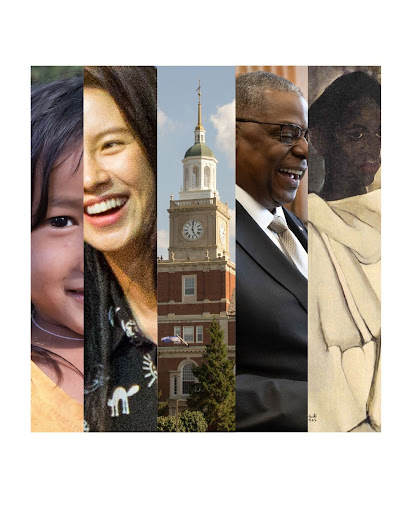
Sociology teaches that society is built on social divides. In accordance with the natural order, social systems cling to arbitrary labels that assign value to individuals. The “tryhard,” the “nepo baby,” the overabundant “social climber” and elusive “opportunistic social butterfly” all have reputations based entirely on external perception and not individual merit.
Similarly, Howard University being labeled “the Mecca” comes with a connotation. Howard, the pinnacle of HBCUs, has a revered student body and alumni association that is nothing to scoff at.
Common among all these labels is the debated identity of a Howard Bison. Who deserves to champion the accomplishment of belonging to this institution? Why are some met with open arms from the student body, and others shunned?
Being a Bison requires you to be willing to grapple with who you are, whether you’re within communities society prescribes you to belong in or not. This is a question that Howard students everywhere are dealing with, regardless of where they are in their journey.
Does advocacy make you a Bison?
For all our gatekeeping about who belongs at Howard, many of us fail to embody what the institution actually stands for. The irony is striking: we debate who deserves to claim the Bison identity while simultaneously neglecting the civic responsibility that Howard’s legacy demands.
This disconnect hasn’t gone unnoticed by student leaders. Eden Boles, the 87th Miss Howard University, has observed this pattern firsthand through her role on campus.
“I was surprised at just how many students don’t vote,” Boles said, shrugging. “A lot of [my campaign trail] involved convincing my off-campus friends [and] my senior friends to vote.”
Our university has produced generations of activists, leaders and changemakers who understood that being a Bison meant political consciousness and engagement. When most students can’t even be motivated to vote in campus elections, we’re essentially cosplaying as inheritors of a tradition we refuse to uphold.
In a public address by the Elections Commission during the Fall Special Election, one officer cited that less than 50 percent of the student body actually participates in student-led elections, with the latest voter turnout being around 17 percent of students.
Perhaps the real question is whether any of us, regardless of background, deserve the title if we’re unwilling to participate in the very activism and leadership that made Howard “The Mecca” in the first place.
Although the majority of us are somewhat absent from political mobilization initiatives—with record-low campus political engagement this year—this couldn’t be any one individual’s responsibility, not even student leaders.
Does race make you a Bison?
I asked Boles what kind of person she considers to be a quintessential Howard student.
“Really anyone, to be honest.” I then asked if “anyone” includes non-Black people. “I mean, sure,” she began, chuckling. “Non-Black students get push back for not representing the majority. But if anyone could change the game, it would be Howard.”
Online cultural attitudes encourage us to be insecure trend followers, imparting judgment on those we deem “less deserving” of the achievements we lay claim to. Maybe what makes a Bison is differentiating yourself from the group.
On that note, I sat with a campus influencer currently taking social media by storm, Amen Hong. Averaging about 75,000 views per post and over 53,000 followers, he could comfortably be classified as a social media influencer. Hong’s most viral post is currently at 6,000,000 views, with over 955,000 likes.
Hong said he is most comfortable around people who are more successful than him. Despite being of Korean heritage, Hong also finds himself most comfortable around Black people, he said, like the students he grew up around in Cleveland, Ohio.
When asked if he has ever experienced imposter syndrome and he looked at me like I had proposed an induction proof to Schrödinger’s cat theory. Quantum physics, anyone?
To Hong, a quintessential Howard student looks like a dreamer, he said. His ambitions led him here, after all. But the larger student body hasn’t always taken well to him and his digital footprint.
Amen’s content on Instagram revolves almost entirely around attending Howard, with undertones of comfort within and appreciation for African American culture. Dissenters online accuse him of fetishizing African American culture or inaccurately representing his experiences at Howard.

“I was naïve to think that [other students] would be cool with me coming. Some just like to hate, but other times people don’t even notice that they’re being bigoted,” Hong said.
Amen is occasionally a hot topic on the popular, forum-based social platform, Fizz, and is met with differing opinions on whether his presence on campus is for the better or worse.
Maybe what makes a Bison is learning to navigate these complex dynamics of belonging and authenticity. This became even clearer when I spoke with Kaia Chebiniak, a bubbly, outgoing sophomore from Boston who brings yet another perspective to the question of Howard identity.
Coming from a majority white area, Howard was actually her last choice among schools. She applied under the strong suggestion of a teacher in her life and remains grateful for that guidance.
Like Hong, she felt somewhat uncomfortable with the potential of being judged. “I didn’t know if people would want me here,” she admitted, referring specifically to other Howard students.
This concern wasn’t unfounded. With a Black mother and white father, Chebiniak has faced questions about her identity that many students never encounter.
“When people call me white, it gets me pretty tight,” she says.
Her mixed heritage creates a unique position within Howard’s predominantly Black community. She said the scrutiny extends beyond casual comments and echoes dated sentiments of economic mobility and social prosperity being limited to cisgender, monoracial Black people.
“It comes from ignorance but also this place of judgement, like ‘I’m blacker than thou.’ But I know who I am,” Chebiniak relented.
The policing of Black authenticity shows up in unexpected ways. Chebiniak notes that in her experience mostly other Black women have been judgmental about her wearing headwraps or waist beads, questioning her right to participate in certain expressions of Black culture and beauty standards. Meanwhile, her white friends were initially hesitant about her attending Howard and “talked trash” about her decision, though those concerns have since subsided.
“My [white peers] said, like, ‘oh, you’re not gonna fit in because you don’t look like them,’ just whatever!” She recalled.
Despite these challenges, Chebiniak said her experience hasn’t been entirely negative.
“I don’t have any complaints about my experience thus far,” she said. “Lots of people do mess with me though.”
In fairness, old-school perspectives on affinity spaces make the topic of non-Black people attending HBCUs a touchy subject. According to Best Colleges, HBCUs existed for Black people to receive higher education after slavery was abolished, but diverted to accept students from all racial backgrounds following racial integration. Although segregation is long-gone, the social stigma for non-Black students encroaching on what once was an affinity space for Black people remains quite real.
In 2023, only 68.8% of all students enrolled at Howard identified as Black or African American, according to the National Center for Education Statistics. In 2022, a different study by the National Center for Education Statistics demonstrated that approximately 24% of all HBCU students identified as nonblack.
As HBCUs receive recognition for academic innovation, their class statistics additionally fall under greater scrutiny. According to National Student Clearinghouse, to drive up retention rates, HBCUs can tangentially accept students with a higher chance of graduating, many of whom are often not Black but are better off financially than many prospective Black college students.
Does anything make you a Bison?
Perhaps it’s the very impossibility of a singular answer–from Boles’ inclusive vision of “really anyone,” to Hong’s dream-chasing ambition despite social media backlash and Chebiniak’s navigation of mixed-race identity in predominantly Black spaces, to the broader student body’s complex relationship with political engagement and social judgment.
The university’s strength may lie not in producing a uniform type of graduate, but in fostering individuals who can navigate complexity, challenge assumptions and carve out their own definitions of success and belonging. Whether you’re the face of campus like Boles, a digital disruptor like Hong or finding your place like Chebiniak, being a Bison seems to require one essential quality: the courage to define yourself on your own terms, even when the community around you isn’t quite sure what to make of that definition.
In the end, perhaps what makes a Bison is simply the willingness to engage with the question itself; to sit in the discomfort of not having easy answers about identity, belonging and purpose, while still showing up authentically to the ongoing conversation about who we are and who we’re becoming.
Copy edited by Daryl Thomas Jr.