

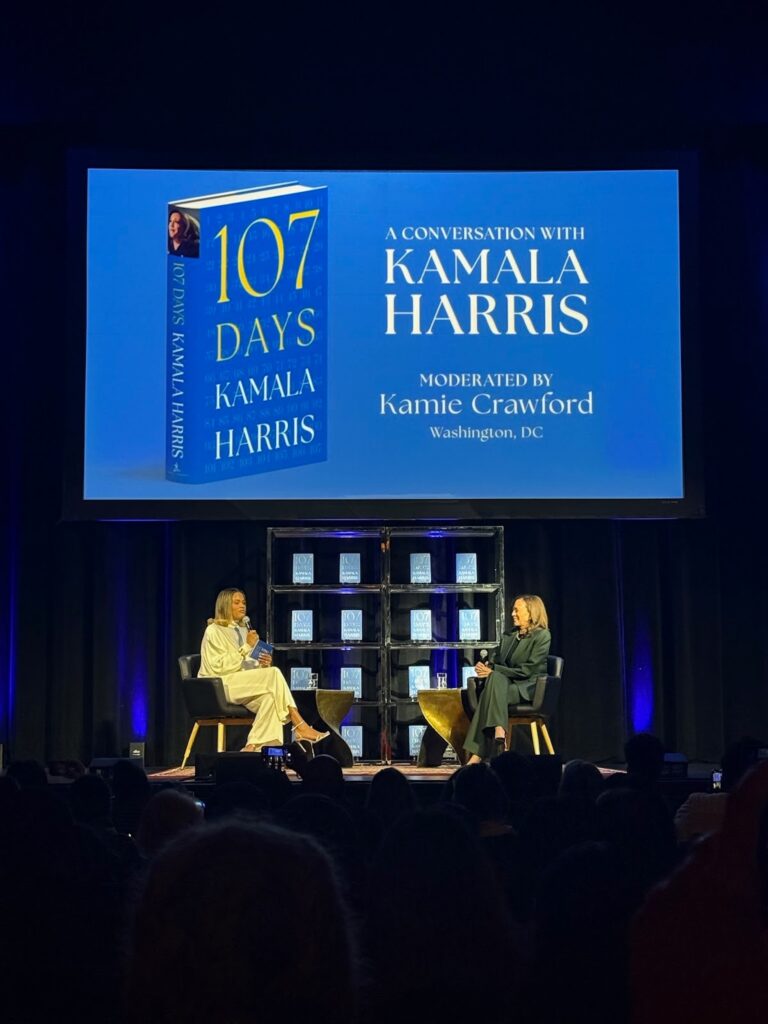
The lights dimmed, and the crowd leaned in as former Vice President Kamala Harris began recounting the 107 days that tested, shaped and defined her historic presidential bid. On Wednesday, Oct. 9, Harris took the stage at Warner Theatre, a sold-out crowd of hundreds awaiting as she made her D.C. stop for the book tour of the newly released “107 Days.”
The event follows the Sept. 23 release of Harris’s political memoir, which she describes as “a candid and personal account” of her brief presidential campaign, the shortest in modern U.S. history. The book tour was announced on Aug. 21 via Harris’s Instagram, with stops planned across the United States over the coming months to promote the release.
“One of the reasons I wrote this book is to hopefully remind us of how those 107 days felt,” Harris said. “That light is inside of us, we have to see it in each other and let it guide us during the darkness to get through this without giving up.”
Her D.C. stop featured two conversations, each led by a different moderator. Kara Swisher, a journalist, podcaster and co-founder of “Recode Decode,” moderated the 7 p.m. discussion, known for her coverage of technology and politics. Kamie Crawford, a television host, model and former Miss Teen USA, moderated the 9 p.m. session. Crawford currently co-hosts MTV’s “Catfish.”
Both moderators engaged Harris in discussions about her new book, her presidential campaign and her experiences in public service.
As Harris reflected on what it will take for the nation to restore accountability and strengthen its democratic institutions, Swisher asked her what the most complex part of running for president was. Harris said her biggest challenge was the time constraint, which led to the title of the book.
“I basically wrote it like a journal, I talked about my prayer every night, which was ‘God, please let me have done everything I could possibly do on this one day.’ I traveled several states in a day. I couldn’t do enough,” Harris answered.
During the session, Swisher shifted the conversation toward current politics, asking Harris about the state of President Donald Trump’s administration and how the country can move forward over the next three years.
“I’ll be very candid, I don’t know that it won’t get worse before it gets better. I don’t have the solution right now to how it stops before the end of his term,” Harris said. “But I know that we have to fight. We have to stay strong. We can not be overwhelmed. We cannot be silenced.”
Harris mentioned what she described as ongoing turmoil within the administration, citing the recent example of the Justice Department moving to indict New York Attorney General Letitia James on bank fraud charges earlier that afternoon. These charges come following Trump’s active pursuit to prosecute his long-term political opponents.
She added that executives in the Trump administration and rich CEOs “deflect the responsibility of the powerful by pointing fingers and blaming the people who are relatively powerless.” She cited attacks on immigrants and diversity, equity and inclusion initiatives, saying it is the responsibility of those in power to solve these issues.
Harris said while she did not yet see a clear solution, the public must remain attentive and continue to engage in democratic processes rather than withdraw in frustration.
“We talked about it in those 107 days when the Supreme Court basically told Trump he’d be immune as president for any misconduct while in office,” Harris said. “We knew this would happen. When I say I don’t have a solution, the point is that the guard rails have failed for the most part, except one guardrail, which is the people.”
Following the discussion, Harris opened the floor to audience questions. Antonio Howard, a doctoral candidate studying media at Howard University, asked Harris about the role of the press and how it has, in his view, turned against the public.
“Antonio, I say the future of journalism, just as the history of journalism, has to be about telling the people the truth,” Harris said. “Part of the challenge that you’re going to face coming out of school in this environment is that probably the best place for you to go to tell the truth is going to be independent media.”
“I would encourage you to think about being creative in the way you use your mediums. I believe that is the future of journalism,” she added.
Chloe Schafer, a member of the George Washington University College Democrats’ executive board, asked Harris what advice she has for student leaders on making tough decisions and being effective leaders in adversity.
“Gen-Z is where it’s at,” Harris said. “What I know about your generation is you are impatient, and I love that about you. You all have got to lead, and there is a lot of encouragement and support for you to do just that, no matter how heavy and intense the head winds are, to keep each other close and bring other people in, and you will see the power of the collective.”
Following the event, videos quickly circulated online showing protesters shouting at Harris, calling her a “war criminal.” One TikTok video by creator Tymek Arshon, which has garnered over 3 million views and 500,000 likes, showed Harris responding, “I am not president of the United States. You want to go to the White House and talk to him? Then go on and do that.”
This was not the first incident of hecklers at her book tour; similar disruptions were reported at her Chicago stop. Other attendees, however, said Harris’s message resonated despite the interruptions.
Torica Exume, who earned her doctorate from The Chicago School of Professional Psychology, said the event was amazing.

“Kamala is definitely the voice for many people. I think the biggest takeaway was when she said to be a joyful warrior,” Exume said. “I also loved how her book broke down her experience day by day and hour by hour; it was very helpful to get to know what happened.”
Reflecting on the past year since Trump’s victory, Exume said Harris’s continued engagement has restored a sense of optimism for her.
“Last year, we lost all hope. I cried. My husband cried. But now, seeing her one year later, we were just so excited. I saw her in Houston, I saw her tonight, I’m seeing her in Miami. She was our last chance of hope for the next four years. So just to hear her laugh, her smile, it brings me so much joy,” Exume said.
While Exume emphasized how Harris’s presence restored a sense of lost hope, Harris herself emphasized how progress is more than just election results.
“The solution is not going to just be the next election. We got to take back the House. We have to back the Senate. But it’s going to be more than that. The solutions we need are going to be also a reconstruction of how we’ve been thinking about how we ended up in a place like this,” Harris said.
Copy edited by Damenica Ellis