

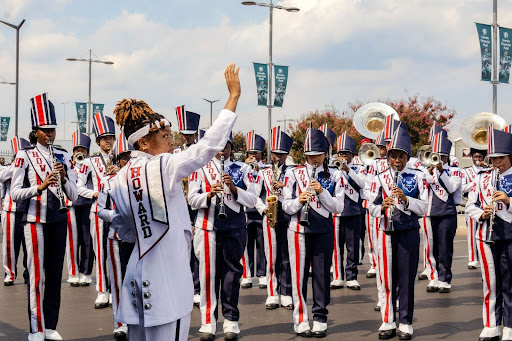
After weeks of unmanageable work hours, early-morning lectures and studying for midterms, Homecoming at historically Black colleges and universities (HBCUs) gives students and partygoers alike the opportunity to unwind and enjoy the playful side of college life.
Homecoming itself is a rite of passage for all HBCU students, akin to being baptized in Blackness. It’s the brisk fall air that calls for fashionably layered outfits. It’s the smell of barbecue and fried fish at tailgates. It’s the sound of sorority songs and fraternity chants as crowds of students and alumni sweep across campuses in droves, their school colors emblazoned on their shirts — and the chance to see HBCU marching bands perform in all their glory.
Howard University’s own SHOWTIME marching band certainly holds its own, captivating crowds with its charm, precision and D.C. swag, yet, being outside the South — the epicenter of many HBCU band rivalries — means we don’t always get to square off or practice like the other powerhouse bands that define HBCU band culture. While we are the number one HBCU, do we really have the number one band?
Marching bands are cherished focal points of HBCU spirit, pride and student camaraderie. Whether it’s during halftime at the Homecoming football game or the so-called “Fifth Quarter,” a term coined by many band aficionados, rival bands go neck-and-neck with each other, enthusiastically displaying their musicality and dance styles.
Band programs thrive when built around organic rivalries and competition. Although a comprehensive comparison of every marching band across the Southwestern (SWAC) and Mid-Eastern Athletic Conferences (MEAC) would require considerable time and effort (as there are approximately 40 bands in total), I can’t help but wonder how Howard University’s SHOWTIME marching band compares to the upper echelon of Black musicality and who that upper echelon even is. With that said, here’s my ranking of the best HBCU bands:
First place – The Human Jukebox, Southern University and A&M College
Although HBCU performance repertoires include classical and traditional marching music, they often dip into the rich pool of African American contemporary music and Southern’s The Human Jukebox is no different. From playing curated music from Kayne West, Michael Jackson, Rihanna, Young Thug and Rich Homie Quan — encompassing jazz, gospel, funk, soul, rhythm and blues and hip-hop — The Human Jukebox has become the pinnacle of the African American and Y2K aesthetics (think flashy performance styles and pop culture references).
Their ensemble features foregrounded percussion, overlapping call-and-response patterns and off-beat phrasing of melodic accents that are deeply emblematic of the bold, experimental public declarations of what it means to be African American today.
Through their song choices, majorette dance routines, performer-audience treatment in public space and penchant for excellence in musicality and competition, it is clear that The Human Jukebox transcends band membership and values belonging to time-honored traditions of African American expressivity.
Second place – The Sonic Boom of the South, Jackson State University
The Sonic Boom of the South is one of the most performative and energetic bands. Renowned for their electrifying performances and a brass section that leaves any audience in awe, The Sonic Boom of the South has performed at presidential inaugurations, the NAACP Image Awards, Motown, during NFL halftime shows and alongside global superstars, including Ciara and, most recently, Usher.
With rhythmic dance troupes that strut, stomp, sway and sashay in jaw-dropping fashion, their choreographed routines coupled with their decked-out, bedazzled uniforms, The Sonic Boom of the South is in a league of its own. Led by five drum majors, male dancers, majorettes and instrumentalists, they are all collectively improvisatori, moving effortlessly with their lithe dance moves, which seem to be uniquely their own. It is safe to say that The Sonic Boom of the South will continue to inspire the youth, fellow HBCU graduates and the world.
Third place – The Marching 100, Florida A&M University
In third place is The Marching 100. Lauded for its commitments to innovation and discipline, and its national and international prominence, having performed at the Louis Vuitton Men’s show in Paris twice, The Marching 100 has been emulated by bands across the country, and it’s easy to see why.
When starting onto the field during a game, the entire band adopts a varied tempo with a slow death-march cadence, only to explode into triple time, strutting to pulsing drumbeats from the percussion section. They then begin to accentuate their movements, each knee lifted to form a right angle, while their instruments flash back and forth in step to the beat with sharp, angular motions as they begin to ‘Snake Walk’ to their positions afield, complete with high-flying drum major splits. Florida A&M University’s The Marching 100 has all the tenets of a prodigious marching band, intense flare that projects authority and inspires confidence, eccentric and endless style with their iconic green, orange and white uniforms and their musicality which touches its audience deeply, emotionally, visually, narratively and by proxy.
Some honorable mentions include: North Carolina Agricultural and Technical State University’s Blue and Gold Marching Machine, and South Carolina State University’s “Marching 101.”
Despite its undeniable charisma and the pride it brings to The Mecca, Howard University’s SHOWTIME Marching Band hasn’t quite reached the same legendary status as its southern counterparts — and that’s okay. Our band lacks the proximity to other intense regional rivalries that push many SWAC universities to innovate, as well as that HBCU ‘hustle mentality and culture’ as it is applied to bands.
Since Howard’s SHOWTIME marching band lacks that steadfast devotion, its focus leans more toward pageantry and school spirit than crowd-commanding showmanship and ‘southern bravado’ that heavily defines other HBCU bands. While Howard might reign supreme in academics (being one of only four HBCUs with a chapter of Phi Beta Kappa) we’re still playing catch-up to the marching band titans of the South. After all, even the number one HBCU can’t claim to do everything the best — at least, not yet.
It is incredibly difficult to place or rank every HBCU band into one tier list or category, as each ensemble carries its own distinct legacy, regional sound and cultural heartbeat that cannot be easily measured against another. Every HBCU band, regardless of location, carries a lineage of excellence and expression that is deeply rooted in its institution’s history and our history as a people that transcends any mere performance.
Some might think that not attending class for a week defeats the purpose of advanced education, but learning involves more than laboring through textbooks. Whether you’re a student or alumni of an HBCU in the south or the north, experiencing your unique HBCU homecoming is a learning tool just as much as any class assignment. Howard University, home to one of the first HBCU Homecomings, set the standard for an event that spread to HBCU campuses across the country and across the decades, touching millions of lives and making countless invaluable memories.
Copy edited by Daryl R. Thomas Jr.