

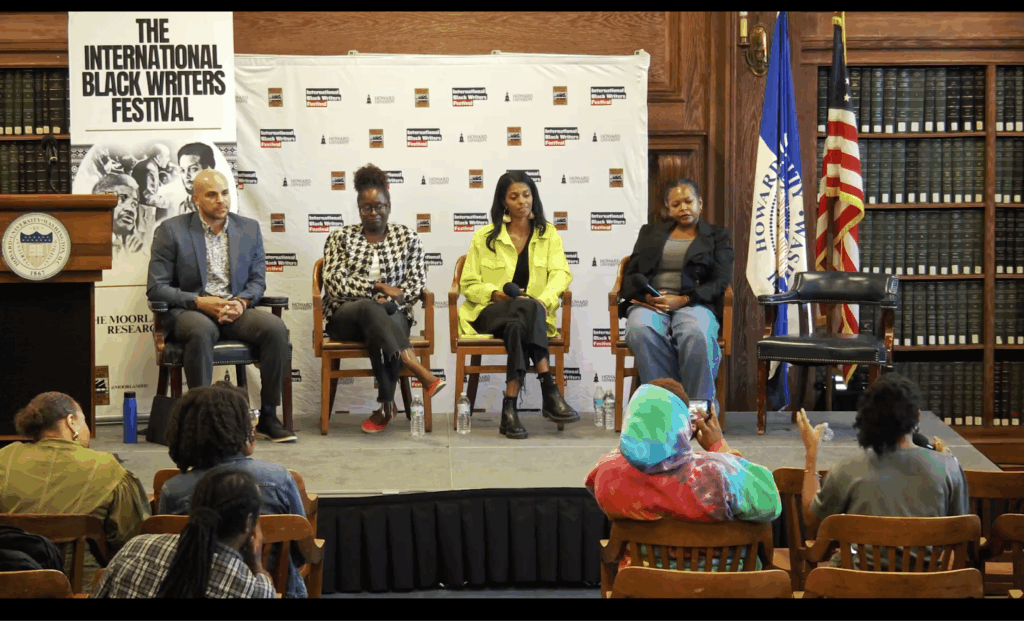
The Moorland-Springarn Research Center (MSRC) hosted the fourth annual International Black Writers Festival in Founders Library, drawing poets, novelists, scholars, students and alumni together under this year’s theme: The Story of Us.
Through panels, reading performances and conversations, the festival highlighted the power of storytelling in preserving culture, connecting generations and shaping collective memory.
“The Story of Us is in some ways the motivation behind the writers festival — to define our own stories, define our own narratives and bring all of these narratives together as it becomes the story of who we are,” said Benjamin Talton, who holds a doctorate in history and serves as director of the Moorland-Spingarn Research Center.
Panels examined literature as a tool for collective memory and social critique. Fire This Time: Creative Writing as Collective Memory focused on writing’s role in preserving experiences, while The Story of Mass Incarceration brought historians and activists together to critique systemic control.
Another panel, Dissecting the Double-Edged Sword of A.I. & Technology, addressed artificial intelligence’s impact on Black communities, linking local experiences to global technological concerns.
Performance was a central focus of the festival, bringing poetry to life through readings that blended personal memory with social critique. Words of Fire: Local Poets featured Joshua Myers, A.B. Spellman, Yao Glover, Laini Mataka, Kenneth Carroll and Gabrielle Oliver, whose work demonstrated poetry’s power to connect and impact our communities.
Oliver recited poems honoring her ancestor Peter Oliver — one of the founders of American architecture and pottery in North Carolina, and the only co-founder who was formerly enslaved — reflecting on how his legacy “eerily relates” to the present day.
Spellman performed “The City Poet on a Stroll,” an ode to U Street and the late poet Gaston Neal, evoking the vibrancy of D.C.’s Black arts scene.
Mataka’s performances, including “Return of the Kings” and “I’m Not a Poet,” drew a standing ovation. In “I’m Not a Poet,” she called herself “Black history’s mouthpiece and rebellion’s archivist,” a line that resonated deeply with the audience.
Several writers, including playwrights Tanya Barfield and Patricia Ione Lloyd, and novelist Jacqueline Woodson — recipient of the Coretta Scott King Book Award — emphasized the responsibility of storytelling.
Speaking at a panel, Woodson urged audiences to see narratives as tools for cultural preservation and accountability, highlighting independent Black booksellers as vital to sustaining literature and linking storytelling to community support.
Later panels took a historical lens, framing storytelling as both a record of the past and a guide for the future. Historian Elizabeth Hinton, who holds a doctorate in history, reflected on how narratives help communities understand their past and imagine new possibilities, reinforcing the festival’s theme that stories are living forces shaping collective identity.
“I believe that telling stories about the past are essential in order for us to understand where we are today, how we got here and how we might envision and realize a different kind of future,” Hinton said.
Inspired by the panels and performances, students actively engaged by pressing panelists with questions and performing original poetry and dramatic monologues from the Chadwick Boseman College of Fine Arts.
Keith Robinson, a junior graphic design major, said he attended the event to hear about what inspires Black creatives and how they contribute to the legacy they leave behind.
“I think that we’re entering a period of censorship, and I think it’s important to highlight Black artists,” Robinson said.
The festival’s topics and student engagement reflect the MSRC’s mission to preserve and promote global Black history and culture through research, archives, public programming and advancing the study of the African diaspora — a connection Talton explained.
“We wanted to pick a theme that can be interpreted in a variety of ways and for participants and people who attend to make it their own. That’s why we gather,” he said.
Talton described the festival as a way to define narratives for people of African descent and to unite those stories under a single, shared theme.
The panels and performances also reflect the MSRC’s mission of making Black history accessible to the public.
“It’s really to preserve our legacy…our stories…our history,” he said.

Through exhibitions, speaker series and events like the International Black Writers Festival, the center brings archival work to life for students and the broader community.
By the festival’s close, Founders Library remained alive with conversation, reflection and the energy of shared creativity. Talton emphasized the inspiration he hopes students take away, noting that seeing accomplished writers in person can motivate emerging artists and writers.
He said the festival helps demystify the writing process, showing students that accomplished authors are real people who have struggled and honed their craft over time.
“I can’t see how you can’t leave [the festival] without being inspired. We always need examples and role models,” Talton added.
Copy edited by Damenica Ellis