

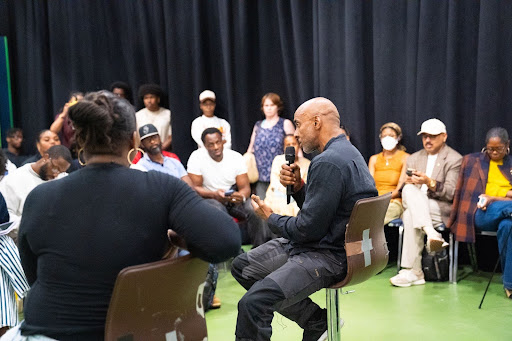
Dozens of Howard University students packed WHUT Wednesday evening, waiting for the arrival of acclaimed cinematographer Malik Hassan Sayeed. When the Howard alum entered his Light, Lens & Motion masterclass, the room erupted in applause.
The event, curated by Amazon MGM Studios in collaboration with the Department of Media, Journalism & Film at Howard, was part of Sayeed’s media tour for the newly released film “After the Hunt,” directed by Oscar-nominated Luca Guadagnino.
“I’m excited to be here — it’s surreal for one. I’m seeing stuff that I know that’s familiar, but different,” Sayeed said. “There’s something mystical about being here — it feels not that long ago, but it’s been 35 years since I graduated from Howard. So I’m excited to come back and speak.”
Born in New York City, with an upbringing in Los Angeles, Sayeed graduated from Howard University in 1990 with a degree in Film Studies.
“After the Hunt” follows Professor Alma Olsson (played by Julia Roberts) as she becomes entangled in a web of suspicion when her colleague and close friend, Henrik Gibson (played by Andrew Garfield), is accused of sexual assault by a gifted philosophy student, Margaret “Maggie” Resnick (played by Ayo Edebiri). As the allegations unfold, Alma Olsson is forced to confront her loyalties, her past and the question of whose truth will prevail.
The masterclass gave students an immersive look into Sayeed’s journey and the cinematography behind his most iconic works and recent projects.
Sayeed’s lens has framed everything from Stanley Kubrick’s “Eyes Wide Shut” to the dystopian “Gattaca.” He was the eye behind Hype Williams’ “Belly” and the visual force behind Spike Lee classics like “Clockers,” “He Got Game” and “The Original Kings of Comedy.”

His craft extends beyond films to music. He captured some of Beyoncé’s visuals — like Formation and Brown-Skin Girl — which won him MTV Video Music Awards.
In addition to the masterclass, students were invited to an advanced screening of the film at Regal Theatres inviting them to prepare questions and comments to ask during the class. Attendees looked at a variety of selections of Sayeed’s work, from the opening scene of Belly to Beyonce’s Formation and even select clips from the new film After the Hunt.
During the event, Sayeed responded to a question by sophomore marketing major Kendall Claytor, concerning the collaboration of working with directors such as Guadagnino.
“I think any part of a working cinematographer’s job is to align their vision with the director’s. I prefer to work with visual directors who have a clear vision and direction; most of them are editors as well. What we’re trying to do is be useful as a tool to execute the film’s vision,” Sayeed said.
Attendees said they enjoy having alumni return to campus and sharing their journey with the student body.
“I really enjoyed seeing clips of his work that spanned from feature films to commercial ads. Also getting insight into how I could possibly approach cinematography more thoroughly,” said Ra’Mya Davis, a senior television and film production major.
Davis added that the event reinforced her confidence in achieving her goals in the film industry.
“I take the reiteration of such encouragement provided by Mr. Sayeed as the final voice to tell me what I need to do and I start fully implementing it to achieve my goals that I have in the world of film,” Davis said.
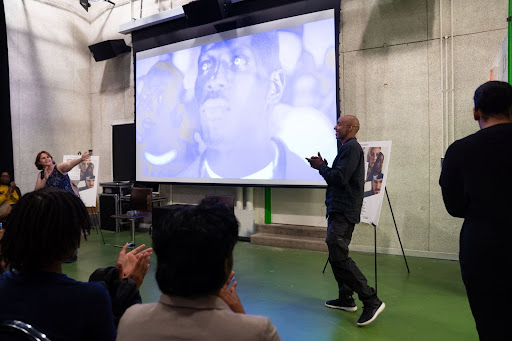
In an interview with The Hilltop, Sayeed spoke about how Howard shaped his path.
“I had some very influential teachers at Howard. George Epting, who taught lighting and design, was very critical — foundational in terms of my understanding of lighting,” Sayeed said.
He also recalled his time in Cramton Auditorium, where he was first introduced to lighting design and the technical aspects of theater electricity.
“There were many foundational elements of cinematography for me that started right here at Howard University and in Washington, D.C.,” Sayeed said.
Those lessons extended far beyond the technical. For Sayeed, the university represented an environment where collective identity and artistry coexisted naturally, he said. The creative communities he found on campus would later mirror the spaces he helped build in the film industry.
“Entering into the workspace is going to be different because we’re entering a space where it’s dominated not by us,” Sayeed said. “But when I was doing music videos, all the sets were us. So where we grew and honed and started learning the craft, it was a Black space and it wasn’t abnormal.”
Sayeed’s foundation at the university propelled him into the industry, where he worked behind the scenes as a part of electrical crews for a variety of intimate music videos and advertisements. While many of these works focused on very intimate or poetic styles, Sayeed spoke to the uniqueness of working on a thriller and how he approached creating suspense and drama in “After the Hunt.”
“This story takes place in the shadows and most of the work I do is in the shadows,” Sayeed said. “So this being a thriller, there’s a lot of secrets and that is where things are hidden, in the dark, and we tried to lean into that in this film.”

Sayeed’s remarks on working in the “shadows” reflect both his technical style as a cinematographer and the broader themes he explores through film. Just as thrillers rely on darkness to conceal secrets and build suspense, he said the creative process also requires artists to embrace uncertainty and push forward in pursuit of their vision.
For him, cinematography is not just about capturing an image, it’s about evoking a mood, translating sound, emotion and rhythm into a visual language that audiences can feel as much as they see.
“If it’s music, I want the visual to look like how the music feels, and not necessarily the lyrics. For a narrative, it’s more about emotionally, what does the scene and the moment need to feel like, and what are we trying to communicate, that has a feeling and emotional component,” Sayeed said.
His words reminded students that cinematography is not just a technical craft, but an act of emotional translation, a process of turning feeling into imagery and light.
“I would tell my younger self and these students, do what it is in you to do. Validate, privilege and honor your truth and know that it’s valuable, real and it needs to be heard. But the only way you’re going to get to it is by doing it,” Sayeed said.
Copy edited by Damenica Ellis