


The Folger Theatre’s production of “Julius X: A Re-envisioning of The Tragedy of Julius Caesar by William Shakespeare” began not with Shakespearean words but with ritual. Director Nicole Brewer stepped into the aisle and asked permission from elders in the audience to tell the story.
“It is part of African tradition to ask for elders’ permission before they tell stories that are collective stories,” Brewer said. “Pouring some sort of libation for the lives that they have lived and the impact that they had.”
Set in 1960s Harlem and written by Al Letson, Julius X reframes Shakespeare’s tragedy through the life and legacy of Malcolm X. The show is staged in association with Folger Theatre at the Folger Shakespeare Library.
Julius Caesar follows the rise and assassination of the Roman general whose growing power threatens the republic. His close friend Brutus joins a group of conspirators who believe killing Caesar is the only way to save Rome from tyranny. Yet their act of betrayal sets off a chain of chaos and guilt, unraveling both their ideals and their city.
The adaption explores the overlap between Caesar and Malcolm X, drawing parallels between the two leaders: their power of persuasion, the betrayals within their circles and the fractures their assassinations left behind. In this version, Rome and Harlem mirror one another, blurring history into the present.
The production reimagines brotherhood and power with a creative team composed of members of Howard University — including Brewer, choreographer Shawn Short, sound designer Thom J. Woodward and actor Nikkole Salter, Chair of Howard’s Department of Theatre Arts.
Brewer and Short both trace their artistic roots back to the university.
“Howard taught me a lot of things and it increased my resilience to adversity,” Brewer said. “It gave me a tough skin and you need that in this industry.”
Short recalled professors reminding students that “Howard’s job is to put the Negro in history,” a lesson he carried into professional practice. Onstage, that shared foundation gave the production its pulse. Performers and designers worked with a familiarity that made the collaboration fluid, as if speaking the same language.
Brewer said the production hinged on how characters balance competing priorities.
“It was a story about Black men loving each other, loving their community and loving their faith,” she said. “The characters prioritize one of those things differently and that’s what creates the tension in the play.”
Those tensions came to life as characters swung from tenderness to confrontation in a single exchange. Brewers called them “abrasions” — visible cracks that revealed how fragile brotherhood becomes when love is divided.
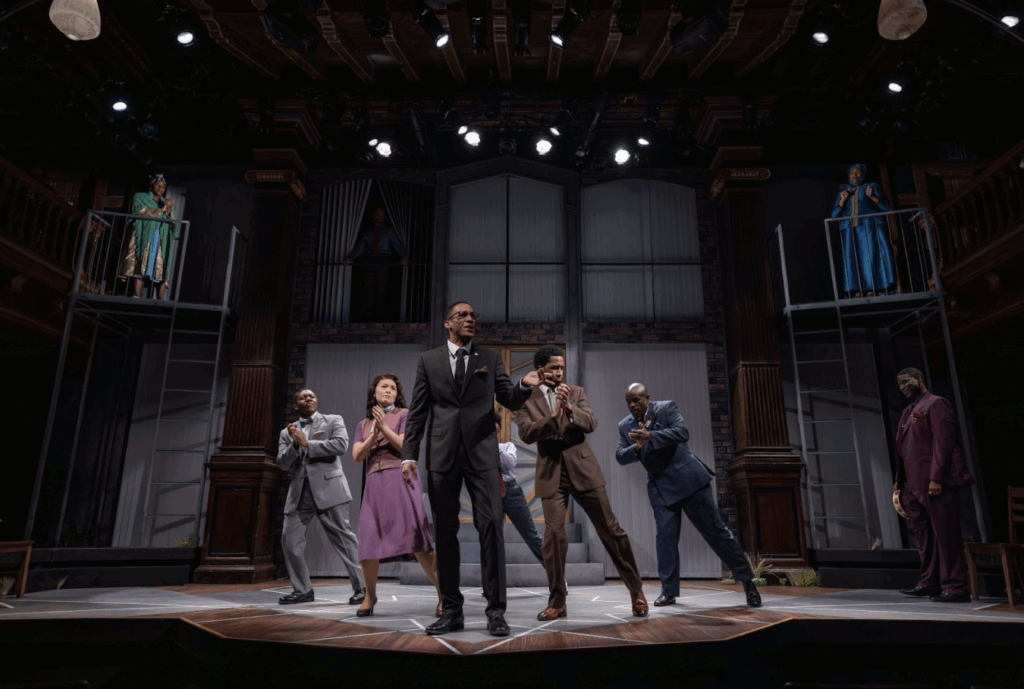
Short’s choreography was designed to reflect character more than era, he said.
“I didn’t go into it with a time period in my mind. In this story, I had to think of the people — what were the personalities of these characters, what were they trying to say?” Short said.
Movement became another language on stage, helping define each character’s role in the story: one pacing in agitation, another grounded in stillness, others sharp in their movements.
“Movement is forever,” Short said. “Walking down the street is the movement. If you get upset and point your finger at a man, that’s a strong stance and that stance reads to everyone.”
The audience played their role alongside cast members as they interpreted and rendered judgement in real time. Each gesture, pause and monologue called on them to decide what was right, who was wrong.
“We are the community, we are judge and jury,” said content creator Bekah Walsh, who dedicates her work to uplifting regional theaters in the D.C. and Baltimore areas.
That role became clear in moments when Brutus, a friend of Julius X who joined the assassination “for Harlem’s sake,” was met with boos, the crowd delivering its own verdict in real time.
Walsh said the rhythm of the show set it apart from any traditional Shakespeare staging.
“It was a very cultural, spoken word with a rhythmic experience,” she said. “If the art of the step was vocal, this is what you’re experiencing.”
For Sirra Fal, who attended opening night, the production merged history into the present.

“I think that doing this show here at this moment was something really worth witnessing, especially at the end with the projections,” she said. “We’re watching history, but also we are watching now. It’s like an out-of-time experience.”
Fal said art and theater is inherently political.
“Those impacts might not be tangible right here in this moment, but it plants a seed,” she said.
Julius’ assassination was staged as Harlem’s unravelling, echoing the deaths of Malcolm X, Martin Luther. King Jr. and others whose death marked the end of an era.
“It was the fall of Harlem in this particular story, just like in real life when Dr. Martin Luther King Jr. was assassinated and Malcolm X was assassinated. It was the end of something,” Brewer said.
She tied that moment to the strain of leadership, where public figures are held to impossible standards.
“There’s a way in which we take people who have positional power or political power and celebrities as well and remove their humanity,” Brewer said. “Not just the fall of Harlem, but for us, what do we risk when we stop communicating with one another?”
Julius X is onstage at the Folger Theatre until Oct. 26, 2025.
Copy edited by Damenica Ellis