

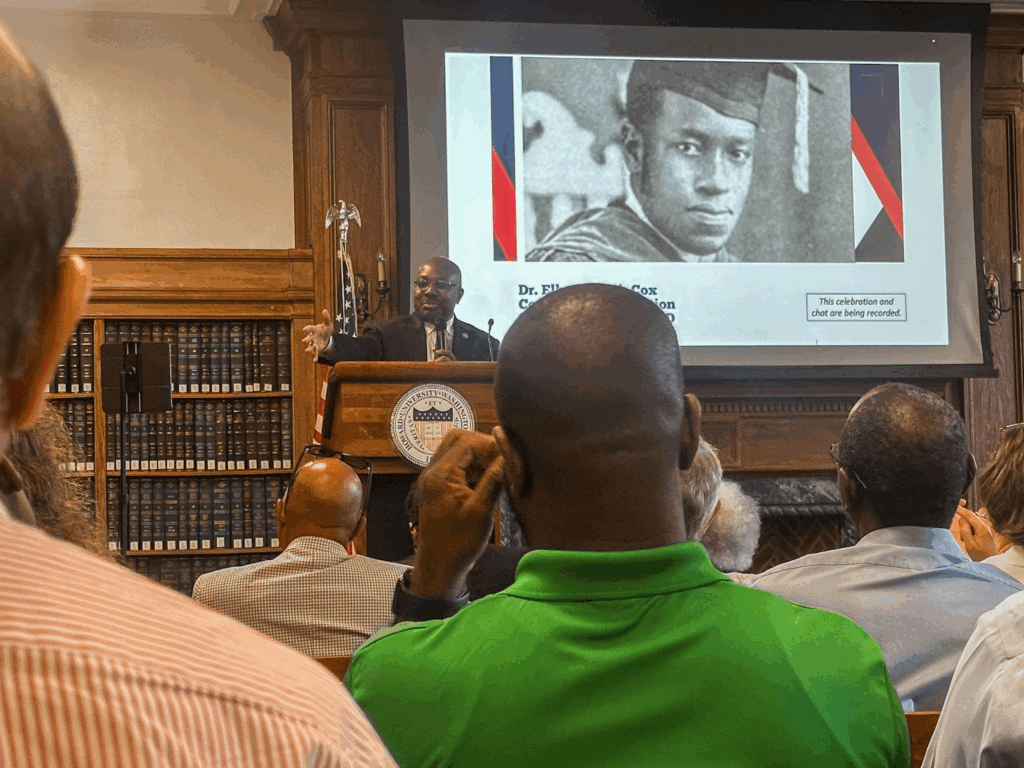
On Sept. 26, 1925, Elbert Frank Cox became the first Black person to earn a Ph.D. in mathematics. 100 years later, Talitha Washington, the Cox family, Howard students and other national figures within the field of mathematics gathered in the browsing room of Founders Library to celebrate Cox and his monumental legacy.
Over the course of two days, they reflected on Cox’s life, sharing personal testimonies about how his legacy shaped their paths in academia.
Kim Lewis, the associate dean for Research, Graduate Programs and Natural Sciences at Howard, shared how her similarities with Cox inspired her achievements. She was one of the few Black women in her graduate program at the University of Michigan.
“Both of us arrived at Howard, drawn to its legacy and mission. We both know how it feels to be the first or only in the room, and how that experience can be both daunting and empowering,” Lewis said.
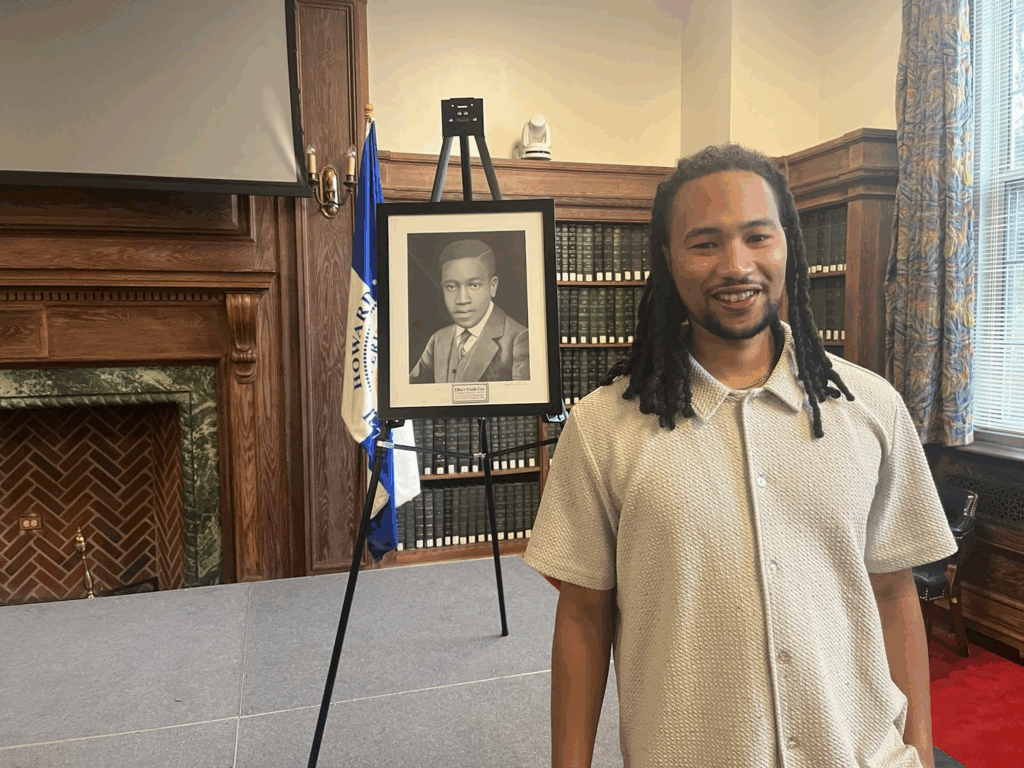
Elbert Frank Cox’s great-grandson Jamar Nash poses alongside a picture of his great-grandfather on Sept. 26. (Indigo Mays/ The Hilltop)
Talitha Washington, executive director of the Center for Applied Data Science & Analytics at Howard, organized the centennial celebration and delivered a public lecture on the life of Cox. Washington shared the hometown of Evansville, Indiana with Cox and remembered when she found out about the shared similarity.
“I said ‘wait, the first Black person to get a Ph.D. in math is from where?’ I think at that point my students heard a little scream from my office,” Washington said.
Cox was born in Evansville in 1895. While his father’s job as a school administrator spared him the worst conditions of poverty that many Black residents in Evansville lived in, Cox grew up in a time of extreme violence and race rioting in Evansville and nearby towns. This legacy would affect residents all the way into the 1980s, when Washington was growing up.
“Cross burnings, Klan rallies, we wouldn’t go to that side of town because things will be thrown at us, either words or objects,” Washington said.
After graduating from Indiana University in 1917, Cox enlisted in the Army during World War I and spent 10 months overseas in France fighting with the segregated 809th pioneer infantry.
Cox briefly taught at a school in Kentucky before joining Shaw University, then a premier Black institution, in 1919. In 1922, he began his doctoral program at Cornell University, completing his dissertation, Polynomial Solutions of Difference Equations, in 1925.
Cox joined Howard in 1929 and continued to teach until 1965. During his time at the university, he taught mathematics, served as chair of the Department of Mathematics and worked extensively on creating a Ph.D. mathematics program at Howard.
Three generations of the Cox family attended the celebration, with ties to Howard. Elbert Lucien Cox Sr., Cox’s son, was a former associate vice president for academic affairs and associate dean in the School of Engineering. His son, Elbert Lucien Cox Jr., is a program executive in astrophysics at NASA.
Cox’s great-grandson, Jamar Nash, is a current psychology Ph.D. candidate at Howard and was directly inspired by his grandfather’s legacy to pursue a doctorate.
“He went through so much more than we could even express in simple words. He inspired so many people,” Nash said. “It was so important to do it here, over any place because this is such a special place and it means a lot to our family.”
Karsh STEM Scholar Madison Simmons, a mathematics major and computer science minor from New York, said the Cox Centennial gave her a valuable perspective.
“It shows how far we’ve come since he did his dissertation in 1925,” Simmons said. “It felt very emotional being here and like seeing a room full of Black mathematicians who were very much, to some degree, inspired by his story.”
At the end of Friday’s event, Elbert Lucien Cox Jr. announced the family’s launch of MathSTEM, a nonprofit that will offer programs to K-6 students in the DMV area to better their understanding of math in a hybrid format.
“This is the best way that we can honor what this man did 100 years ago, so that children in the future will succeed,” Cox Jr. said.
Copy edited by D’Nyah Jefferson – Philmore