

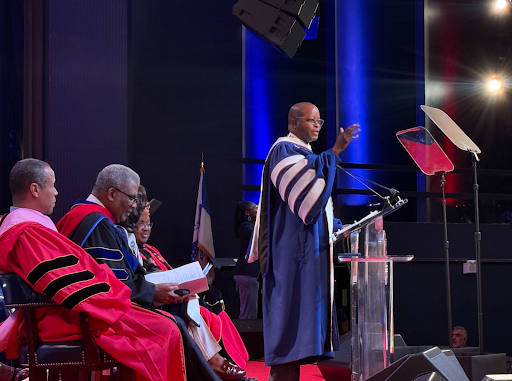
Howard University opened the academic year with its 158th annual Convocation, welcoming one of the largest incoming classes in the school’s history. The ceremony, held last Friday, was led by civil rights attorney Sherrilyn Ifill and reintroduced Howard’s interim and former president, Dr. Wayne A.I. Frederick.
The celebration featured prayers, reflections on Howard’s legacy, and a call for the class of 2029 to take up the mantle of leadership in a moment of political and cultural change.
Frederick addressed the audience, emphasizing Howard’s unique place in American higher education as the only federally chartered historically black college and university (HBCU). He highlighted the school’s enduring history of financial struggle and resilience, reminding students that their time at Howard is part of a much larger story of survival and triumph.
“Universities exist for the amplification of other people’s humanity,” Frederick said. “Before we go out and change the world, we must first care for one another on this campus.”
He urged the class of 2029 to value citizenship not only in the context of the nation but within the Howard community itself — through acts as simple as acknowledging peers in an elevator or supporting a classmate in need.
For Leslie D. Hale, the Board of Trustees Chairwoman, this was the first convocation in her position. She said Howard is a place of learning and a training ground for leaders who transform communities and “will not only change the way you view the world but the way you see yourself in the world.”
She urged students to take advantage of Howard’s unique resources and reminded them that the university offers opportunities that converge in one place.
Professor Sherrilyn Ifill, the convocation’s keynote speaker, drew on her work establishing the 14th Amendment Center at Howard Law School. She encouraged students to see themselves not only as inheritors of history but refounders of American democracy.
“Our democracy is designed to be remade,” Ifill said. “The question is whether you will have the courage and imagination to be the framers of its next iteration.”
Ifill said today’s challenges can be moments of creation, without naming specific issues. She linked the present to the post- Reconstruction “Nadir” (1877 – 1915)– often described as the lowest period for Black Americans– noting that even amid disenfranchisement and racial violence, Black communities built new institutions and businesses, including the NAACP and the National Urban League.
She referenced the founding of the NAACP and Urban League to the rise of Black-owned banks and the creation of Black fraternities and sororities, many that were founded at Howard, and continue today.
“There are planting seasons and harvest seasons,” Ifill said. “Right now, it is planting season.”
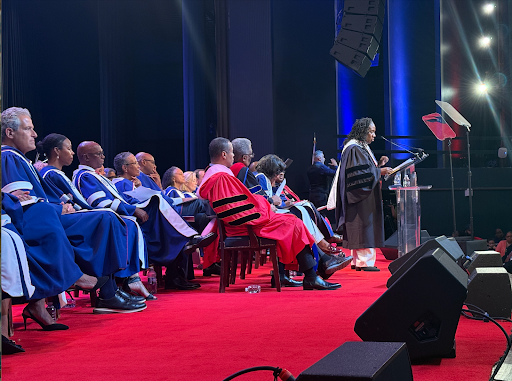
Ifill closed with lessons for navigating Howard and the broader world: protect the communities closest to you, feed your mind with new ideas, rest when needed and always believe in your power to create change.
Richard Emmanuel Johnson, a freshman economics major from Durham, North Carolina, called convocation a defining moment that introduced him to Howard University and inspired his journey ahead.
“It was amazing to see Black excellence all around the room,” Johnson said. “When the keynote speaker talked about planting and harvest seasons, it reminded me that Howard’s legacy isn’t something to coast on. It’s something to live up to and continue.”
Copy edited by Damenica Ellis