

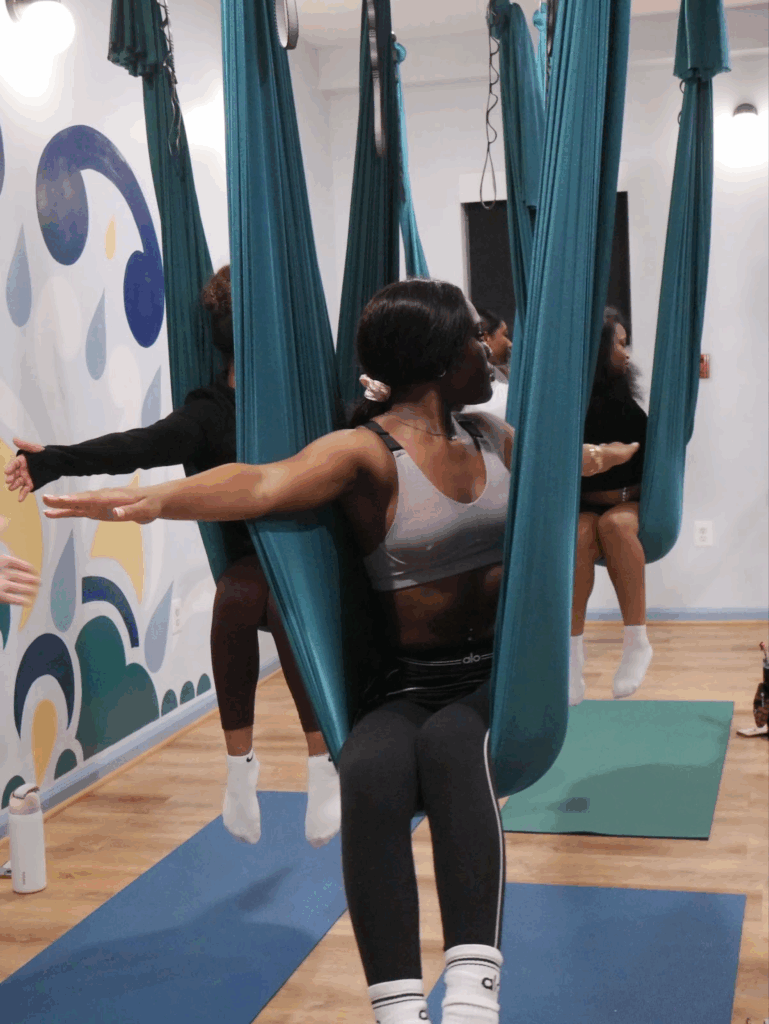
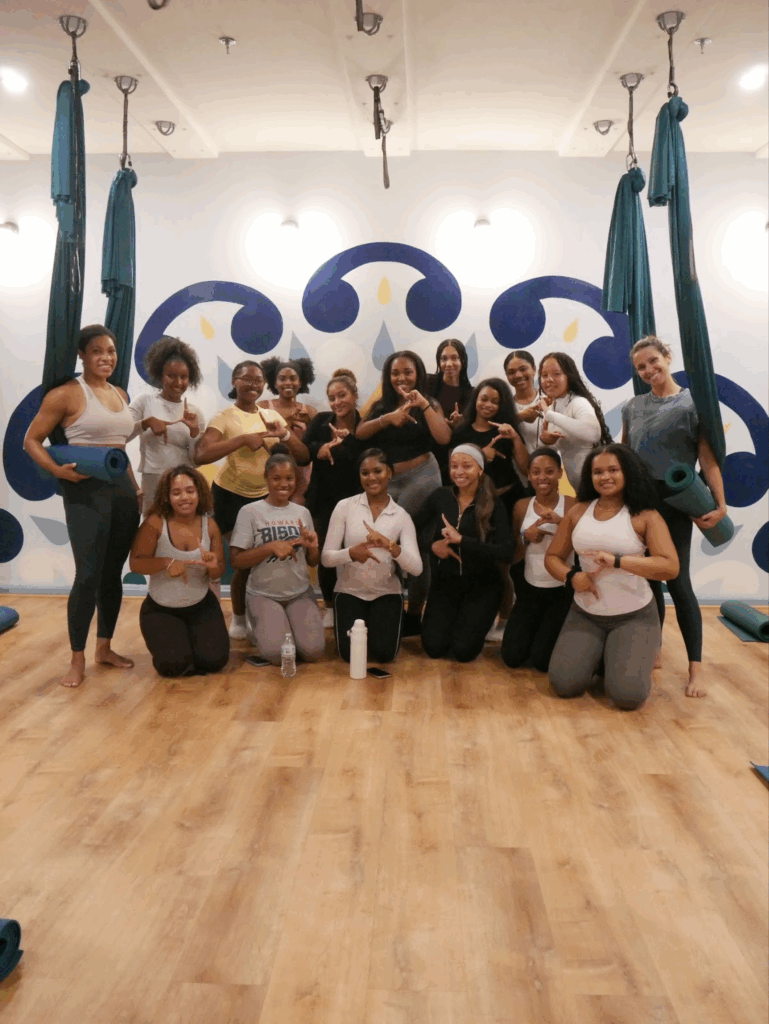
The Howard University Changing Health Attitudes + Actions to Recreate Girls (CHAARG) chapter partnered with newly opened EndlessOM Yoga & Aerial for an aerial yoga class that encouraged students to explore wellness through movement and reflection.
The event introduced students to the art of aerial yoga and opened space for reflection on students’ physical and mental well-being on Howard’s campus.
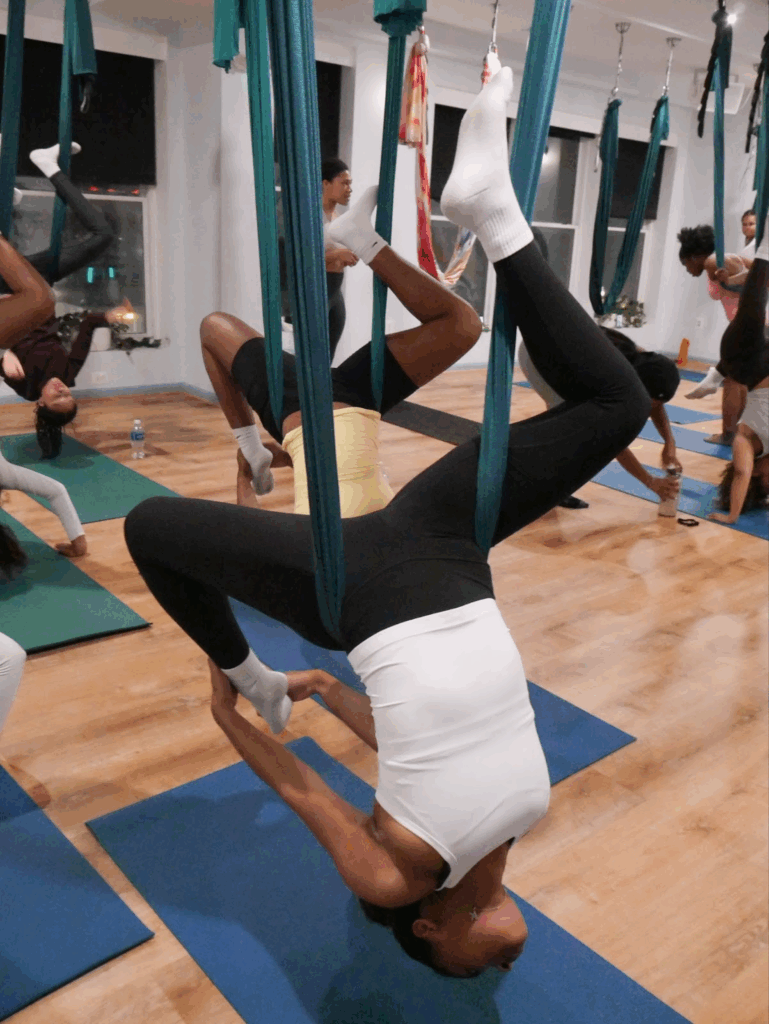
The event took place inside the only exclusively aerial yoga studio in D.C., and it introduced Howard students to the practice of yoga in silk hammocks. Guided by studio owner Sara Crosby and instructor Paula Hagan, students learned preliminary poses, stretches and techniques during a two-hour “Aerial 101” class.
Students recorded their poses, laughed through their mistakes and encouraged one another through challenging stretches.
“I think that making wellness fun and engaging is the best way to get young people, especially in college, who need these wellness practices, is to shut off their computers, put down their phones, come with a group of friends and do something fun,” Crosby said. “Do something that’s going to make them laugh and then bring their friends back the next time.”
Crosby stressed the importance of making wellness practices like aerial yoga enjoyable and entertaining. She noted college students often juggle academic pressure, financial challenges and unique social expectations, making self-care essential.
“You have to convince college students that self-care is nonnegotiable and selfishness isn’t necessarily a bad thing. You are the person you have to carry around for the rest of your life. We have to work past that thought process that somehow it is a luxury to take care of yourself. That somehow it should just be a sidebar, and it shouldn’t be a top priority,” Crosby said.
Her perspective aligns with broader conversations about student wellness nationwide. According to the latest Healthy Minds Study, more than 60 percent of students meet the criteria for at least one mental health problem.
Jasmine Marie, author of Black Girls Breathing and founder of the organization under the same name, emphasized the importance of students finding approachable ways to care for themselves.
“If you tell someone, ‘take care of your mental health,’ that feels overwhelming in itself,” Marie said. “Being able to break down true movements that are basic and easily digestible — finding just one thing you can do for yourself, whether that be taking 30 seconds for meditation or breathwork — those small actions can impact your generation, generations to come, and those around you positively.”
Marie said her own experiences with fast-paced, stressful environments in college and the workforce pushed her toward breathwork. That practice, she said, gave her tools to create mental space and helped inspire her larger mission of making wellness more accessible for the Black community.
“It’s hard for us, especially as Black people, generationally, to embody a sense of rest. It takes practice to feel comfortable taking time off, and not attributing your worth to what you have, what title or what job you have and that takes time to unlearn,” Marie said. “Knowing how breathwork can impact trauma on the body, I knew our community could need this the most.”
Tai Beauchamp, an award-winning media personality, wellness advocate, and founder of @morningmindsetwithtai, spoke to the importance of college students viewing wellness as a multifaceted and broader concept than just fitness or mental health.
Beauchamp said that wellness comes in eight forms: spiritual, social, environmental, financial, emotional, communal, intellectual and occupational. These eight forms of wellness speak to a total wellbeing, she said.
“I want to challenge young people to understand wellness as a larger pie and to think, ‘How do you slice up that wellness pie?’ Ensure you have at least four pieces of that eight slice pie in check, that way if those other pieces are falling short, it doesn’t feel as crippling,” Beauchamp said.
Beauchamp also discussed how some college students feel they’re running out of time or can’t balance academics and wellness practices.
“The truth is, you have time. You don’t have to do everything right now. But you do have to ask yourself ‘Is how I’m spending my time providing a return on my investment?’’ Beauchamp said.
Howard students spoke to their perspective on finding time for wellness, and what balancing mental health with academics looks like on campus.
“At a prestigious HBCU like Howard, I know there’s a lot of pressure to be in tons of extracurriculars all while performing well academically,” Maya Olidge, a sophomore honors English and economics major from Atlanta, said. “I wouldn’t say we prioritize our mental health. I’d say our work comes first, for better or for worse.”
Olidge noted that academic and on-campus activities are the center focus for many students, but finding moments to practice wellness can be significantly beneficial for the student body.
“I think we balance our mental health by trying to enjoy the little things. Once a week, me and my friends try to have a de-stress day where we can experience the Howard community we know and love so much. Those are the little small things that have impact,” Olide said.
Events like Howard CHAARG and Endless OM brought participants one step closer to wellness and self-care practices. Students reflected on their experience after the class.
“I would say this type of wellness and yoga workout was inspiring,” Drion Kim, a sophomore nursing major from Boston, said.

For students, the class offered both a workout and a chance to reflect on their own approaches to wellness.
“I’d say to young people, make it a point to pause four times a day and take one deep breath. Maybe the timing is inconsistent— that’s fine. But taking just one minute to be conscious of how you can instantly calm your nervous system just by watching your breath, that’s it. That’s yoga. That’s practicing wellness.” Crosby said.
Copy edited by D’Nyah Jefferson – Philmore