

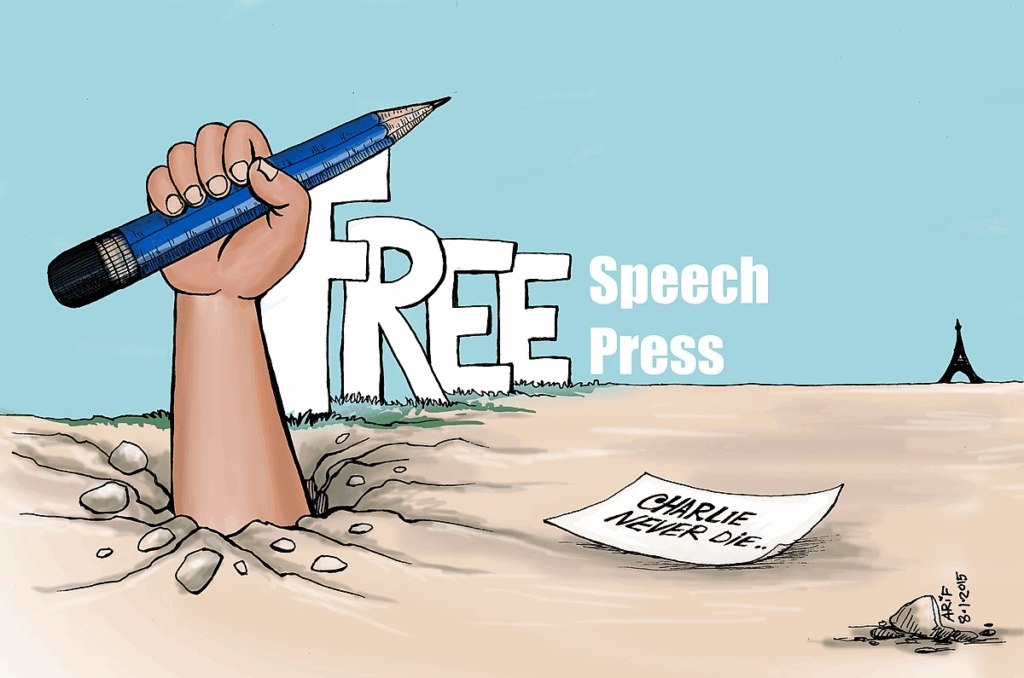
Since the assassination of conservative political advocate Charlie Kirk, several prominent media figures and American employees have lost their jobs or experienced public pushback due to their responses to Kirk’s character and death. This has raised questions about the future of free speech in America.
On Sept. 10, Kirk’s right-wing non-profit organization Turning Point USA hosted an engagement event in Orem, Utah. A few minutes into a discussion where Kirk debated an attendee on transgender people’s involvement in gun violence, Kirk was fatally shot in the neck. President Donald Trump announced Kirk’s death soon after via a post on Truth Social.
Many messages of sorrow were posted from social media users who admired him. Alongside Trump, celebrities such as Kristen Chenoweth, Barack Obama, Todd Chrisley and Kamala Harris took to social media to express their sympathies for Kirk’s family and to publicly condemn gun violence.
However, many people were quick to point out that while Kirk did not deserve this act of violence, their sympathies were clouded due to Kirk’s controversial history of far-right values, bigotry and misinformation.
Howard University student and organizer of Howard University’s chapter of the Blackout Arts collective said, “You can not be willing to fight on behalf of a man who died while saying exactly what he believed in, but then also criticize people who are speaking up about who they believed Charlie Kirk was as a person.”
Some of Kirk’s most controversial statements involve him saying that he would make his young daughter carry a rape-induced pregnancy to term. He has also referred to the Civil Rights Act of 1964 as a “mistake” and claimed that deaths as a result of gun violence are ultimately “worth it” if it means gun laws have fewer restrictions.
The current concern of the public involves not only the gun violence that led to Kirk’s death, but the possibilities of free speech being in jeopardy since many public figures have faced backlash and job losses for their statements regarding the killing.
A Howard University student who wishes to remain anonymous said that the current events that have taken place feels like a, “continued step in the conservative push towards heavily censoring the media.”
It has been less than a month since Kirk’s death and three notable job losses have occurred. Former Washington Post Editor Karen Attiah and MSNBC political commentator Matthew Dowd have both been fired from their positions in light of Kirk’s death.
“You can’t stop with these sort of awful thoughts you have and then saying these awful words and then not expect awful actions to take place,” Dowd said before he was fired.
In response to Kirk’s death Attiah shared a post on Bluesky quoting another one of Kirk’s statements in which he suggests that Black women didn’t have the intellectual ability to be worthy of prestigious political positions. However she has since claimed that she was not fired for this post.
Attiah claims that she was fired for speaking out against racial injustices in relation to gun violence. Although most of her posts did not address Kirk specifically, posts that caused her firing were made around the same time of Kirk’s death.
Popular American talk-show host Jimmy Kimmel briefly faced cancellation of his long-running talk show before having his show reinstated after six days due to a comment that he made about the political division that occurred as a result of Trump’s reaction to Kirk’s death.
“With all these terrible things happening, you would think that our president would at least make an attempt to bring us together, but he didn’t,” Kimmel said.
According to BBC and NBC news, many employees from diverse professional backgrounds have faced disciplinary action in light of their comments about Kirk.
Members of Trump’s administration such as Vice-President JD Vance and Deputy Chief of Staff for Policy and Homeland Security, Stephen Miller, have doubled down on encouraging consequences for left-leaning people who they believe are to blame for this recent political discourse.
With these instances of job termination, particularly from prestigious positions, some are calling into question the value that free speech truly has in the United States. Especially since this is a principle that Kirk and the alt-right was a strong advocate for.
Another Howard University student who wishes to remain anonymous believes that while there is an ever-growing desire to “speak the truth,” they now fear that, “more people will be a lot more nervous about what they say.”
Free speech has been one of the most foundational principles of this country, pursuant to the first amendment of the constitution, but the events that have occurred over the past few weeks may show that free speech as we know it may be changing before our eyes.
Copy edited by Damenica Ellis