

Several Historically Black Colleges and Universities (HBCU), either closed or went on lockdown following campus threats earlier this month.
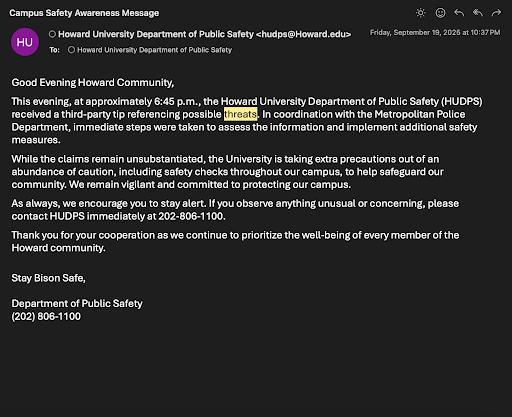
Hampton University, Bethune-Cookman University, Southern University, Virginia State University, Clark Atlanta University and Alabama State University instituted campus lock downs following threats. On Sept. 19, the Howard University Department of Public Safety released an email, informing students and faculty about possible threats.
Virginia State’s president, Makola M. Abdullah, Ph.D. released a letter saying the threats to HBCU campuses are not random, but rather targeted to instill disruption, intimidation and fear within HBCU communities.
“They are targeted attacks on institutions that have long stood as pillars of excellence, empowerment and progress. HBCUs exist because we refused to be denied an education — and we thrived because we continue to rise in the face of adversity,” Abdullah said.
Along with these institutions, Spelman College and Morehouse College, implemented shelter in place operations on Sept. 11. In a post on the social media platform X, Spelman College clarified there were no threats directed toward the institution, but acknowledged its close proximity to Clark Atlanta.
“Out of precaution and due to our close proximity, we are asking Spelman faculty, staff and students to shelter in place and avoid the CAU campus until further notice,” the statement said.
When Erinn Gardner, a junior English major and entrepreneurship and innovation minor at Spelman, arrived on campus Sept. 11, she learned about the shelter in place operations via social media and email.
Alabama State University sophomore Sam Barnett said that she was informed about her campus’ lockdown during her 8 a.m. biology class. She received a text and email from the university that the campus was on lockdown.
Shelter in place operations were lifted at Alabama State, Spelman, Morehouse and Clark Atlanta a few hours later. On the morning of Friday, Sept. 12 Bethune-Cookman lifted its lockdown.
Some students drew a connection between the campus threats and the assasination of Charlie Kirk on Sept. 10. The suspected assassin was identified as Tyler Robinson, a 22-year-old white man from Utah.
These students believed that the treats were racially motivated due to Kirk’s political audience. Barnett weighed in, characterizing the HBCU threats as a by-product of Kirk’s death and said that his supporters were looking to scapegoat someone other than themselves.
“HBCUs getting threats after a white nationalist was killed is very on the nose,” Barnett said. “Threats will continue to come strictly because a lot of people are upset. People who are Republicans or conservatives are very upset because they feel like this is an attack on them.”
Similarly, Gardner stated there wasn’t much speculation surrounding the circumstances of the threats and that most people said they knew that it had something to do with Kirk’s assasination.
Gardner added that there was confusion about exactly how the threats were related to the assasination because students did not know who the assassin was. Gardner said that a lot of people believed that the bomb threat toward Clark Atlanta was retaliation by the far right.
“Maybe it was a right-winged person coming for HBCUs, which tend to be left-wing. Maybe they were thinking: since you got one of ours, we’re going to get one of yours,” Gardner said.
Once news about Robinson was released, Gardner questioned why HBCUs were receiving threats.
“When we found out who the shooter was, we said ‘what does this have to do with us?’ They try to make everything about Black people and harm us in any way possible when the situation has absolutely nothing to do with us,” Gardner said.
In the wake of these threats, Gardner stressed that HBCUs should be intentional about hosting seminars and take the proper precautions to ensure that students feel safe.
Copy edited by Damenica Ellis