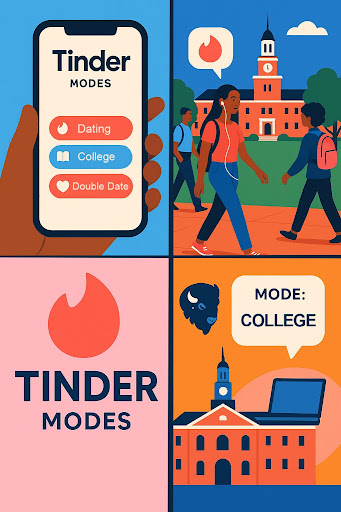
Tinder announced its new feature, Modes, a redesign of the dating app that aims to give users different ways of matching through Double Date Mode and College Mode, both targeted towards Generation Z users. Howard students express mixed feelings about the app and the pressures of online dating culture.
College Mode was inspired by the success of Tinder U™, a feature that allowed students to verify their college email and match exclusively with peers on their campus. College Mode aims to help undergrads connect with students from their own or nearby campuses, according to Cleo Long, senior director of Global Product Marketing.
Elysia Chase, a sophomore sociology major from West Orange, New Jersey, said dating apps are a convenient way to meet new people.
“Howard’s the only place I’ve been recommended to use dating apps because of how bleak the dating life is on campus,” Chase said. “A lot of people I know are on Hinge, Tinder, Bumble. I think dating apps are normal and it’s a reason why people aren’t talking in person because they feel more comfortable on screen.”
Tinder began rolling out Double Date Mode in the summer and has users exchanging nearly 25 percent more messages per match compared to one-on-one chats, according to the app’s press release.
Profiles in College Mode highlight aspects of student life, including major, classification, Greek life and other campus activities.
Long said Modes align with the dating experience of Gen Z users, opening the door to a larger conversation on how the Modes feature specifically impacts the Black community.
“Schools like Howard have been priority campuses for us and we’ve activated on those campuses in the past to make sure the student experience there is represented,” She said. “We see College Mode as a way to keep building on that, ensuring that students at HBCUs have the same opportunities to connect and that the feature reflects the diversity of the college community overall.”
Chase commented on the convenience of dating apps like Hinge and Tinder, saying that students may view them as a way to bypass the challenges of meeting people in person. She added that people commonly use social media apps like Instagram for dating. Given this trend, she wouldn’t be surprised if dating culture becomes almost entirely virtual.
“Because of the imposter syndrome at Howard, people don’t really act like themselves in social settings. I feel like going up to people on campus just doesn’t really happen anymore,” she said. “I also think because of the women-to-men ratio, a lot of guys feel like they have the upper hand when it comes to dating and they can be very entitled.”
Students say the university’s gender gap makes it difficult to find potential partners. According to the latest figures from U.S. News, female students make up 72 percent of Howard’s student body.
Her observations reflect unique aspects of Howard’s campus environment, where a majority female student body and competitive social culture intersect. While dating apps provide a convenient way to meet people, they also amplify social dynamics shaped by campus demographics and students’ pressures to present a curated version of themselves.
relatable.
Tsion Teshom, a sophomore biology and criminology double major from Las Vegas, agreed.
“It’s really nerve-racking meeting new people on campus. I feel like a lot of students are more nervous talking in person than online, and it’s the same for the guys. They’re more comfortable approaching women online and with the 70-30 ratio, I know a lot of guys just like to play around,” she said.
She added that with Howard’s 70-30 women-to-men ratio, College Mode can help students connect with people from other campuses.
“We see Modes as a way to move beyond the basics, creating spaces tailored to different interests, intentions and styles of dating,” Long said. “For Gen Z, that flexibility is key, because the way they approach relationships is constantly evolving and we want Tinder to evolve right alongside them.”
Safety is one of the biggest concerns when turning a swipe into a real-life meeting. Meeting someone for the first time through an app poses several risks, from scams to harassment and to its furthest extent, physical harm.
Tinder acknowledges these concerns on its “Safety Tips” page, advising users to always meet in public places, keep early conversations on the app and avoid sharing personal or financial information.
“Double Date uses the same reporting and moderation tools that apply across Tinder, including features like blocking, reporting and in-app prompts such as ‘Are You Sure?’ and ‘Does This Bother You?’ All of which help maintain a safe and respectful environment,” Long said.
Teshom shows that not all students are convinced that dating apps are the best way to meet new people.
“I’d rather see someone in person than online,” she said. “In my opinion, I don’t think dating apps are that safe. I could be connecting with someone who’s a kidnapper. I just don’t feel a strong sense of trust using dating apps.”
However, there is appeal in College Mode, she said, where there is the comfort of knowing she’s connecting with other students who share her environment.
She added that while she remains cautious about online dating, having a feature designed specifically for college communities could make the experience feel less intimidating and more relatable.
“It’s really nerve-racking meeting new people on campus. I feel like a lot of students are more nervous talking in person than online, and it’s the same for the guys. They’re more comfortable approaching women online and with the 70-30 ratio, I know a lot of guys just like to play around,” she said.
She added that with Howard’s 70-30 women-to-men ratio, College Mode can help students connect with people from other campuses.
“I feel like the College Mode feature is a good idea, to be honest. I think it will definitely help students to find their love story, those feeling lonely, or in need of finding connections in college,” Teshom said.
Samah Mahfoud, a sophomore physics major from Maryland, explained that dating apps can be dangerous because people may become too reliant on them to form connections.
“I personally think dating apps can have a negative impact because most people already don’t meet in person, and now they will start relying on these apps to meet people,” she said. “Even if you do see someone in person, the first thing they ask is for your Instagram and you just talk to that person through Instagram.”
While she worries about people relying too heavily on apps, she also notes that platforms like Tinder and Hinge don’t really carry a negative stigma on campus.
“I don’t think dating apps have a negative stigma surrounding dating apps, there’s a lot of people on these apps like Tinder and Hinge,” Mahfoud said.
Copy edited by Damenica Ellis