

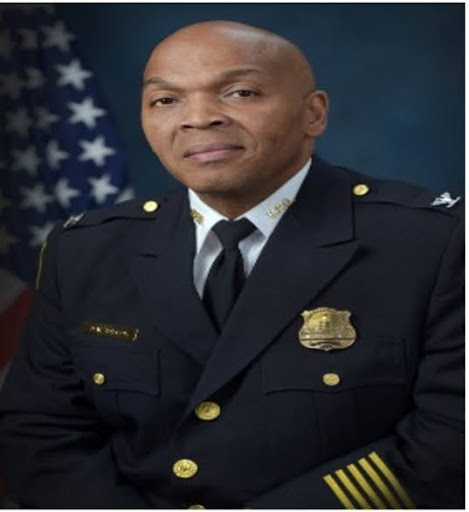
David Taylor, a 30-year veteran in law enforcement, will be the new police chief of Howard University.
Taylor, whose official date of appointment is Sept. 22 but began a month earlier on Aug. 18, said he will prioritize student safety, inclusive environment and transparency. He said he plans to continue the work of the previous chief, Marcus Lyles.
“I hope to build off some of the successes that AVP (Associate Vice President) Lyles has already installed, which pretty much will be centered around showing that each student feels safe, secure and in an inclusive environment,” he said.
Taylor described his vision for Howard as a “model campus program,” positioning the university as a standard for campus safety.
“That means consistently learning from the students, faculty and staff, and staying abreast of trends or things that may impact our university,” Taylor said.
Taylor addressed the recent protests and walkouts by students, voicing support for student protests while also emphasizing that protests should follow the Howard assembly policy, which prohibits violence during student assemblies.
“I think protests have been a staple of Howard’s proud history. I will always respect that as long as it’s done peacefully and in compliance with the Howard assembly policy,” said Taylor.
Taylor said transparency is very important to him and his goals for Howard, as it has been throughout his career.
To that end, Taylor and his team have introduced several changes. Lyles, who is now associate vice president of public safety and emergency management, highlighted updates in workforce size and transportation.
“We are going to be hiring and we’ve already started the process with 32 to 40 additional sworn campus police officers,” Lyles said. “…Over the summer, we purchased a new fleet of vehicles, you may see those out and about. We want to make sure that we’re visible, so we have a new fleet of vehicles to respond appropriately.”
Taylor mentioned the history of on-campus police and confirmed that they are currently armed.
He described Howard’s relationship with the D.C. Metropolitan Police Department (MPD) as strong.
“[MPD has] been an extremely great partner when it comes to collaborating on things that we may need assistance with,’’ Taylor said. “They’ve been a great partner of ours, and one that we are proud to say, are on our amazing team.”
Some students say that they haven’t always felt protected by campus police. Leilah Spalding, a freshman sociology and history double major from Seattle, Washington, said that safety concerns sometimes discourage her from going out.
“I feel like I’ve been not going out more unless it’s a necessity,” she said. “And that’s just unfortunate, because ‘why do I have to feel unsafe going out?’”
Spalding also said that she hasn’t received much aid from campus police.
“When I had an encounter with them, they seemed not helpful. I haven’t really felt any presence from them overall,” Spalding said.
Taylor said his intention is to support students and the university community at large.
“More than anything, [my goal is] to stay prepared and show that my team is prepared [by] making sure that we’re training to a higher standard so that we can meet the needs of the university and beyond,” he said.
Although Taylor credited Lyles with providing a “strong foundation to build on,” some students, including junior English major True Walker, still want clearer communication from campus police.
“We need more transparency about what’s going on and where they are if we need help. Just be more open about what they can do for us right now,” said the junior English major from Los Angeles, California.

Spalding agreed.
“I think that knowing that they are dependable is important,” she said.
Taylor stressed the importance of communication between campus police and students, noting that his team is sharing data to keep the community informed.
Lyles added that they have taken action towards increased communication.
“Just next week, we’re going to be having our first safety committee, with student representatives from each school, college and residence hall,” he said.
To facilitate better communication and understanding, Spalding advised campus police to treat students with respect and compassion.
“As campus police, you should be interacting with the students in a positive manner, not in a way that’s enforcing and trying to have a power dynamic over us,” she said. “We should be able to see them as advocates for us and not against us.”
Copy edited by D’Nyah Jefferson – Philmore