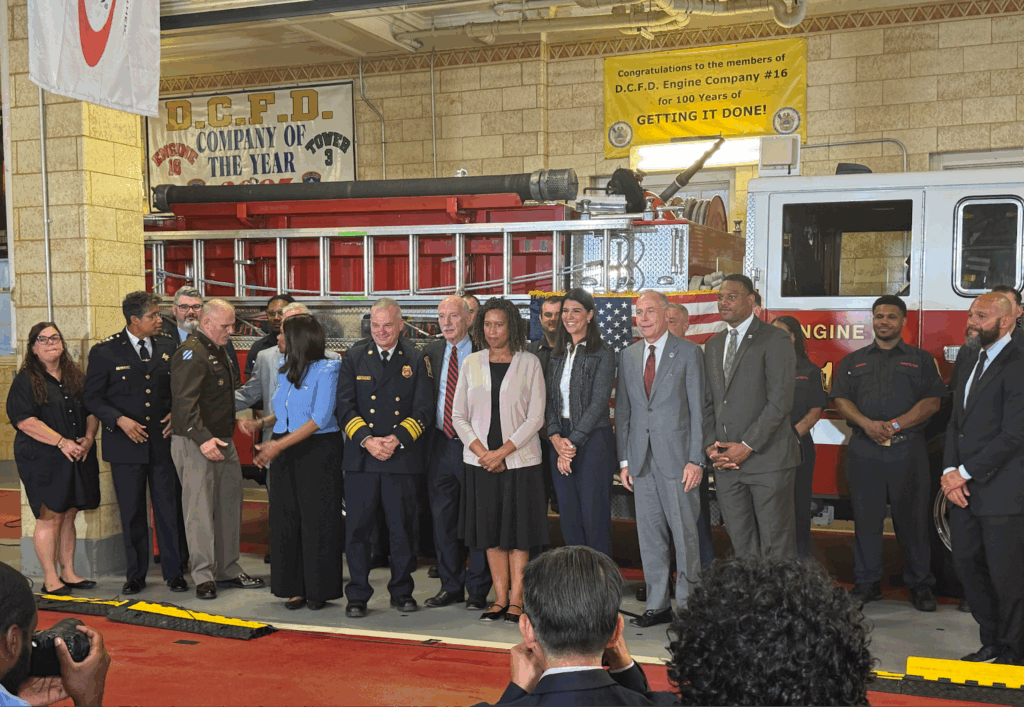
On Thursday, Mayor Muriel Bowser and the D.C. Council hosted a commemorative ceremony at Engine 16 in Ward 2 to mark the 24th anniversary of the September 11 attacks. The event brought together city officials, first responders, survivors and community members to honor nearly 3,000 lives lost and recognize the District’s role in the response.
Mayor Bowser honored the sorrow of the day while recognizing the courage of those who responded.
“We remember the courage of our first responders in the midst of chaos, the D.C. Air National Guard who scrambled to protect our skies, D.C. fire and Emergency Medical Services (EMS) members, MPD officers who rushed to the Pentagon and the dispatchers who took calls that day at the office of unified communications,” she said.
Attorney General Brian Schwalb called on Washingtonians to remember the victims and their families, as well as the sacrifices made by firefighters, police officers and emergency personnel.
“It requires us to remember the incredible talent and dreams that were snuffed out that morning,” Schwalb said. “We offer them by stopping to remember, but not let their memories be gone.”
Deputy Fire Chief Sean Brooks, a firefighter at the time who responded to the Pentagon on 9/11, recalled how his company was dispatched shortly after the second plane struck in New York. Initially he didn’t realize what was occurring on the television.
“That’s a pretty hard fire, I thought. Then the second plane hit and we knew it wasn’t an accident,” he said.
Brooks described the uncertainty of that day, including repeated evacuations amid reports of additional aircraft and his team using a single working cell phone to assure their families they were safe.
Union leaders and the D.C. National Guard also spoke at the ceremony, stressing the need to support first responders and maintain readiness for emergencies.
“Our ability to rise up and meet the standards of ‘always there, always ready’, was put to the test,” said Commanding General Leland D. Blanchard II.
Blanchard ll also spoke to the frightening uncertainty that comes with being a first responder.
“It’s hard to imagine leaving for work like any other day not knowing if you have the chance to say goodbye to loved ones. But that day, they made the decision to do whatever it takes,” he said.
Outside the ceremony, scholars continue to examine the lasting influence of 9/11 on American society. Howard University professor Norman Sandridge discussed how the attacks reshaped daily life and national priorities. He pointed to heightened airport security, expanded surveillance under the Patriot Act and a surge in academic interest in Middle Eastern studies as direct outcomes of the tragedy.
“Never forget can mean different things to different people,” Sandridge said. “For some, it honors the heroism of firefighters and neighbors; for others, it underscores security and vigilance.”
The event concluded with the presentation of a ceremonial resolution recognizing the service of D.C. Fire and EMS.
Copy edited by Damenica Ellis