

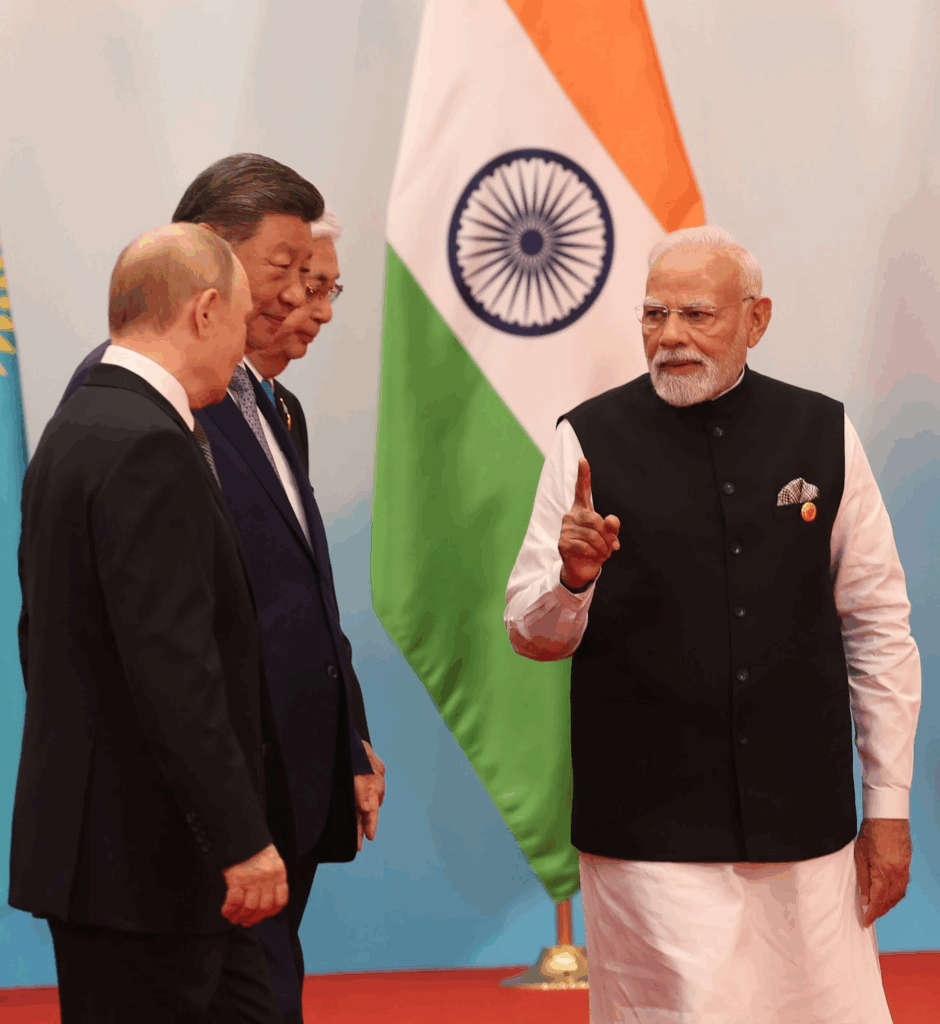
In Tianjin, China, where the spirits of the Silk Road still linger, three world leaders found themselves bound by a shared defiance against U.S. economic pressure at the 2025 Shanghai Cooperation Organization (SCO) Summit last week. This very defiance was created due to the tariffs set by Washington.
President Donald Trump’s additional 25 percent tariff from late August engulfed India. It came as a direct response to India’s purchase of discounted Russian oil. India is the only founding member of the BRICS Alliance that was not in favor of its de-dollarization plan and a long-term partner of the United States.
India, however, has reaffirmed in a statement that it will continue to buy Russian oil to ensure the energy security of its 1.4 billion people. The country cited that it is “extremely unfortunate” that the United States chose to impose these tariffs on New Delhi for actions that several other countries are also taking in their own national interest.
At the SCO Summit Chinese President Xi Jinping and Indian Prime Minister Narendra Modi offered a moment of diplomatic warmth amidst a backdrop of simmering tensions. It had been seven years since the leaders of both countries had met in China due to the border disputes and other underlying issues.
Xi described it as “the right choice” for India and China to be friends and urged the two ancient civilizations to unite, metaphorically calling for the “cooperative pas de deux of the dragon and the elephant.”
In an apparent dig at Trump’s global tariff push, Chinese President Xi Jinping told fellow leaders in his Monday opening speech that the “shadows of Cold War mentality and bullying have not dissipated, with new challenges mounting.”
On Sep. 3 at Beijing’s Diaoyutai State Guesthouse, after the SCO Summit, the Russian Prime Minister Vladimir Putin stated that the way Washington has behaved with New Delhi and China, imposing unilateral sanctions and tariffs, is not how a country conducts dialogue with sovereign nations.
“It is utterly impossible to talk to them like that with such a harsh and aggressive tone,” Putin said.
Trump shared his thoughts on Sept. 5 in an early morning post on Truth Social saying, “looks like we’ve lost India and Russia to deepest, darkest, China.”
“In a month or two months, I think India is going to be at the table and they are going to say they’re sorry,” U.S. Secretary of Commerce Howard Lutnick said that same morning in an interview with Bloomberg.
Adam S. Hersh, a senior economist at the Economic Policy Institute, regularly provides expert testimony before Congress and advises U.S. and international policymakers as well as civil society leaders.
“I think all the regional players in other parts of the world are realizing that the U.S. has not been a credible, reliable partner anymore whether that is trade and economics or in the security sphere,” Hersh told The Hilltop.
He added that countries like India, Malaysia, Vietnam and Korea are taking steps to reorient their economies and relationships to mitigate the tariff effects, emphasizing emerging self-reliance movements.
Kimathi Talton, a senior international affairs major and philosophy minor from Brooklyn, New York, echoed what Hersh said about the damaged image of the US as a reliable trading partner.
“Trump’s tariffs have for sure damaged the U.S.’s credibility as a reliable trading partner, and what happened at the SCO highlights India’s skepticism about Washington’s long-term consistency,” Talton said.
Talton noted that India is likely hedging by strengthening ties within BRICS and bolstering energy and defense cooperation with Russia to secure its strategic interests.
However, on Sept. 6, after Trump called the relationship between India and the United States “special,” Modi struck a conciliatory note, saying that he deeply appreciates and fully reciprocates the “positive assessment” of their ties.
Copy edited by Daryl R. Thomas Jr.