

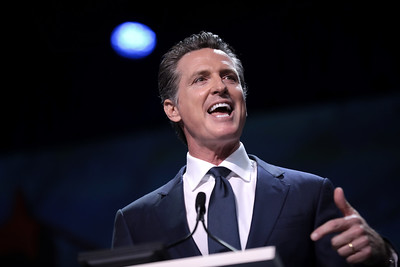
California Governor Gavin Newsom announced his Election Rigging Response Act, combating Texas redistricting, in a Tik Tok video.
In a world where political discourse is readily accessible through the touch of a screen, digital platforms are pivotal in shaping Generation Z’s perceptions of politics and politicians.
Now, more than ever, politicians are attempting to appeal to younger demographics through popular platforms such as X, Instagram and Tik Tok.
Gen Z is the first generation to grow up with access to social media and advanced technology, with little recollection of a world without instant communication.
Social platforms such as Instagram became widely popular around 2014 and political discourse intensified when Donald Trump entered the 2016 presidential race.
A 2016 Washington Post article said Trump was “on his way to becoming the first major U.S. politician to use [Twitter] in a way that truly shapes, not just amplifies, his message.”
His blunt style, often punctuated with one-word judgments like “sad,” helped him build an online community and cement his influence.
Nearly a decade later, politics and social media are inseparable. From viral campaign videos to TikTok explainers, online platforms have become the primary way young people receive and interpret political messages.
Newsom, a veteran Democrat with decades of political involvement, has emerged as one of the most prominent figures in the Democratic Party. Partially due to his open opposition to Trump.
His recent campaign illustrates this growing connection between politics and social media. In the Tik Tok announcing his new act that was posted Aug. 8, he said, “Donald Trump is trying to light a torch on democracy… His agenda is failing, his presidency is failing.”
While grounded in the serious policy debate over redistricting in California, Newsom rolled out his message through sharp, shareable online content that resonated with younger audiences via Tik Tok, Instagram and X. For Gen Z, who often encounter politics first through their feeds, his approach provides a look into how social media is reshaping civic life.
For students like Kyla Keita, a Howard senior criminology and psychology double major, politics on social media is nothing new.
Keita has had a phone since she was in first grade and social media since around fourth grade, she said. Growing up around classmates who expressed prejudice, she said she gravitated toward politics that aligned with her moral beliefs and often saw those debates play out online.
That influence felt even stronger in the Trump-Harris election.
“I could have sworn there’s such a tiny little group of people that are voting for Trump… because that was literally all I was seeing,” Keita said.
When Harris lost, she realized how much her perspective of both candidates had been shaped by what she saw on her feed.
Keita said that even with lighter, trending topics on social media, she often finds her opinions shifting after seeing how others frame the conversation, a phenomenon researchers call “emotional contagion” or “social influence.” For her, the real challenge is ensuring that political expression online reaches beyond those who already agree.
Kennedy Williams, president of Howard University College Democrats, said the accessibility of politics online makes leaders like Newsom more visible but not necessarily more persuasive.
“Social media can spark conversations,” Williams said. “But the real action comes through voting, organizing and holding leaders accountable. What matters is how students translate digital energy into real-world impact.”
Computer science major Ife Martin said she first encountered political news through short-form videos on TikTok.
“Politics can get boring or frustrating,” she said. “So having bite-sized clips is helpful for our generation.”
However, Martin’s background in computer science makes her skeptical of the machinery behind the feeds, she said.
“We don’t have as much control as we think we do,” Martin added. “Algorithms decide which political messages show up and platforms also censor or suppress certain content. I’ve seen pro-Palestine posts flagged on Instagram when they weren’t harmful at all.”
Her skepticism reflects a wider trend, according to Pew Research, about 58 percent of Gen Z report encountering political news incidentally through their feeds rather than actively seeking it out.
At the same time, a March 2024 Pew survey found that nearly half of TikTok users under 30 say they use the app to keep up with politics or get news. While much of this information is gathered passively, the steady stream of political content on social media undeniably shapes Gen Z’s news diet.
She also mentioned AI as a new challenge, with platforms capable of generating manipulated videos and misinformation.
Strategy, Sincerity and the Silo Effect
Veteran Democratic political strategist, commentator and former senior spokesperson for Hillary Clinton’s 2016 presidential campaign, Karen Finney said authenticity matters, even in an algorithm-driven world.
She recalled how Trump’s unfiltered online persona in 2016 resonated with voters because “people believed that what he was saying online was authentically the same… similar to what he was saying offline.”
That lack of separation between persona and platform, she said, helped him break through traditional media.
Today, Newsom’s meme-ready content positions him as someone Gen Z might see as authentic, even if critics compare his style to Trump’s.
“Young voters can tell when a politician is being sincere,” Finney said. “But they also have to stay curious and seek out multiple perspectives, because algorithms can trap you in one silo.”
Finney added that authenticity alone isn’t enough. She warned that algorithms funnel people into echo chambers, making it harder to get a full picture of politics.
“Algorithms control a lot of what you see and interact with,” she said.
To push back, Finney said she often tries to “trick the algorithm” by deliberately seeking out different sources and perspectives.
“Stay curious. Don’t just rely on one news source or one feed. Ask yourself: what’s the other side of this story?”
She said she wants to remind students that even before social media, people’s political perspectives were shaped by their media habits.
“Back in the day, it was, ‘what channel are you watching?’ If you only watched one news channel or read one newspaper, you were already getting one side of the story,” Finney said.
What has changed, she added, is the speed and scale: algorithms now curate those choices automatically, often without users realizing it.
Today many people consume politics through fast, visual and often filtered algorithms, but still insist on authenticity and action. Social media has brought politics closer to Gen Z, but some believe it has also blurred the line between information and manipulation.
As campaigns like Newsom’s Election Rigging Response Act circulate online, the question remains: will these strategies genuinely mobilize young voters, or will they reinforce the echo chambers students already live in? For Gen Z, the future of politics may depend on what they see on their screens and whether they can step beyond the feed and transform digital energy into real-world change.
Copy edited by Damenica Ellis