

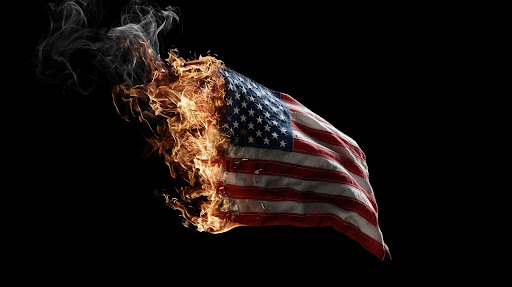
President Donald Trump signed an executive order directing the U.S. attorney general, Pam Bondi, to prosecute anyone who burns or desecrates the American flag. This passage raised immediate concerns among free speech advocates.
The order, Prosecuting Burning of The American Flag, was signed on Aug. 25, and says the American flag is the most cherished and sacred symbol of freedom, identity and strength in the United States.
The Trump administration described the desecration of the American flag “as uniquely offensive and provocative.” The order characterizes it as a statement of contempt against the political union that preserves U.S. citizen’s rights, liberty and security.
“Burning this representation of America may incite violence and riot,” the order states.
Jay Carey, a 54-year old veteran, was detained outside the White House by the National Guard for burning the American flag as a sign of protest with other veterans on Aug 25.
Carey argued his freedom of constitutional right was being violated and stated that he would take his arrest all the way to the Supreme Court if he had to.
“I fought for every single one of your rights, to express yourself however you feel that you may want to express yourself,” he said.
Constitutionally, flag burning is considered a right of free speech.
In a 1989 case, Texas v. Johnson, the Supreme Court decided the burning of the U.S. flag is a form of symbolic speech and a right protected by the First Amendment of the Constitution.
Free speech attorneys, such as Brian Hauss, cite the 5-4 ruling as protection and right to free expression even while politically charged and offensive to some.
The order called for Bondi to litigate the challenge to the 1989 ruling in an attempt to get the issue back in front of the Supreme Court. On Monday, Trump described the court behind the ruling a “very sad court.”
Richard Seltzer, a political science and international studies professor at Howard University who holds a doctorate in history, opposes the executive order.
“It’s a constitutional right even if it’s a stupid thing to do and it’s still their right to do it,” Seltzer said.
Though the executive branch is supposed to have shared power when inciting laws into action because of the balancing between the legislative and judicial branches, those efforts have shown to be futile in the midst of the current administration.
“Trump realizes that there are some things he can choose to accentuate that the American public will, to some extent, go along with such as burning the flag,” Seltzer said.
It’s the three branches of government’s responsibility to protect constitutional rights, Seltzer said, and not leave the power solely to the executive branch to distribute.
“Very few people want to burn the flag or support burning the flag, but it still is your right to burn the flag. Just as [it is] your right to be an Atheist or a Muslim,” Seltzer added.
The executive order from the Trump administration acknowledged First Amendment rights associated with flag burning. According to the order, the Supreme Court has never upheld constitutional protection against flag burning when it’s likely to be done in a way that may incite lawless action or amount to fighting words.
“He’s chipping away and unfortunately the Supreme Court is allowing him to chip away. But at some point, they need to stand up and do what they need to do and say we need to preserve these rights. Unfortunately they haven’t done that yet.” said Seltzer.
Sophomore journalism major Zaniyah Kemp said the executive order is “a bit much and over the top.”
Kemp added the majority of people are not burning flags to stir up violence, instead they are doing it out of protest or freedom of expression.

“If he wants to pass it, he could at least be more specific like if it is on public property and affecting other people,” Kemp said. “But it needs to be more specified because if it’s your own flag, it is your freedom of right.”
Copy edited by Damenica Ellis