

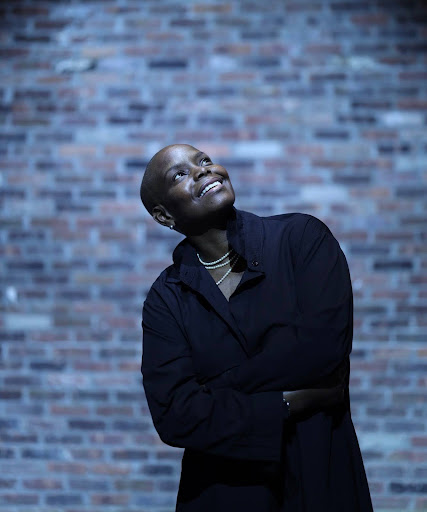
Acclaimed dancer and choreographer, Hope Boykin, is performing her piece En Masse with the Martha Graham Dance Company during A Century of Dance at The Soraya in Northridge, California. Her inclusion in the centennial tour places her among a select group of choreographers entrusted to honor Graham’s enduring legacy.
A North Carolina native, Boykin’s passion for dance began early. She earned three American Dance Festival Young Tuition scholarships before attending Howard University from 1990 to 1993, where she worked with choreographer Lloyd Whitmore and his New World Dance Company.
Her introduction to professional dance came when her mother took her to see the Alvin Ailey American Dance Theater in Durham, North Carolina — a moment Boykin recalls as life-changing.
Intent on finding a community that nurtured both her identity and artistic goals, Boykin weighed her options carefully for the next stage of her education.
“I knew for college I wanted to be surrounded by people who looked like me. Howard was my first choice,” Boykin said. “Knowing Debbie Allen graduated from HU is what pushed my ‘yes’ over the edge.”
At the time, Howard did not offer a dance major, only courses through musical theater and physical education.
Boykin often overloaded her schedule with dance classes while working toward a psychology degree, a balance that proved challenging. Eventually, she transferred to The Ailey School in New York, though her ties to Howard never faded.
Even as she embarked on a professional career that required leaving Howard, Boykin’s connection to the university endured, sustained by the friendships, mentorships and sense of belonging she had discovered on campus.
“After I left Howard, I was often invited back to teach masterclasses, to teach in workshops, to choreograph with the students. Students who are now dancing professionally, who are on Broadway,” Boykin said. “Howard was not something I ever walked away from, the community and the people that I met there.”
Today, Boykin advises programs at the University of California’s Glorya Kaufman School of Dance, the Kennedy Center and Howard University’s College of Fine Arts.
Boykin combined the guidance of her instructors with her own drive. Her experiences taught her to recognize her strengths while continually pushing her limits — a philosophy she now instills in her students at Howard.
“Howard was not something I ever walked away from,” she said. “I returned often to teach workshops, choreograph, and connect with students — many of whom are now professionals on Broadway and beyond.”
Boykin went on to assist choreographers Milton Myers and Talley Beatty, joined Complexions Contemporary Ballet as a founding member, and later performed with PHILADANCO.
In 2000, she began a 20-year tenure with Alvin Ailey American Dance Theater, where she performed internationally and choreographed works such as r-Evolution, Dream. Her honors include a New York Dance and Performance “Bessie” Award, a 2019–20 Urban Bush Women Choreographic Fellowship, and an Andrew W. Mellon Foundation Bubble Residency.
Royce Zackery, chair of Howard’s Dance Arts program, credits the department with shaping Boykin’s artistic development.
“Howard’s Department of Theatre Arts is not just a training ground — it is a cultural incubator,” he said. “The environment allows a student to shape movement as a language of both personal truth and collective history.”
Among Howard’s most accomplished alumni are dancers who made their distinct mark at the Alvin Ailey American Dance Theater. George Faison danced with the company in the late 1960s before returning as a choreographer, and Ulysses Dove launched his professional career there after attending Howard.
Zackery also recalled moments of being struck by Boykin’s presence when performing.
“I remember being so amazed and inspired by how effortlessly Hope commands the stage, and entices audiences show after show, year after year,” he commented.
Boykin’s role in the centennial places Howard back in the spotlight of modern dance, continuing a legacy first forged by Mary Hinkson, the first Black woman to choreograph for the Martha Graham Company in the early 1950s.
“Hope’s inclusion in the Martha Graham centennial…is a landmark moment for Howard,” Zackery said. “It affirms that the voices nurtured in our studios, on our stages, and within our academic rigor are not only relevant — they are essential.”

Boykin’s reach extends far beyond her own career, inspiring the next generation. Dancers such as Morgan Williams, a junior from Houston, Texas, first encountered Boykin’s legacy in fifth grade.
“I was given the opportunity to travel to New York with my dance school and took classes at the Alvin Ailey American Dance Company in about 2015 or 2016,” she recalled. “I was able to see pictures of [Boykin] and I remember how beautiful she looked dancing, thinking that could be me in the future.”
For Williams, alumni like Boykin play an essential role in shaping the next generation of dancers.
“I think with alumnus Boykin, I have also learned to market myself in order to gain future connections and explore a deeper understanding of the careers around me,” she said.
Kai Smith, a senior dance major from Harlem, took Boykin’s internship course and credits her with bridging the gap between student and professional life.
“She always reminds us that we’re capable…bridging the gap between where we are and where we want to be,” Smith said. “It sets the blueprint, and it also allows me to know that the work that I’m interested in is achievable.”
Smith pointed to Boykin’s versatility across multiple disciplines as proof that creativity has no limits.
“This woman has done dance, choreography, theater, spoken word, film…it’s inspiring to see someone not be afraid to try,” she said.
Smith sees the value of recognizing achievements within the arts as a way to inspire and motivate others. She believes that highlighting the impact of leaders like Boykin encourages students and emerging artists to understand what is possible and to strive toward their own goals.
“If we keep having conversations like this, we can continue to open the door and create a global arts industry that reflects everyone,” Smith said.
Speaking directly to the next generation of performers, Zackery shared guidance honed from his own journey in the arts.
“Invest in your craft, but more importantly, invest in your voice,” he said. “Technical mastery is essential, but it is your unique perspective that sets you apart. Be disciplined, be curious, and surround yourself with people who challenge you to grow.”
Copy edited by D’Nyah Jefferaon – Philmore