

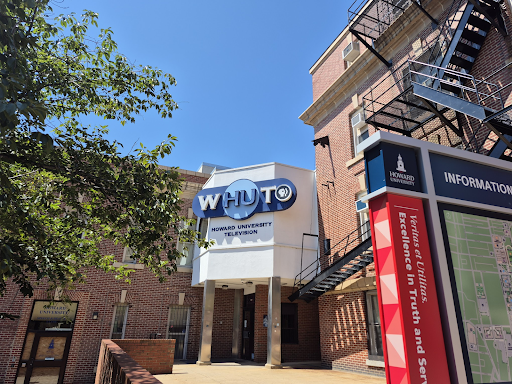
Washington Howard University Television (WHUT), the only Black owned public television network that is operated by a historically Black university, has lost its federal funding.
On May 1, President Donald Trump issued executive order 14290 that ended indirect and direct funding to National Public Radio (NPR) and Public Broadcasting Service (PBS).
Founded in 1967, The Corporation for Public Broadcasting (CPB), funded public media across the United States, helping provide access to educational programming to underserved audiences.
In the order, Trump declared that taxpayer money should support unbiased, nonpartisan and accurate news coverage. According to the executive order, CPB is not in accordance with the Trump administration’s standard due to “principles of impartiality.”
CPB funding made up about 30 percent of WHUT’s budget, the network’s manager, Sean Plater said. Over 1,500 media stations are publicly operated and receive federal funding. For WHUT, their CPB funding went toward providing assistance and resources to educators, schools and community outreach.
“[The funding] makes up the community work that we do, the unique programming that we produce that is geared to the African American community that you don’t find on PBS anywhere,” Plater said. “All of those dollars are tapped into that.”
One of the largest CPB grants the network received was the “Ready to Learn” grant, which helped produce educational content for children, including shows such as “Sesame Street.”
The grant was originally approved by the first Trump administration to begin in 2020 and was set to expire Sept. 30 of this year. On May 2, the U.S. Department of Education notified CPB the grant was to be terminated immediately — defunding production, storytelling, research and creative processes that went into forming and publishing content.
The director of content at WHUT, Angela Hailstorks, said grants such as Ready to Learn are a large part of the free support provided to communities and schools.
“Out of nowhere, it was like, hey that money is gone. It’s done. Now that stops your ability to go and activate the way you may want to, or need to,” she said.
WHUT’s education outreach director, Keisha Nelson, said that the Ready to Learn grant funded programs that connected families and community work. She mentioned that series centered around educational topics like critical thinking, literacy and computational thinking are at risk of being lost.
According to Nelson, on May 2 the network had to stop spending all money related to Ready to Learn. This included the end of a partnership with Highland Dwellings, a residential community in Southeast D.C., in which WHUT hosted monthly dinners with workshops.
Since these grants were blocked, networks have to pivot in the way they fund educational content and programming. WHUT specifically is urging their audience to donate to the network.
Public media is a source of educational content, its services also include informing the public of emergencies, alerts and current affairs. According to CPB, 99 percent of the U.S. has access to the free programming and services of public media.
“In D.C., we get all the information and then some,” said Hailstorks. “But in rural areas, they are much more reliant on their public media stations to tell them what’s going on, to keep them informed and to reach them in a case of an emergency.”
Almost 250 radio and TV stations that receive CPB funding are in rural areas and about 80 of them are public TV stations, according to CPB. Rural areas have a harder time raising money for donors, and 28 percent of funding for rural stations are from individual donations— while non-rural areas raise 40 percent in individual donations.
“We are not just TV stations, we’re providing services and that’s something I want people to know,” Hailstorks said.
Some of WHUT’s services include going to schools in the D.C. area and giving children unique experiences that assist them with educational development.
“We have a really great program based around exposure, called ‘For a Day,’ where the design is to allow kids to see what it is like to be a chef for a day, a veterinarian for a day —and so they get an experience that they wouldn’t see anywhere else,” said Plater.
The network’s services have also worked to preserve D.C.’s history. WHUT was awarded two Emmys; one for a mini docuseries called “Decades” and another for coverage of Kamala Harris’ 2024 election night campaign on Howard’s campus.
Now that the U.S. Congress has passed the CPB funding cuts, these programs and services are at risk of being lost. Plater and Hailstorks said some viewers are concerned about what this means for WHUT and if the shows that have lasted for generations will now be gone.

When WHUT announced on Instagram that Trump’s executive order would stop federal funding for public media, many social media users expressed their worries and concerns.
Instagram user ezstreet commented “Freedom of Speech is under attack. Just like everything else. Supreme Court do your job.”
“We reach over 2 million households in the DMV area. So I think there’s a lot of concern that we’re being targeted,” Hailstorks said. “There’s a lot of concern on if we will still be here a year from now, two years from now and what are we gonna do.”
According to Hailstorks, WHUT is working towards filling the gaps that the lost CPB funding has caused, partly by asking for donations on the network’s website, but they still do not have all of the answers.
“Our team is resilient, and we believe that we’re gonna get through this and continue to thrive on the other side of it,” Plater said.
Copy edited by Damenica Ellis