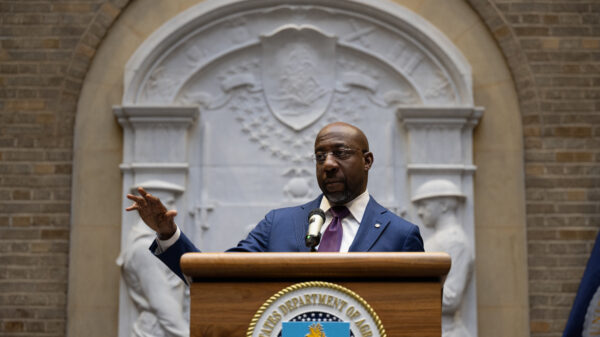

The White House ordered a comprehensive review of eight Smithsonian museums in Washington, D.C., including the National Museum of American History, earlier this month.
The review follows President Donald Trump’s March executive order accusing the Smithsonian of promoting a divisive, race-centered ideology and directing museums to align exhibits with American exceptionalism.
The order, “Restoring Truth and Sanity to American History,” says “a concerted and widespread effort to rewrite our Nation’s history, replacing objective facts with a distorted narrative driven by ideology rather than truth” has taken place over the past decade.
Post-review the administration released a list of exhibits it finds objectionable, highlighting pieces that focus on race, slavery, immigration and transgender identity.
Among the listed exhibits are a Benjamin Franklin display concentrating on slavery, an Intersex-Inclusive Progress Pride flag, Hugo Crosthwaite’s animation of Dr. Anthony Fauci and a National Museum of African Art installation on enslaved Black people.
The White House instructed museums to begin implementing changes within 120 days, with the review expected to conclude in early 2026.
One section affected during the review was The American Presidency: A Glorious Burden, of the American History Museum, which included a placard referencing Trump’s two impeachments.
The temporary label was removed and later reinstalled with changes, sparking debate about political influence on historical displays.
Oliver Everett, a junior history major at Howard University and former Smithsonian Folkways intern, explained that curatorial decisions are already being affected.
“At times we were deciding whether we should have a list of words not to use in our exhibits, which meant constantly watching how we described history,” he said. “The review will most likely change how exhibits are worded or interpreted, even if the physical displays remain.”
Civil rights advocates have expressed concern that the administration’s focus on the National Museum of African American History could downplay the contributions of Black Americans.
Dr. Valeriia Popova, a professor of comparative politics at Howard University, described the review as unprecedented.
“All governments engage in rewriting history, but what makes this moment unprecedented is that we have never seen a U.S. administration intervene in museums like this before,” she said.
She went on saying that, from a scholarly perspective, the effort fits the definition of propaganda. However, she cautioned that citizens should view it more critically, recognizing it as “propaganda that is dangerous and harmful.”
President Trump defended the review on Truth Social saying,“The Smithsonian is out of control, where everything is about how horrible our country is and how bad slavery was—nothing about success, brightness, or the future.”
Stephen Miller, former senior advisor to Trump, added that the Smithsonian has strayed from its mission.
“It should be a place for families and children to celebrate American history and greatness. Instead, the exhibits have clearly been taken over by left-wing activists,” Miller said.
The Smithsonian has denied political influence, asserting that any changes are made for curatorial reasons and that factual, unbiased history remains the institution’s priority.
Minority Leader Hakeem Jeffries offered support for the museum, stating, “The museum of African American history needs to hold the line and stay the course, we have your back.”
Experts warn that the administration’s focus on removing “divisive” content risks presenting a sanitized version of American history, where sensitive issues like slavery, systemic racism and LGBTQ+ contributions are minimized or altered.
“What Donald Trump and those around him are doing right now is obliterating our shared history, erasing it like it never existed—and that is terrifying,” Popova said.

Observers also highlight that the focus on political figures and race-related content could set a precedent for future administrations to intervene in cultural institutions.
The Smithsonian, which brings its total annual audience to about 30 million visitors, now faces the challenge of balancing curatorial independence with federal oversight, ensuring that historical accuracy and educational value are preserved.
As the review continues, historians, students and civil rights advocates are closely monitoring the outcome, warning that the decisions made today could influence public knowledge and perceptions of American history for generations.
“Visitors will be walking away with a less critical look at the nation’s history,” Everett said.
Copy edited by Damenica Ellis