

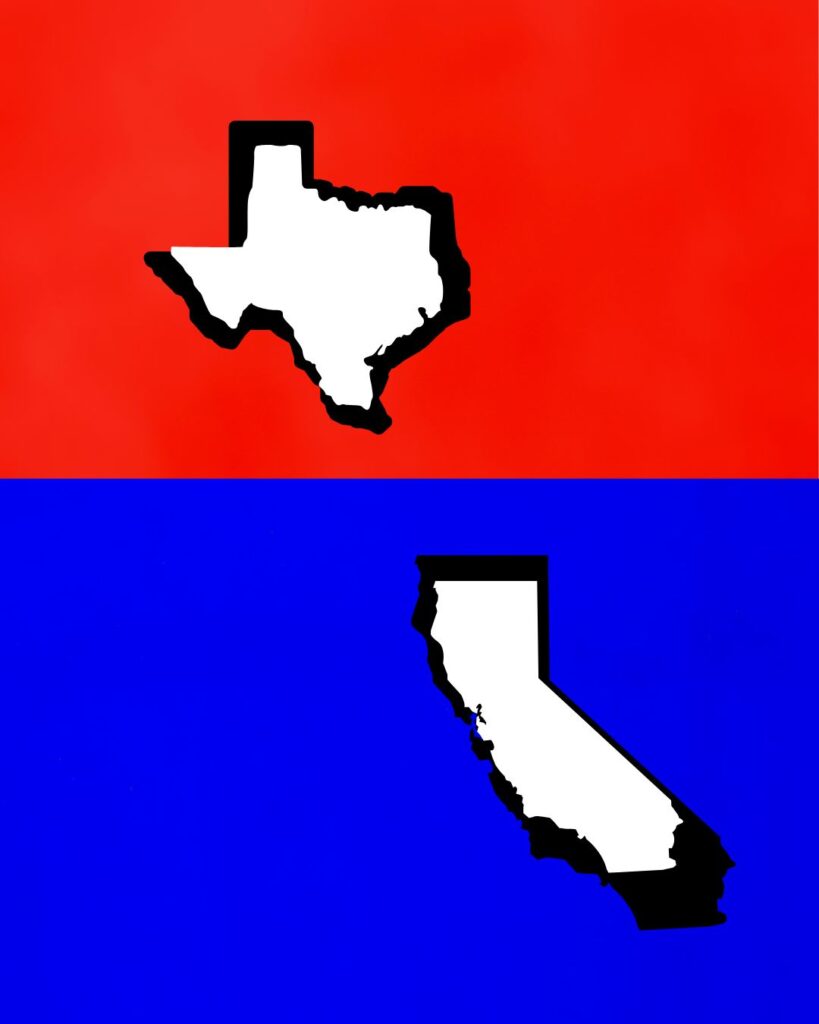
California Gov. Gavin Newsom signed the Election Rigging Response Act (Proposition 50), aiming to counter redistricting efforts in Texas and other Republican-led states, which Newsom and Democratic leaders describe as President Donald Trump’s “power grab.”
The move by Cailforinia came a day after Texas lawmakers approved a new congressional map on Aug. 20, which critics say favors Republican candidates through gerrymandering. The changes were criticized for weakening the voting power of minority communities and boosting Republican influence in key districts.
Democrats argued that the maps could undermine fair representation, drawing national attention and sparking a broader debate over partisan redistricting.
Newsom announced the move on X, framing the ballot initiatives as a way to give Californians the power to hold the Trump administration accountable for what he characterized as efforts to undermine democracy.
“Californians have been uniquely targeted by the Trump Administration,” Newsom said in a press statement. “Thanks to the hard work of the California legislature, they will have a choice to fight back — and bring much-needed accountability to Trump’s efforts to undermine the democratic process.”
The Election Rigging Response Act consists of three bills: Assembly Constitutional Amendment 8 (ACA 8), Senate Bill 280 (SB 280) and Assembly Bill 604 (AB 604). As described in the press conference statement, ACA 8 allows voters to adopt a temporary congressional map designed to neutralize the effects of redistricting plans passed in Texas.
SB 280 sets the timeline and funding for the special election, while AB 604 establishes the temporary district maps that would take effect if Proposition 50 passes following the Nov. 4 election.
Named to reflect its goal of securing fair elections in all 50 states, Proposition 50 is central to California’s effort to challenge redistricting efforts by Trump-aligned Republican lawmakers in Texas, who have redrawn congressional districts in a way critics say aims to solidify GOP power.
Von Walker, a third year law student at Howard University Law School and former graduate elections director for Howard’s Elections Commission, framed California’s plan as “a direct reaction to what is happening across the country, including Texas, where these maps have the potential to influence electoral outcomes in a quite significant way.”
He contrasted Texas’ approach with California’s, noting that while Texas lawmakers can redraw districts without voter input, California’s process requires voter approval, a distinction Walker believes highlights the state’s stronger commitment to democratic accountability.
Newsom was joined by Assembly Speaker Robert Rivas and Senate President Pro Tempore Mike McGuire, who called the legislation a necessary defense of democratic institutions.
“California will not be a bystander to Trump’s power grab,” Rivas said. “We are acting to defend our state from his attacks, by taking it directly to the voters.”
McGuire described the legislation as a temporary, fairness focused response to what he called Republican attempts to “blatantly steal” the election.
On August 21, the governor also issued a proclamation formally calling the special election for November 4, 2025.
California’s resistance to Trump-era policies has recouped at least $168 billion in federal funds, the governor’s office reported, highlighting a $5 million investment in litigation with a “3.4 million percent return on investment.”
As California moves forward with Proposition 50, residents and California lawmakers are weighing in on what the measure could mean for the democracy at both the state and national level.
Democratic Assemblyman Marc Berman, who supported the legislation, described the effort as a necessary defense of democratic principles.
“We don’t want this fight and we didn’t choose this fight, but with our democracy on the line, we will not run away from this fight,” Berman said.
California Assemblyman James Gallagher, the Republican minority leader, criticized Trump’s attempts to influence redistricting in other states, while cautioning that California’s retaliatory strategy could threaten its independent redistricting system. In response, Republicans have filed a lawsuit and requested a federal investigation into the plan.
Amid the political debate, students are also weighing the impact of redistricting on communities.
“Redistricting isn’t just about lines on a map. It affects which communities are heard and which are left out,” said Camille Bryant, a junior at Howard University from Pasadena, California. “How the districts are drawn can change who gets represented and which issues matter most, so it’s important for voters to stay informed.”

Walker pushed back on the idea that California’s initiative undermines democracy. Walker noted that California’s approach reflects a broader constitutional balance.
Walker explained that, unlike in Texas, California’s approach to redistricting requires voter approval before any new congressional maps can take effect, a process he believes places more democratic power in the hands of the electorate.
For students at historically Black colleges and universities like Howard, Walker said, these redistricting battles are not abstract.
“Redistricting determines who represents communities in Congress and that directly affects policies on student aid, public safety, health care and more,” he said.
He emphasized that civic engagement doesn’t require legal background. Understanding both sides of the issue, he noted, is the first step toward meaningful political participation, whether on campus, in Washington, or back home.
Copy edited by Damenica Ellis