

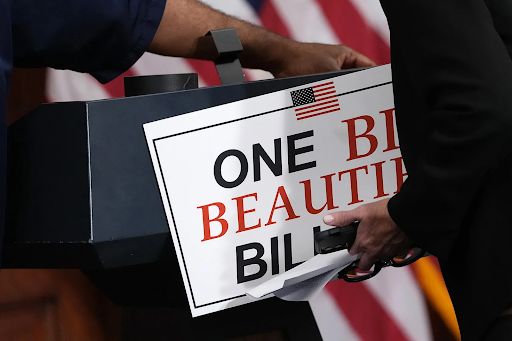
After months of intense debate and anticipation, President Donald Trump officially signed the One Big Beautiful Bill Act, a sweeping tax and spending package, into law last month.
At nearly 900 pages, the bill, approved on July 4, cuts federal support programs, redirects spending to military and border security, and introduces significant changes to student loan policy.
For Howard University students and the broader collegiate community, the impact is clear: higher education is about to become more expensive.
Dominique Riley, an incoming freshman, said she was appalled after reading the legislation.
“There is so little consideration for how many people in the U.S. are already struggling with basic necessities,” she said. “This administration keeps trying to open doors that nobody wants to open and close the ones that people actually need.”
The legislation phases out subsidized federal loans, caps borrowing limits for undergraduate, graduate and parent borrowers and dismantles income-driven repayment plans such as the Biden-era SAVE program.
Without the SAVE plan’s protections, borrowers may see their monthly payments rise by $300 to as much as $1,000, the Urban Institute estimates.
The Center for American Progress reported that cuts to Pell Grants and subsidized loan eligibility could raise costs for low-income students by thousands over four years. The move away from federal repayment programs could push borrowers into private loans with fewer protections.
While the long-term impacts of the bill are unclear, Riley believes the broader message is already evident.
“It is hurting the little guy more than it is going to hurt them,” she said.
The House approved the bill in a 218-214 vote, following a narrow 51-50 senate vote that required Vice President JD Vance to break a tie, according to the U.S. Senate website.
The Congressional Budget Office estimates the bill would add $3.4 trillion to federal deficits over the next several years.
The passing of the Big Beautiful Bill has sparked collective concern among incoming undergraduate and potential graduate students.
For graduating seniors like Camille Wilson, who plans to attend graduate school, the legislation casts a shadow over future plans.
“I’ve always planned to attend graduate school, but with these changes, I’m not sure I’ll be able to afford it anymore,” Wilson said. “It’s making me question if going is even possible.”
The new federal loan caps for graduate and professional students are scheduled to begin with loans disbursed after July 1, 2026, meaning students enrolling in graduate programs starting in the 2026-27 academic year will be the first to face the new limits.
These include an annual maximum of $20,500 and a lifetime cap of $100,000 for master’s and academic doctoral programs, and $50,000 per year with a $200,000 aggregate limit for professional degrees such as law or medicine, according to the Urban Institute.
Students who plan to begin or continue graduate studies after that date may find their borrowing power significantly reduced, raising questions about whether pursuing an advanced degree is still financially possible.
As the bill begins its slow rollout, many students are left navigating uncertainty about how they’ll afford college in years to come.
Copy edited by Damenica Ellis