

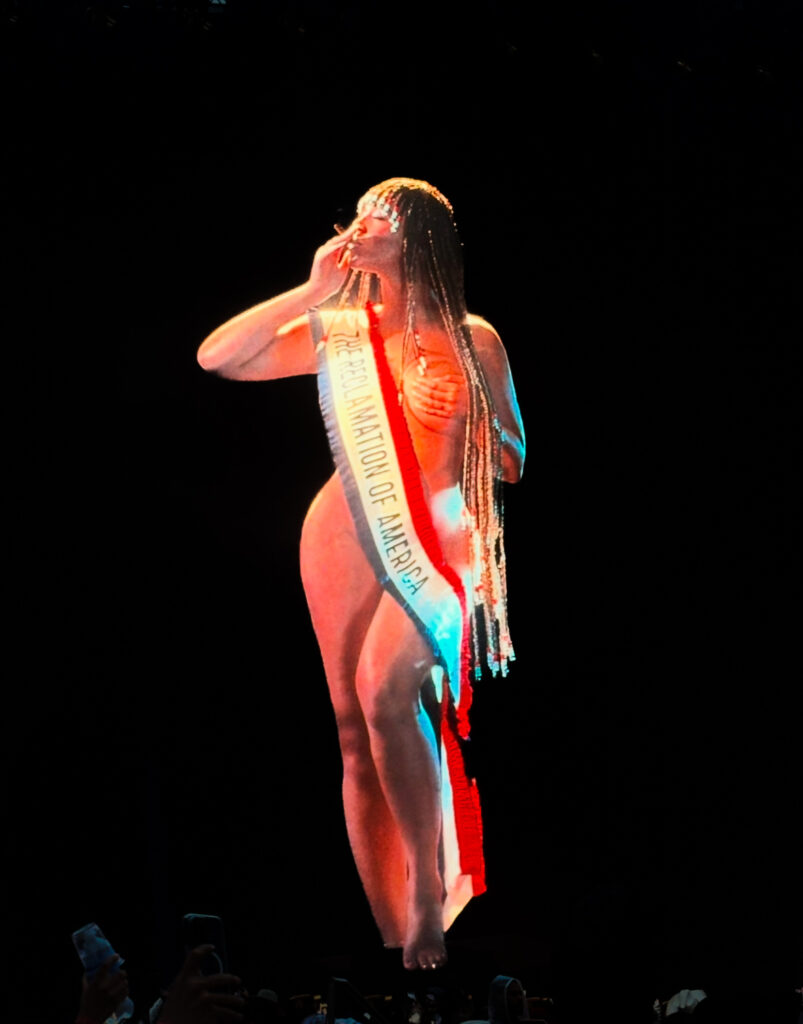
The “COWBOY CARTER” album came to life in March of 2024 and the tour began in April of this year. The project is a love letter to Black country music and its historical roots. Every song is enriched with unapologetic, intimate lyrics and perfectly complemented by honest, shameless visuals. The work challenges what it means to be American, especially in a time where diversity is threatened.
Beyoncé continues to face immense backlash for highlighting the Black American experience through country music instead of the genres that she previously adhered to, namely R&B, Hip-hop and rap. Still, loyal fans only grew to admire the artist more.
“I just feel like if she listened to everybody, then she wouldn’t be where she was,” Howard Bison and tour attendee Alex Johnson said.
Despite the love it received from fans, “COWBOY CARTER” was dismissed by country artists such as Gavin Adcock. During a live performance, he exclaimed, “it ain’t ever been country music and it ain’t gonna be country music!”
Beyoncé discusses the disapproval she endures from the country music industry despite her Southern heritage in track 1 of the album.
“They used to say I spoke, ‘too country,’ and the rejection came, said I wasn’t ‘country ‘nough,’” she sings in, “AMERIICAN REQUIEM.”
In Beyoncé’s requiem, country is a gentrified genre that Black Americans deserve to reclaim. She honors her Black ancestors by implying the death of what America stands for: whiteness. A requiem is defined as, “a musical composition in honor of the dead.” When performing this song live, Beyoncé and her dancers are adorned in pristine, glittering white instead of black, a common color for funerals. With this, she is insinuating a rebirth for the nation that will be founded in purity and truth instead of discrimination and dishonesty.
She encourages her audience to “face the wind” and “stand for something,” urging them to fight against a false, whitewashed history and say, “goodbye to what has been” in order to usher in a new age of America.
The visuals paired with the album contain intricate personal histories that encapsulate Black experiences, building nuanced layers and meaning to the album.
The artwork for the first limited edition exclusive “COWBOY CARTER” vinyl is Beyoncé smoking a cigar and wearing nothing but a sash reading, “act ii BEYINCÉ.” In the first episode of Health Harmony & Heather with Heather Thomson, Beyoncé’s mother, Tina Knowles, disclosed that “Beyincé” was supposed to be her maiden surname, but was purposely misspelled with an “o.”
Although her mother tried to correct the misspelling, she was told to, “be happy that you’re getting a birth certificate.” Tina Knowles added that, “at one time Black people didn’t get birth certificates…because it meant that you really didn’t exist. You weren’t important.”
Beyoncé references this in “YA YA”, track 20 on the album.
“B-E-Y-I-N-C-E, ya. My family lived and died in America. Good ol’ USA. Whole lotta red in that white and blue, history can’t be erased.”
Within this verse, she rectifies her family history and reclaims the name that was once taken from them —“Beyincé.” On a larger scale, she is suggesting that Black Americans can do the same and take ownership and pride in the nation that they and their ancestors built.
The “red” she refers to is an undeniable acknowledgement to the blood spilled to establish this country. It is a fortification of the Black American identity that is consistently erased and misconstrued. However, Beyoncé argues that when our legacy is defined by us, it’s something worth being proud of and that Black Americans are the true core of the nation.
“I Want to Hear an American Poem” by Ras Baraka is one of several interludes displayed during the tour. Baraka asserts that the underrepresented parts of America that are deemed ugly are more American experiences than what is typically portrayed as American.
“I want to hear an American poem, an American poem about share croppers on the side of the road, of families in cardboard boxes, not about kings or majestic lands, or how beautiful ugly can be,” he says.
As the words echoed throughout the stadium, images and videos of Black creatives across multiple generations flashed on the screens.
“It just shows how deep our culture and our history goes, and we’re not subjected to just one kind of thing. And yeah, Black people have been country and have been doing country music forever,” Johnson said.
According to lifelong fan Alliya Bojador, the profound sense of community Beyoncé advocated for was emulated by her fans, the Beyhive.
As the Cowboy Carter tour came to a close on July 26 in Las Vegas, Bojador also completed her third Beyoncé tour, attending five shows in three different cities across the nation. Regardless of the stadium she was in, she recalled that the fans truly set the tone.

“That’s part of Beyoncé’s whole experience is like, yes, you experience her, but you also get to experience just the joy the Beyhive brings,” said Bojador.
During this tour, Bojador created keychains to pass out at each venue that she attended. She said she was inspired by K-pop concerts and hoped to continue the tradition for future tours and keep building connections within the Beyhive.
Bojador said, “I’m a huge fan of SZA, huge fan of Kehlani, but it’s like we go to those concerts and it feels like we’re there individually. With the Beyhive, it’s like we’re friends, we’re gonna party together.”
As Cowboy Carter concludes, the Beyhive is reluctant to move on after only three months of touring, but they are still buzzing about the unforgettable experience. Although Act II of RENAISSANCE is complete, Beyoncé and the Beyhive continue to weave a distinctive legacy as they prepare for Act III.
Copy edited by Daryl Thomas Jr.